
Reducing Healthcare Disparities Through Telehealth
Reducing healthcare disparities through telehealth requires more than a video visit. Learn how device-enabled virtual care can extend equitable access.
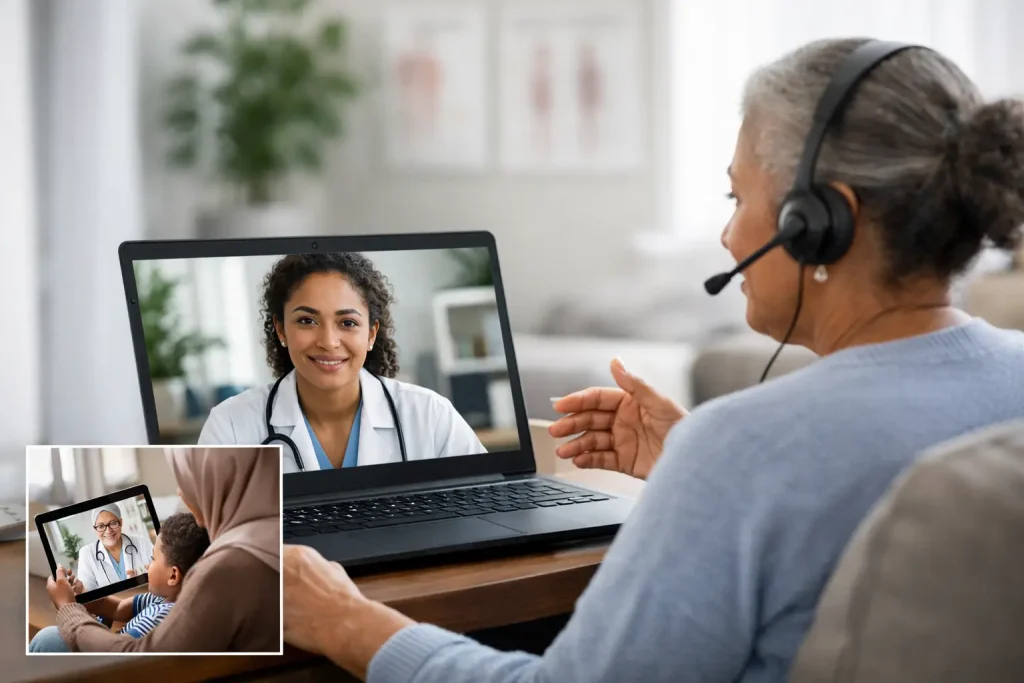
A missed appointment is rarely just a missed appointment. For a family without reliable transportation, a rural patient facing a two-hour drive, or a caregiver supporting an autistic child who finds clinical settings overwhelming, it can mean delayed diagnosis, interrupted treatment, and preventable escalation. Reducing healthcare disparities through telehealth begins by recognizing that access barriers are clinical barriers, not simply scheduling inconveniences.
For healthcare organizations, the opportunity is not to replace in-person care with video calls. It is to build connected-care pathways that bring clinically meaningful assessment, monitoring, education, and follow-up closer to where patients live, learn, and receive support.
Why access disparities persist beyond the exam room
Healthcare disparities are shaped by far more than whether a provider accepts a patient’s insurance. Geography, clinician shortages, transportation, broadband availability, language needs, disability accommodations, work schedules, caregiver capacity, and trust in the healthcare system all influence whether care can be received and sustained.
Rural communities often experience these barriers at once. A critical access hospital or rural health clinic may serve a broad geographic area with limited specialty coverage. Patients may postpone preventive care or chronic disease follow-up because each visit requires time away from work, fuel costs, child care, and long travel. The same pattern can affect urban safety-net populations when public transportation, appointment availability, and fragmented care coordination create friction at every step.
Pediatric care presents additional challenges. A child with special healthcare needs may require frequent follow-up, while the parent or guardian must coordinate school, work, siblings, and transportation. For autistic children, unfamiliar waiting rooms, sensory overload, and changes in routine can make a conventional visit especially stressful. A care model that meets families in familiar settings can reduce those burdens while strengthening caregiver participation.
Telehealth reduces barriers only when it supports clinical care
Basic video visits can improve convenience, but convenience alone does not close an equity gap. A clinician may be able to discuss symptoms over video, yet still lack the objective information needed to make confident decisions. Without relevant vital signs, visual examination capability, or a clear escalation pathway, virtual care can become limited to triage rather than an extension of primary and specialty care.
Device-enabled telehealth changes that equation. When appropriate clinical data can be captured remotely and shared with the care team, organizations can support more complete virtual physical exams, chronic condition monitoring, post-discharge follow-up, and preventive interventions. The goal is not to conduct every encounter remotely. It is to determine which portions of care can safely and effectively move closer to the patient, and when an in-person visit is necessary.
This distinction matters for equity. Patients with the greatest barriers to travel are often the least well served by a telehealth program that assumes high-speed home internet, personal devices, digital confidence, and an uncomplicated clinical presentation. Programs must be designed around real-world conditions rather than ideal workflows.
Designing equitable telehealth pathways
Equitable virtual care starts with segmentation. Organizations should identify which populations face the greatest access barriers and which clinical use cases are suitable for virtual examination, remote patient monitoring, chronic care management, or hybrid follow-up. A rural health organization may prioritize hypertension and diabetes monitoring, behavioral health access, pediatric follow-up, and specialty consults. A community health center may focus on post-discharge transitions, preventive care gaps, and care coordination for patients with complex social needs.
The pathway should clearly define who initiates the encounter, where it occurs, what data is collected, who reviews it, and how the patient moves to in-person or emergency care when needed. In practice, this may involve a community clinic, school-based health program, home health team, or trained support person helping a patient connect with a remote clinician.
A successful model also accounts for the caregiver. Caregivers are often the people who observe symptoms, assist with monitoring, manage medications, and reinforce care plans between visits. Including them in virtual encounters can give clinicians a more accurate view of the patient’s daily environment and can make instructions easier to understand and follow.
Match technology to patient and workflow needs
Technology selection should follow the clinical workflow, not the other way around. A platform designed for virtual primary care needs to support the information clinicians actually use to assess and manage patients. That can include connected examination tools, remote patient monitoring devices, patient engagement workflows, and secure communication that fits HIPAA-compliant operations.
The deployment model also matters. Some patients can participate from home with their own devices. Others may benefit more from a supported location such as a school, community clinic, long-term care facility, or pediatric practice. In these settings, a trained staff member can assist with device use, help capture data, and ensure that the virtual encounter does not depend entirely on the patient’s technical resources.
Dr. Miltie’s N9+ supports this more clinically connected approach by enabling remote physical assessments and patient data capture beyond the traditional exam room. When paired with customized pathways of care, the technology can help organizations extend clinician reach without treating virtual care as a one-size-fits-all service.
Build for digital inclusion, not digital assumptions
A telehealth program can unintentionally widen disparities if it requires resources that many patients do not have. Digital inclusion should be a core implementation requirement, not a separate initiative added later.
Organizations should assess whether patients have reliable connectivity, appropriate devices, private places for visits, and the confidence to use the platform. Audio-only outreach, interpreter access, caregiver-assisted visits, multilingual instructions, and low-bandwidth options can be essential for engagement. For some patients, a supported telehealth visit at a local care site may be more equitable than an unsupported home-based appointment.
Accessibility is equally important. Patient-facing workflows should consider hearing, vision, mobility, cognitive, and sensory needs. Pediatric organizations should account for developmentally appropriate communication and the comfort of children who may respond better to care in familiar environments. These considerations are not merely patient experience enhancements. They directly affect whether a patient can participate in care at all.
Operational readiness determines whether access improves
Many telehealth initiatives generate early enthusiasm, then struggle because clinical, operational, and financial ownership is unclear. Equity-focused programs need disciplined implementation, beginning with leadership alignment on the target population, clinical scope, staffing model, and measures of success.
Care teams need training that covers both technology and clinical protocol. Staff should know how to prepare patients, capture and document remote data, identify red flags, route messages, and escalate care. Clinicians need confidence that the information collected remotely is reliable, accessible in their workflow, and sufficient for the intended use case.
Reimbursement planning should happen early. CMS reimbursement pathways and payer-specific policies can influence service design, documentation requirements, eligible personnel, and patient cost-sharing. Remote patient monitoring and chronic care management may support financially sustainable models for qualifying populations, but organizations should validate current requirements and build documentation workflows accordingly. The best program design balances clinical value, patient access, operational capacity, and reimbursement realities.
Measure equity as an outcome, not an intention
Utilization alone does not prove that telehealth is reducing disparities. A program may have high visit volume while still excluding patients with limited connectivity, limited English proficiency, disabilities, or complex care needs. Leaders should examine who is using virtual care, who is not, and whether virtual pathways are improving continuity for the populations they intend to serve.
Useful measures include completed-visit rates, time to appointment, no-show patterns, travel avoided, follow-up completion, emergency department utilization, chronic disease indicators, caregiver satisfaction, and escalation rates. Results should be stratified where appropriate by geography, age, language preference, payer, disability status, and other factors relevant to the organization’s population.
Qualitative feedback is just as valuable. Patients, caregivers, community partners, and frontline staff can identify barriers that dashboards miss. A family may report that a virtual visit saved a day of travel but needed better interpreter support. A school nurse may find that the workflow is clinically valuable but requires clearer role definitions. These insights help organizations refine care delivery before small obstacles become structural exclusions.
A more practical definition of healthcare equity
Equity does not mean delivering identical care in identical ways. It means designing care around the different barriers patients face while maintaining clinical standards and clear accountability. Some patients need a remote monitoring pathway. Others need a facilitated virtual exam at a community location. Others need an in-person visit, transportation support, or a combination of services over time.
The most effective telehealth strategies treat virtual care as part of a broader Circle of Care™ that connects clinicians, caregivers, local support staff, and patients. When healthcare organizations combine clinically relevant technology with thoughtful workflows and reimbursement-aware implementation, telehealth can do more than shorten the distance to an appointment. It can help make ongoing, high-quality care more realistic for the communities that have historically had the farthest to travel.
Move from information to action
See how the N9+ can fit your organization.
Explore the remote physical exam platform or request a focused demonstration.