
Remote Exams vs Video Visits for Care Teams
Remote exams vs video visits differ in clinical depth, workflows, and access. Learn how care organizations can choose the right virtual care model today.
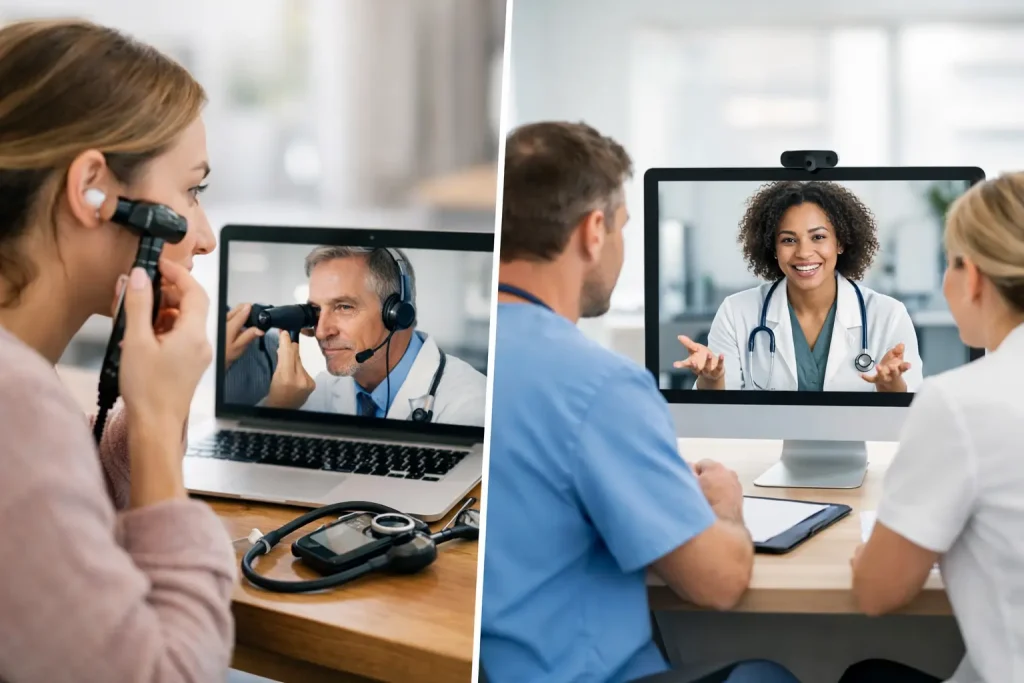
A caregiver holds a phone up to a child’s face during a virtual visit, trying to describe a rash, a persistent cough, or new ear pain. The clinician can listen carefully, ask focused questions, and provide guidance. But without clinical-grade data, the encounter may still end with uncertainty, an in-person referral, or a delayed decision. That is the practical difference at the center of remote exams vs video visits: one is primarily a conversation, while the other can support a clinician-directed physical assessment.
For healthcare organizations expanding access across pediatric, rural, community, and home-based settings, this distinction affects more than technology selection. It shapes staffing models, care pathways, patient experience, clinical confidence, documentation, and financial sustainability.
Remote Exams vs Video Visits: The Core Difference
A video visit connects a patient and clinician through live audio and video. It is well suited for history-taking, medication follow-up, behavioral health, care planning, education, symptom triage, and many low-acuity concerns. The clinician can observe the patient’s appearance, breathing effort, movement, speech, and home environment, but the encounter depends largely on what can be seen or described through a standard camera.
A remote exam adds connected diagnostic tools and a structured clinical workflow to the live encounter. Depending on the care model and available devices, clinicians may be able to assess clinically relevant findings such as heart and lung sounds, temperature, oxygen saturation, blood pressure, pulse rate, ear images, throat images, or skin conditions. The clinician remains in control of the assessment, directing a caregiver, nurse, medical assistant, community health worker, or other trained facilitator in real time.
The distinction is not that one modality is inherently better. A video visit may be exactly the right intervention for a medication check or post-discharge conversation. A remote exam becomes more valuable when a clinical decision depends on objective data or a closer physical assessment that video alone cannot provide.
Why Video Visits Can Reach Their Clinical Limit
Video visits have earned an important place in virtual care because they reduce travel, shorten wait times, and make it easier for caregivers to participate. For rural patients, families without reliable transportation, and people managing chronic conditions, that access can be meaningful. They also allow organizations to preserve in-person capacity for patients who truly need it.
Still, a standard video connection does not turn a phone or laptop into an exam room. Camera quality, lighting, internet reliability, patient positioning, and caregiver comfort all influence what a clinician can observe. Even when a rash, wound, or respiratory concern is visible, visual observation may not be sufficient for a confident diagnosis or treatment decision.
This limitation can create an avoidable loop: a patient completes a video visit, receives a recommendation for an in-person evaluation, and travels to a clinic or emergency department that may be hours away. The video visit was not wasted. It may have identified the need for escalation. But it did not always resolve the care need at the first point of contact.
For organizations serving dispersed populations, the goal should not be to replace every office encounter with video. The goal is to determine which encounters can be resolved safely and appropriately through a virtual pathway, and which need device-enabled assessment, local facilitation, or in-person care.
What a Clinician-Directed Remote Exam Changes
A remote exam extends the clinician’s ability to gather findings during a virtual encounter. Rather than relying only on a patient or caregiver’s interpretation of symptoms, the care team can capture information that helps guide clinical judgment.
This can be particularly useful in pediatric care. A young child may not be able to describe wheezing, ear discomfort, dizziness, or throat pain. Caregivers often provide essential context, but they should not be expected to perform a clinical assessment without support. With a connected exam system and clear clinician direction, a caregiver or trained local facilitator can participate meaningfully without being asked to diagnose.
The setting matters as well. A child with autism or special healthcare needs may tolerate an assessment better in a familiar home, school, pediatric practice, or community clinic than in an unfamiliar office. Lower-stress settings can improve cooperation and help caregivers share more complete observations. Remote examination tools do not eliminate the need for trauma-informed, patient-centered care, but they can make care delivery more adaptable to the patient.
For chronic care management and remote patient monitoring programs, the value is often continuity. A clinician may use recurring data and virtual assessments to identify changes earlier, reinforce a care plan, and determine when an in-person evaluation is warranted. The most effective programs connect these activities to established clinical protocols rather than treating data collection as a separate technology task.
Choosing the Right Virtual Care Model
Care leaders should begin with the clinical use case, not the device. The question is not simply whether an organization wants telehealth. It is whether the organization needs communication, clinical assessment, ongoing monitoring, or a combination of all three.
Video visits are often appropriate when the expected outcome is counseling, education, medication management, behavioral health support, care coordination, or follow-up where no new objective findings are needed. They can also be an effective first step for symptom triage, provided the organization has a clear escalation process.
Remote exams are more appropriate when the care pathway frequently requires vital signs, auscultation, visualization beyond a consumer camera, or other objective clinical inputs. Common examples include pediatric sick visits, respiratory follow-up, chronic disease check-ins, transitional care, school-based care, home health, and rural outreach. The specific tools should match the services being delivered and the competencies of the people supporting the patient.
A hybrid model is often the most practical approach. A clinic might start with video for access and triage, schedule a remote examination when findings are needed, and reserve in-person appointments for cases requiring hands-on procedures, imaging, laboratory testing, or a higher level of evaluation. This approach helps avoid forcing every patient into the same pathway.
Operational Requirements Matter as Much as Clinical Capability
A remote exam program succeeds when technology, workflow, and accountability are designed together. Buying connected devices without defining who supports the patient, how data reaches the clinician, and what happens after an abnormal result can create operational friction rather than improved access.
Healthcare organizations should establish protocols for patient eligibility, informed participation, device cleaning and inventory, staff training, documentation, escalation, and follow-up. The workflow must also clarify whether the examination is facilitated by a caregiver, school nurse, community health worker, medical assistant, or another member of the care team. Each role needs appropriate training and a defined scope of responsibility.
HIPAA-compliant technology and secure data handling are foundational, but compliance should not be treated as a finish line. Leaders also need to consider interoperability, clinical documentation practices, user permissions, device connectivity, and the burden placed on frontline teams. A technically capable platform that adds multiple disconnected steps may not scale across a rural network, federally qualified health center, or multi-site pediatric program.
Reimbursement planning belongs in the early design phase. CMS policies, payer requirements, state rules, eligible practitioner types, and documentation expectations can vary by service and care setting. Organizations should align their virtual exam and remote monitoring workflows with current reimbursement guidance and compliance policies, while recognizing that coverage rules can change. A reimbursement-aware implementation helps leaders build programs that are clinically meaningful and financially supportable.
Designing for the Circle of Care
The strongest virtual care models recognize that the patient is rarely alone. A child may be supported by a parent, school nurse, pediatrician, specialist, therapist, and care coordinator. An older adult may depend on family, home health staff, and a primary care team. Remote care works best when these participants are connected around a shared plan rather than asked to navigate isolated encounters.
Dr. Miltie’s Circle of Care™ model reflects this operational reality. A connected-care approach can bring the clinician, patient, caregiver, and local support person into the same care process, allowing relevant information to be captured where the patient is and reviewed by the appropriate clinical team. That model is especially valuable where workforce shortages and distance make traditional access difficult.
The objective is not to make every visit virtual. It is to give care teams more options to deliver the right level of assessment in the right setting. When a video conversation is sufficient, it should be easy to provide. When clinical findings are needed, a remote exam can help the team move from observation to informed action without making travel the default answer.
Move from information to action
See how the N9+ can fit your organization.
Explore the remote physical exam platform or request a focused demonstration.