
Emerging Virtual Care Technologies for Community Health
Emerging virtual care technologies for community health help providers extend clinical reach, strengthen continuity, and deliver care closer to home today.
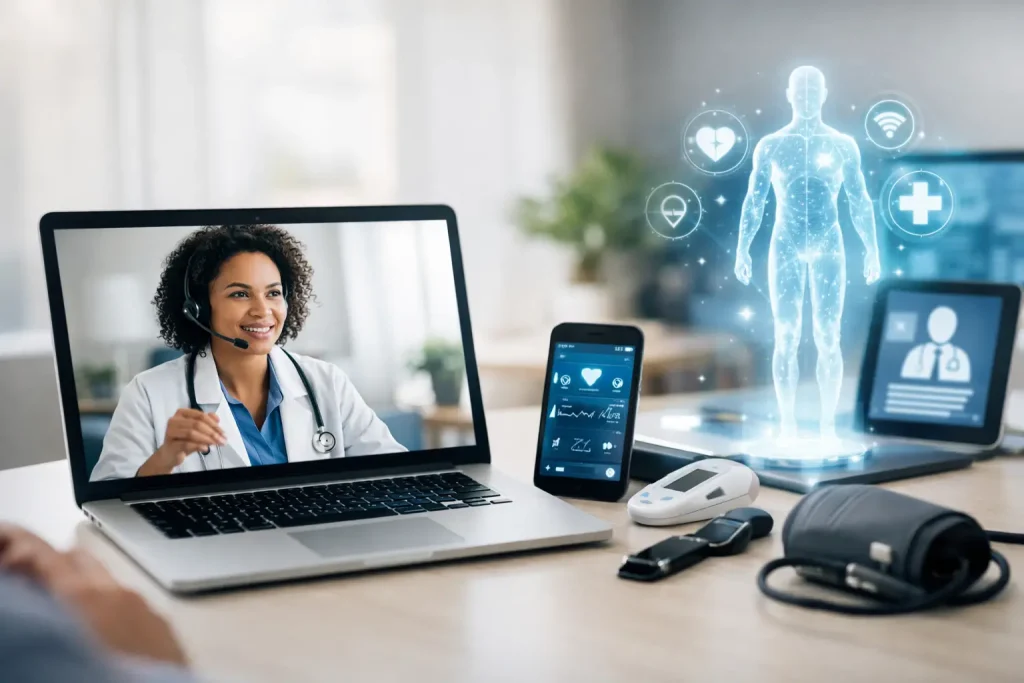
A missed follow-up appointment can mean very different things in a community health setting. For a family in a rural county, it may mean a four-hour drive and missed wages. For a child with autism, it may mean facing an unfamiliar environment that makes an otherwise routine assessment difficult. For a community health center, it may mean a preventable gap in chronic disease management. Emerging virtual care technologies for community health are changing what care teams can do between visits, beyond clinic walls, and closer to where patients live.
The most consequential shift is not the video visit itself. It is the ability to combine clinician-directed virtual physical exams, connected devices, remote patient monitoring, care coordination, and caregiver participation into a practical model of ongoing care. For rural health clinics, federally qualified health centers, critical access hospitals, and pediatric practices, these capabilities can help make limited clinical capacity reach farther without treating virtual care as a lesser version of in-person medicine.
Emerging Virtual Care Technologies for Community Health
Virtual care has matured from a scheduling convenience into a clinical delivery capability. A basic video connection can support conversation, medication review, behavioral health check-ins, and education. Yet a clinician often needs more than a patient-reported description to make an informed decision. They may need to see inside an ear, assess the throat, listen to heart and lung sounds, review skin findings, or examine trends in vital signs.
Connected virtual examination technology helps close that information gap. Mobile, wireless examination systems can enable trained staff, caregivers, or patients, when appropriate, to capture clinically relevant findings under clinician direction. This changes the question from, “Can we hold a virtual visit?” to, “Which elements of this patient’s care can be delivered safely and effectively in the setting where they are?”
That distinction matters in community health. The right model may place connected exam capabilities in a school, a satellite clinic, a long-term care facility, a home health program, or a patient’s home. It may also support a local nurse or medical assistant who can facilitate an exam while a remote clinician provides real-time guidance. The technology is valuable because it strengthens clinical decision-making, not because it replaces every in-person encounter.
Virtual physical exams are becoming more clinically useful
A virtual physical exam is not a single device or a single workflow. It is a coordinated interaction among the patient, a local facilitator when needed, the remote clinician, and a connected set of tools that can transmit findings for review. When designed well, it can support assessment of common acute concerns, follow-up visits, and selected chronic care needs without requiring travel to a distant specialty or primary care site.
For pediatric organizations, this can be especially meaningful. Young children and patients with special healthcare needs may be more comfortable at home, in a familiar pediatric office, or in a school-based setting than in a hospital or specialty clinic. Caregivers can participate more fully, helping clinicians understand symptoms, routines, medication adherence, and barriers that may not be visible during a brief office visit.
The trade-off is that technology does not eliminate the need for clinical protocols. Organizations need clear criteria for which presentations are appropriate for virtual assessment, when findings require escalation, who facilitates the encounter, and how documentation enters the medical record. A remote exam should extend clinical judgment, not pressure clinicians to make decisions with incomplete data.
Remote patient monitoring is moving from data collection to action
Remote patient monitoring has long promised greater visibility into patients’ daily health. The challenge has been turning incoming readings into timely, clinically useful action. A blood pressure value, pulse oximetry reading, weight trend, or symptom report has little value if the care team lacks a defined pathway for review, outreach, and escalation.
Emerging models connect monitoring to chronic care management, care coordination, and patient engagement. Instead of simply collecting readings, organizations can establish thresholds, assign responsibility for follow-up, and document interventions. This is particularly relevant for patients managing hypertension, diabetes, heart failure, chronic respiratory disease, or complex pediatric conditions that require ongoing attention between appointments.
Community health leaders should resist the temptation to measure success by enrollment alone. A large monitoring panel can burden staff if alerts are poorly configured or if workflows do not distinguish routine variation from meaningful change. Programs work best when the patient population is selected intentionally, clinical goals are specific, and staffing matches the level of follow-up patients need.
The Care Setting Is Becoming Part of the Care Model
The next generation of virtual care is less focused on where the clinician sits and more focused on where care can safely occur. A connected-care program can allow a patient to receive services in a location that reduces stress, transportation barriers, and missed work or school. For underserved communities, that can improve continuity without asking families to absorb the full cost of access.
Schools are a strong example. A school-based virtual care program can help a child receive timely assessment while a caregiver joins remotely and the school nurse supports the encounter. This approach may reduce unnecessary early dismissals and emergency department use for selected concerns. It also requires thoughtful agreements around consent, privacy, staffing, and communication with the child’s established primary care provider.
Home-based care offers another opportunity, especially for medically complex patients, older adults, and families who face mobility or transportation constraints. Virtual tools can make follow-up more feasible, but home deployment must account for broadband access, device connectivity, digital literacy, language needs, and caregiver capacity. Equity is not achieved by offering a virtual option that some patients cannot realistically use.
Caregiver participation is a clinical advantage
For many community-based patients, caregivers already perform essential care coordination work. They track symptoms, administer medications, arrange transportation, and communicate with multiple providers. Virtual care can bring that knowledge into the clinical encounter more consistently.
This is particularly relevant for autistic children and pediatric patients with special healthcare needs. A caregiver may help interpret baseline behavior, sensory triggers, communication preferences, or subtle changes that are difficult to capture in a clinic. Care delivered in a familiar environment can also reduce distress and support a more representative assessment.
Organizations should design for caregivers without shifting professional responsibility onto them. Training should be plain-language and role-specific. Technical support should be available. When a caregiver is asked to help use a connected device, clinicians should provide clear instructions and confirm that the task is appropriate for that family and situation.
Implementation Requires More Than Technology Procurement
Healthcare organizations often begin virtual care planning with a product evaluation. Devices and software matter, but implementation decisions determine whether a program becomes operationally useful. Leaders need to map the full care pathway: referral or patient identification, consent, scheduling, device availability, clinical encounter, documentation, follow-up, and escalation.
Integration also deserves early attention. A disconnected platform can create duplicate documentation and add friction for clinicians already managing demanding workloads. Technology should support the organization’s existing care teams, clinical governance, and electronic health record processes wherever possible. HIPAA-aligned privacy practices, access controls, training, and data-handling policies should be addressed before scale, not after an incident or audit.
Financial sustainability is equally practical. Reimbursement requirements vary by service, payer, patient eligibility, clinical setting, and documentation. Remote patient monitoring, chronic care management, telehealth, and virtual examination workflows may each have distinct operational requirements. A reimbursement-aware deployment helps organizations align program design with their revenue cycle processes while keeping the clinical purpose at the center.
Dr. Miltie approaches this challenge through connected examination technology, customized care pathways, and its Circle of Care™ model, helping organizations coordinate virtual care across patients, caregivers, local staff, and remote clinicians.
What Community Health Leaders Should Prioritize
The strongest virtual care strategies start with a defined access problem rather than a technology category. A rural clinic may need to reduce travel for specialty follow-up. A pediatric practice may need a lower-stress way to assess selected patients. A health system may need better continuity after discharge. Each objective calls for a different combination of virtual exams, monitoring, coordination, and local support.
Leaders should also establish measures that reflect both clinical and community value. Appointment completion, time to assessment, avoidable travel, caregiver participation, escalation rates, staff workload, patient experience, and disease-specific outcomes can reveal whether the program is improving access without compromising quality. Not every successful program will produce the same metrics, but every program should be accountable to measurable goals.
The future of community health will not be entirely virtual, nor should it be. The opportunity is to build care models in which an in-person visit is available when it is needed, while meaningful clinical support is no longer limited by distance, transportation, or the walls of an exam room. The organizations that plan around patient context, clinical appropriateness, and operational readiness will be best positioned to bring care closer to the communities they serve.
Move from information to action
See how the N9+ can fit your organization.
Explore the remote physical exam platform or request a focused demonstration.