
Rural Health Access for Community Providers Dr. Miltie N9+
See how rural health access for community providers with Dr. Miltie N9+ supports virtual exams, monitoring, and coordinated care in underserved areas.
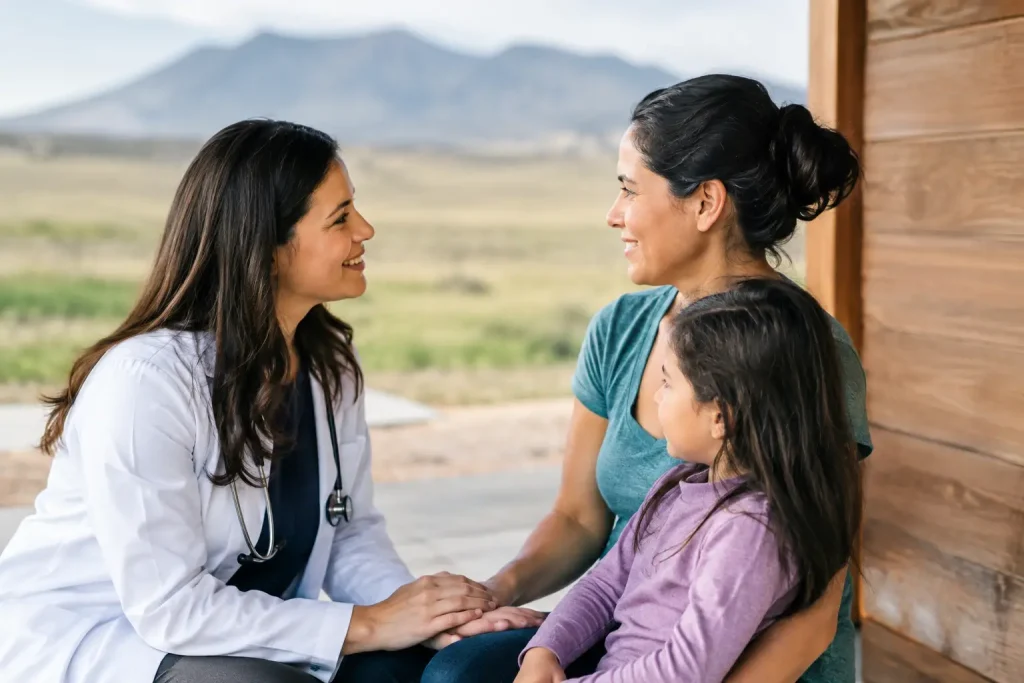
A missed follow-up visit in a rural community is rarely just a missed appointment. It can mean a parent taking unpaid time off work, a patient traveling hours for a brief assessment, or a local clinician delaying a decision because the right data is not available. Rural health access for community providers using the Dr. Miltie N9+ is designed to address that gap by bringing clinician-directed virtual examinations and connected care closer to where patients live, learn, and receive support.
For rural health clinics, critical access hospitals, federally qualified health centers, and community health centers, the issue is not simply whether telehealth is available. The issue is whether a virtual encounter can provide enough clinical context to guide care confidently, coordinate next steps, and preserve the trusted role of the local care team.
Why Rural Access Requires More Than Video Visits
Video has an important role in access, particularly for follow-up, behavioral health, care coordination, and education. But a video visit alone may not give a clinician the information needed to assess a new concern, manage a chronic condition, or determine whether a patient needs escalation. In rural settings, where specialty coverage may be limited and travel burdens are high, that limitation can carry real operational and clinical consequences.
A more complete virtual care model pairs the conversation with clinically relevant data. Depending on the organization’s care pathway and staffing model, this can include wireless examination capabilities, vital signs, remote patient monitoring, symptom tracking, and structured documentation for the treating clinician. The goal is not to replicate every in-person visit remotely. It is to make more encounters clinically useful and to reserve travel, referrals, and on-site capacity for the situations that truly require them.
This distinction matters for community providers. They are often managing a broad range of needs with finite staff, limited specialty access, and patients whose ability to travel is constrained by distance, weather, transportation, work, caregiving, or disability. Technology must strengthen local care delivery rather than create another disconnected workflow.
The Dr. Miltie N9+ in a Community Care Model
The Dr. Miltie N9+ is a mobile, wireless virtual examination and patient monitoring system built to help clinicians assess patients beyond the traditional exam room. It supports a connected-care approach in which a clinician can direct an assessment while a trained staff member, caregiver, or patient participates from a community-based setting.
That setting may be a rural clinic, a school-based health program, a pediatric practice, a patient’s home, or a partner location. The practical value is flexibility: care organizations can create pathways that fit their populations and operational realities instead of requiring every patient to enter the same brick-and-mortar workflow.
The platform is particularly relevant when access challenges intersect with continuity of care. A patient with hypertension, diabetes, respiratory symptoms, heart failure risk, or another chronic condition may need timely follow-up but not necessarily a long trip for every assessment. A connected exam and monitoring workflow can help the care team identify when routine support is appropriate, when a virtual clinician visit is warranted, and when an in-person evaluation should be arranged.
It depends, of course, on the condition, the patient’s stability, local clinical protocols, and the availability of trained support. Virtual examination technology is not a substitute for emergency services or hands-on care when the clinical situation requires it. Its value lies in creating a stronger front line for assessment, monitoring, and informed escalation.
Extending the Reach of Limited Clinical Teams
Workforce scarcity is one of rural healthcare’s most persistent constraints. Recruiting clinicians is difficult; retaining them can be just as challenging. Community organizations need models that allow scarce clinical expertise to reach more patients without compromising the judgment and relationships at the center of care.
A clinician-directed virtual exam can help distribute work appropriately. A local nurse, medical assistant, community health worker, or other trained team member can support the patient at the point of care while a remote clinician reviews findings and guides the encounter. This does not eliminate the need for local staff. Instead, it can make local staff more effective by connecting them to a broader clinical team and clearer next steps.
For health systems, this model can also support hub-and-spoke care. Specialty, pediatric, primary care, and care management resources can extend into satellite clinics and community sites without requiring every service line to be physically present at every location. The most effective programs define which visit types are appropriate, who performs each role, and how results enter the organization’s existing clinical workflow.
Pediatric Care Benefits From Familiar Settings
The access challenge can be especially acute for children and families. Pediatric specialty appointments may require significant travel, missed school, transportation planning, and time away from work. For autistic children and pediatric patients with special healthcare needs, unfamiliar clinical environments can also increase anxiety and make assessment more difficult.
Care delivered in a familiar setting can change the experience. A child may be more comfortable at home, in a school-based setting, or with a trusted local care team. Caregivers can participate more fully, describe changes they have observed, and receive guidance without carrying the full logistical burden of a distant appointment.
The clinical pathway still matters. Some pediatric concerns require an in-person exam, diagnostic testing, or urgent intervention. Others are well suited to virtual follow-up, chronic care management, symptom assessment, medication monitoring, or coordinated consultation. Community providers should build pathways around the needs of their patients, not around a one-size-fits-all technology deployment.
The Circle of Care™ Is an Operational Model, Not Just a Feature
Connected care succeeds when information and accountability move with the patient. Dr. Miltie’s Circle of Care™ model supports collaboration among patients, caregivers, local providers, remote clinicians, and care coordinators. In rural communities, this can reduce the fragmentation that occurs when a patient receives services across distant hospitals, local clinics, schools, home-based programs, and specialty practices.
For an organization, that means determining who receives the data, who follows up on abnormal findings, how caregivers are included, and when the local provider remains responsible for the next step. Without this clarity, even advanced technology can add work rather than reduce it.
A thoughtful deployment should connect virtual examinations and remote monitoring to the organization’s established care management processes. That includes documentation standards, consent and privacy practices, clinical escalation protocols, staff training, patient education, and reporting. HIPAA compliance and security requirements must be addressed as part of the implementation, not treated as an afterthought.
Designing for Sustainability, Not Pilots
Rural technology programs often struggle when they begin with a device rather than a care model. A successful implementation starts by identifying a defined access problem: delayed pediatric follow-up, long specialty wait times, chronic disease monitoring gaps, avoidable transfers, limited clinician coverage, or low engagement after discharge.
From there, leaders can select the patient populations, sites, staffing roles, and measures that matter. Those measures may include completed visits, time to assessment, travel avoided, adherence to follow-up, avoidable utilization, clinician capacity, patient experience, or care gap closure. The right metrics vary by organization and payer environment, but they should be established before scaling.
Financial sustainability deserves equal attention. Reimbursement for telehealth, remote patient monitoring, chronic care management, and related services depends on program design, documentation, payer policy, site of service, state requirements, and the services actually furnished. A reimbursement-aware approach helps organizations align workflows with applicable CMS guidance and payer rules while recognizing that coding alone does not make a program viable.
The strongest models combine reimbursement planning with operational discipline. They ensure staff know when to use the technology, patients understand how to participate, and clinicians receive data in a format that supports decision-making rather than administrative burden.
Rural Health Access for Community Providers With N9+
For community providers, the question is not whether virtual care will replace rural healthcare. It will not. The question is whether connected virtual care can make the existing rural care network more responsive, more clinically informed, and easier for patients to use.
The Dr. Miltie N9+ can support that goal when it is deployed as part of a patient-centered strategy: one that respects local workflows, supports caregiver involvement, equips clinical teams with actionable information, and creates clear pathways for escalation. For many communities, the most meaningful care transformation begins not with a new destination for patients to reach, but with a better way to bring the care team within reach.
Move from information to action
See how the N9+ can fit your organization.
Explore the remote physical exam platform or request a focused demonstration.