
Next Generation Accountable Care Organization Model (NGACO Model)

Historical program update (November 3, 2026). This article preserves CMS’s January 11, 2016 announcement of the Next Generation Accountable Care Organization (NGACO) Model. The model ran during performance years 2016 through 2021 and is no longer open for new participation. The historical counts, application dates, and participant list below are not current opportunities. Sources: CMS’s original 2016 fact sheet and CMS’s completed model and evaluation information.
For information about newer Medicare accountable care models, see CMS’s ACO REACH Model, which has a 2026 performance year. Model-specific payment, enrollment, and eligibility requirements must be checked with CMS; this 2016 article is historical background, not current application guidance.
Historical overview: The Next Generation ACO Model was introduced in 2016 to test accountable care arrangements with greater financial risk and incentives for coordinated, high-quality care.
January 11, 2016 by Centers for Medicare & Medicaid Services (CMS)
Overview (2016)
In January 2016, the Centers for Medicare & Medicaid Services (CMS) announced a new accountable care organization (ACO) model called the Next Generation ACO Model (NGACO Model). The 21 ACOs participating in the NGACO Model in 2016 had significant experience coordinating care for populations of patients through initiatives, including, but not limited to, the Medicare Shared Savings Program and the Pioneer ACO Model. Building on experience from the Pioneer ACO Model and the Medicare Shared Savings Program, through this model, CMS planned to partner with ACOs that are experienced in coordinating care for populations of patients and whose provider groups are ready to assume higher levels of financial risk and reward. This reflected the administration’s goal, announced at the time, of tying 30 percent of traditional, or fee-for-service, Medicare payments to alternative payment models, such as ACOs, by the end of 2016 — and 50 percent by the end of 2018.
In its January 2016 fact sheet, CMS reported more than 477 Medicare ACOs serving nearly 8.9 million beneficiaries across the Medicare Shared Savings Program and Pioneer ACO Model. These were historical participation figures, not current counts. CMS described promising early quality and spending results; they were not guarantees that all ACOs would achieve savings.
Selected Organizations (2016)
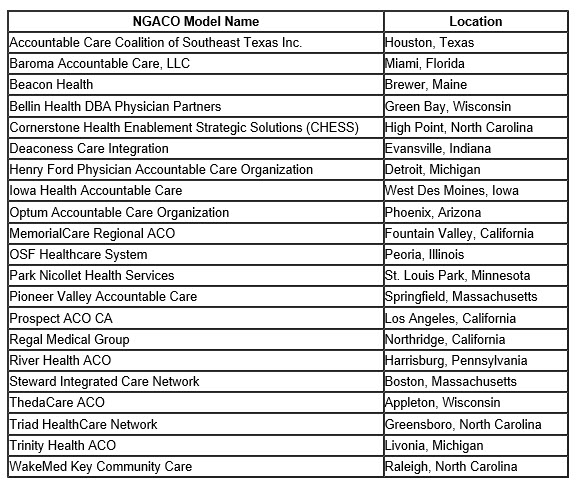
The NGACO Model organizations represent a variety of provider organizations and geographic regions, and were selected by fulfilling specific eligibility criteria outlined in the Request for Applications found at the Next Generation ACO Model web page. These organizations were selected through an open and competitive process from a large applicant pool that included many qualified organizations.
The 21 organizations participating in the NGACO Model in 2016:
The NGACO Model’s Core Principles
- Protect Original Medicare beneficiaries’ freedom to seek the services and providers of their choice;
- Engage beneficiaries in their care through benefit enhancements designed to improve the patient experience and reward seeking care from ACOs;
- Create a financial model with long-term sustainability;
- Utilize a prospectively-set benchmark that: (1) rewards quality; (2) rewards both improvement and attainment of efficiency; and (3) ultimately transitions away from an ACO’s recent expenditures when setting and updating the benchmark;
- Mitigate fluctuations in aligned beneficiary populations and respect beneficiary preferences by supplementing a prospective claims-based alignment process with a voluntary process; and
- Smooth ACO cash flow and support investment in care improvement capabilities through alternative payment mechanisms.
Medicare ACOs are comprised of groups of doctors, hospitals, and other health care providers and suppliers who come together voluntarily to provide coordinated, high-quality care at lower costs to their Original Medicare patients. ACOs are patient-centered organizations where the patient and providers are true partners in care decisions. Participating patients will see no change in their Original Medicare benefits and will keep their freedom to see any Medicare provider. Provider participation in ACOs is also voluntary. When an ACO succeeds in both delivering high-quality care and spending health care dollars more wisely, it will share in the savings it achieves for the Medicare program.
The goal of care coordination is to ensure that patients, especially those with chronic conditions, get the right care at the right time while avoiding medical errors and unnecessary duplication of services. Any patient who has multiple doctors has experienced the frustration of fragmented and disconnected care: lost or unavailable medical charts; duplicated medical procedures and tests; difficulty scheduling appointments; or having to share the same information repeatedly with different doctors. ACOs are designed to lift this burden from patients, while improving the partnership between patients and doctors in making health care decisions. Medicare beneficiaries will have better control over their health care, and providers will have better information about their patients’ medical history and better relationships with their patients’ other providers. For providers, ACOs hold the promise of realigning the practice of medicine with the ideals of the profession—keeping the focus on patient health and the most appropriate care.
Medicare beneficiaries whose doctors participate in an ACO will still have freedom of choice among providers and can still choose to see providers outside of the ACO. Patients choosing to receive care from providers participating in ACOs will also have access to information about how well their doctors, hospitals, or other caregivers are meeting quality standards.
2016 Round 2 Application Process (Historical)
When this information was issued in January 2016, CMS expected Round 2 letters of intent and applications in spring 2016. That application period has passed; the NGACO Model concluded following the 2021 performance year.
The CMS Innovation Center
The CMS Innovation Center was created by the Affordable Care Act to test innovative payment and service delivery models to reduce program expenditures while preserving or enhancing the quality of care for Medicare, Medicaid and Children’s Health Insurance Program beneficiaries.
Working in concert with the Shared Savings Program, the CMS Innovation Center is testing a number of ACO models and has sponsored learning activities that help providers form ACOs and improve their results. More information on all of these initiatives is available on the CMS Innovation Center website at https://innovation.cms.gov/.
Move from information to action
See how the N9+ can fit your organization.
Explore the remote physical exam platform or request a focused demonstration.