
RHTP Technology Innovation Solutions for Rural Care
RHTP technology innovation solutions help rural providers extend clinical reach with virtual exams, remote monitoring, and sustainable care coordination.
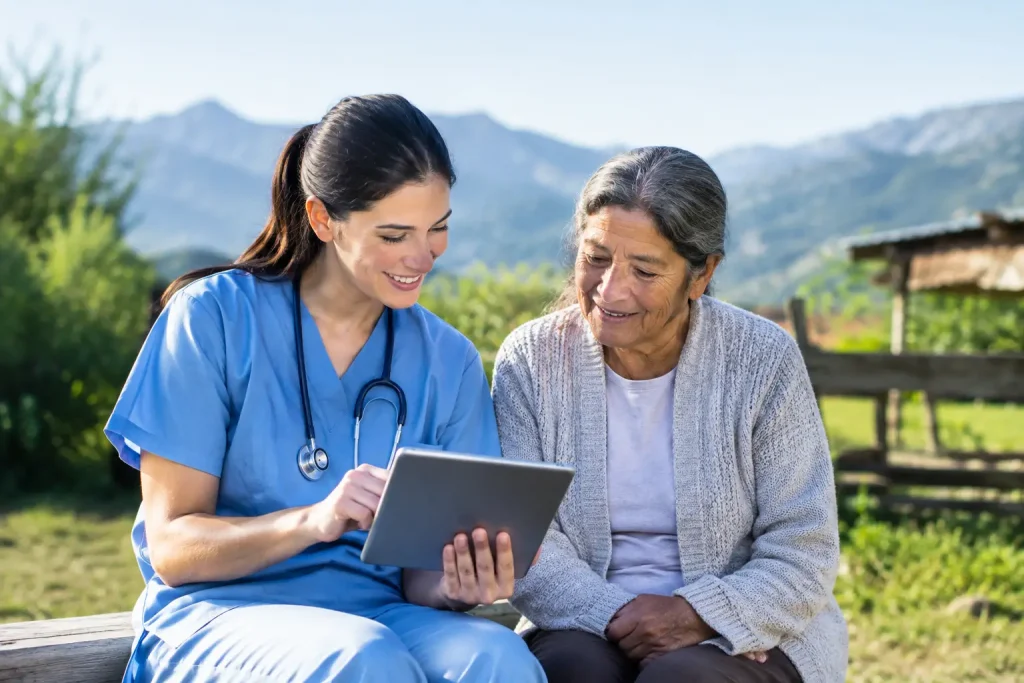
RHTP technology innovation solutions are most valuable when they solve the practical distance between a rural patient and the clinical services they need. For a critical access hospital, rural health clinic, federally qualified health center, or community-based program, that distance can mean missed follow-up, delayed assessment, caregiver strain, and avoidable travel across county or state lines. Technology must do more than add a video visit. It must help clinicians obtain meaningful information, coordinate next steps, and keep care connected after the screen goes dark.
Rural transformation requires clinically useful technology
Rural health transformation depends on operational models that expand access without asking already limited teams to absorb another disconnected workflow. Many organizations have adopted telehealth, yet basic video alone has clear clinical limits. A clinician may be able to speak with a patient, observe general appearance, and provide education, but cannot always complete the physical assessment needed to make a confident decision.
This limitation is especially consequential for children, older adults, patients managing chronic conditions, and people whose transportation, mobility, or caregiving circumstances make in-person care difficult. A virtual model that cannot capture clinically relevant data may still leave the patient traveling for a brief assessment, undermining the access gains telehealth was intended to create.
The strongest technology investments extend the clinician’s ability to assess, monitor, and coordinate care across locations. They support a care pathway rather than a single encounter. That distinction matters when organizations are evaluating initiatives associated with rural health transformation goals, including preventive care, workforce efficiency, chronic disease management, patient engagement, and measurable access improvements.
What RHTP technology innovation solutions should deliver
For healthcare leaders, the question is not whether to deploy more technology. It is whether a proposed solution improves the clinical and financial performance of care delivery. Effective RHTP technology innovation solutions should bring together four capabilities: virtual physical assessment, remote patient monitoring, care coordination, and deployment support aligned with the organization’s operational realities.
A virtual visit should include more than conversation
A clinician-directed virtual exam can help make remote encounters more actionable. Connected examination tools can enable the capture and transmission of patient data that informs clinical judgment, while allowing the clinician to guide a caregiver, school nurse, medical assistant, or other trained facilitator through the visit.
The right model depends on the service line and setting. A school-based pediatric program may prioritize rapid assessment and caregiver participation. A rural clinic managing hypertension, diabetes, or pulmonary disease may need recurring monitoring data and structured escalation workflows. A home health or long-term care program may focus on early identification of changes that warrant intervention.
The common requirement is clinical relevance. Devices and workflows should support the assessments providers actually need, not produce data that is difficult to interpret, review, or act upon.
Monitoring must lead to action
Remote patient monitoring is not simply the collection of readings between appointments. Its value comes from an agreed process for reviewing data, identifying risk, contacting the patient, and documenting follow-up. Without this structure, technology can create alert fatigue and place more burden on clinical staff.
A scalable program defines who monitors incoming information, what thresholds require outreach, when a clinician becomes involved, and how the care plan is updated. These decisions should reflect patient acuity, staffing capacity, and local referral resources. For some organizations, a centralized care team is appropriate. For others, a distributed model that empowers local staff may fit better.
Chronic care management and remote monitoring also require attention to reimbursement and documentation. Programs should be designed with applicable CMS requirements, payer contracts, coding practices, consent processes, and recordkeeping needs in mind. Financial sustainability should be considered before launch, not after a pilot has already demonstrated demand.
Care coordination cannot be an afterthought
Rural patients often receive care across a patchwork of settings: primary care offices, hospitals, specialists, schools, homes, behavioral health programs, and community services. A technology platform should help these participants work from a shared understanding of the patient’s next step.
This is where customized pathways of care become valuable. A pathway can define intake questions, virtual exam protocols, monitoring schedules, escalation criteria, caregiver education, referrals, and follow-up intervals. Standardization does not mean treating every patient identically. It gives teams a dependable framework while leaving room for clinician judgment and patient-specific needs.
For pediatric populations, coordination also means recognizing the central role of parents and caregivers. Care delivered in a familiar environment can reduce stress for children, including autistic children and pediatric patients with special healthcare needs. It can also give clinicians a clearer view of barriers that may be less visible in a traditional exam room, such as medication routines, equipment access, or caregiver concerns.
Designing for rural workflows, not generic telehealth
A rural care organization should evaluate technology against the realities of its workforce and communities. Connectivity may be inconsistent. Staff may serve multiple functions. Patients may have limited digital confidence or lack access to a private space for visits. Referral options may be distant, and emergency transport resources may be constrained.
These conditions do not make connected care impractical. They make thoughtful implementation essential. A program may need mobile equipment that can move between sites, training that prepares facilitators to support a clinician-directed exam, and workflows that account for intermittent connectivity. It may also need multiple access points, such as homes, schools, community clinics, and partner facilities.
The Dr. Miltie N9+ is designed for this kind of distributed care delivery, combining mobile wireless virtual examination and patient monitoring capabilities with a connected-care approach. Through the Circle of Care™ model, organizations can configure workflows around the patient, the local care team, and the clinical services that need to reach beyond brick-and-mortar facilities.
Technology selection should also include privacy and security review. HIPAA compliance, role-based access, data handling practices, integration needs, and patient consent processes are foundational requirements. A promising clinical use case can lose support quickly if staff must duplicate documentation or work around systems that do not fit established governance.
A practical implementation path
The most durable programs usually begin with a specific care gap rather than a broad mandate to “do telehealth.” Leaders might identify pediatric follow-up after emergency department discharge, chronic disease monitoring for patients who face transportation barriers, access to specialist-supported assessments, or school-based evaluation pathways.
From there, define the clinical model. Identify who initiates the encounter, who facilitates it, which data points are collected, who reviews them, and what happens when findings indicate concern. Include frontline clinicians and operational staff early. They can identify friction points that may not appear in a technology demonstration, such as room availability, device cleaning, scheduling rules, caregiver communication, or documentation ownership.
A phased rollout is often wiser than an enterprise-wide launch. Start with a patient population where the access problem is clear and outcomes can be measured. Track utilization, completed visits, travel avoided, time to follow-up, escalations, patient and caregiver experience, staff workload, and reimbursement performance. Clinical outcomes should remain central, but operational measures show whether the model can be sustained.
There are trade-offs. A highly customized workflow may fit one site exceptionally well but take longer to scale. A standardized pathway may accelerate deployment but require local adaptation. Home-based care may maximize convenience, while school- or clinic-based facilitation may offer more reliable equipment, connectivity, and support. The best choice depends on the population, the available workforce, and the decisions clinicians need to make remotely.
Innovation is measured at the point of care
Rural health technology earns trust when it helps a clinician make a better decision, helps a caregiver participate with confidence, and helps an organization deliver care without adding unnecessary complexity. The goal is not to replace in-person care in every circumstance. It is to reserve travel and face-to-face capacity for the moments when they are truly needed.
For organizations building sustainable rural access models, the next useful step is to map one high-friction patient journey from the first concern through follow-up. The most meaningful innovation opportunity is often waiting in the handoff that currently asks a patient to travel farther than their health should require.
Looking for current opportunities?
Funding intelligence now lives at Atlas by Dr. Miltie.
Atlas is a separate experience for discovering grants, evaluating fit, and producing submission packages.
Move from information to action
See how the N9+ can fit your organization.
Explore the remote physical exam platform or request a focused demonstration.