
2019 Survey of Telehealth Insurance Laws: 42 States and DC
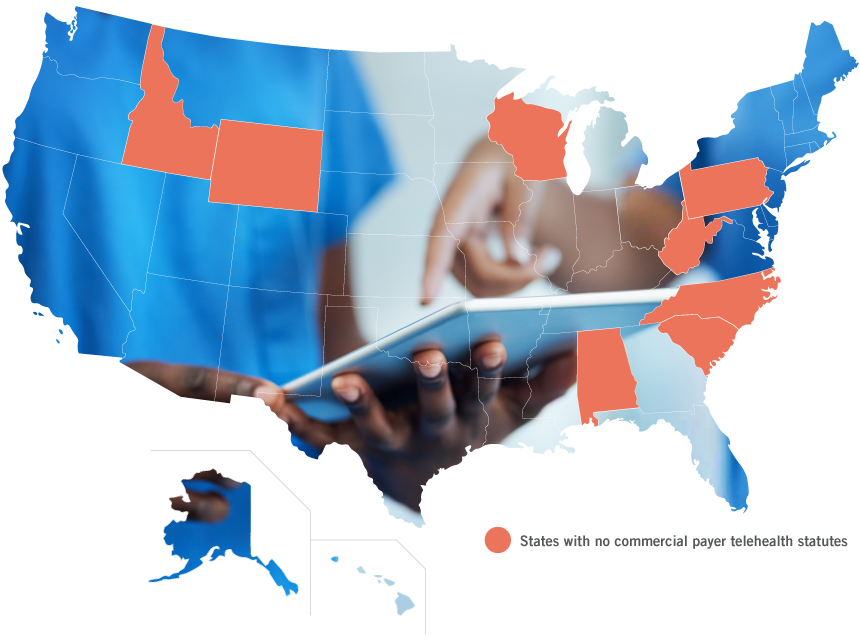
Foley & Lardner's 2019 survey reported telehealth commercial-payer laws in 42 states and Washington, D.C. Coverage and payment parity varied, and these counts are not current legal guidance.

Historical telehealth-law survey (December 2019): The state counts and coverage comparisons below describe laws as of October 2019, not current requirements. A law mentioning telehealth did not necessarily require an insurer to cover every service or pay the same rate as an in-person visit. For subsequent changes, consult current state statutes and payer contracts. Source: Foley & Lardner’s December 2, 2019 announcement.
Two years after Foley’s 2017 Telemedicine and Digital Health Survey uncovered a demand for telemedicine and digital health services, as well as coverage and reimbursement to match the growing demand, Foley explores how each state has responded in its 2019 50-State Telehealth Survey findings plus District of Columbia (DC) of Commercial Payer Statutes.
Foley & Lardner reported that as of October 2019, 42 states and Washington, D.C., had some form of telehealth commercial-payer law. The existence of such a law did not necessarily require an insurer to cover every telehealth service or provide payment parity.
Foley’s report breaks down variances in telehealth commercial statues state-by-state, including:
- States that have commercial payer statutes in place
- States that have coverage parity or limitations
- States that have payment parity
- States that impose originating site limits
- States that have patient cost shifting protection
- State laws that address telehealth narrow or exclusive networking
- States that require coverage of reimbursement of remote patient monitoring
- States that require coverage of store & forward/asynchronous telemedicine
For the original findings, read Foley & Lardner’s December 2, 2019 survey announcement.
Move from information to action
See how the N9+ can fit your organization.
Explore the remote physical exam platform or request a focused demonstration.