
From Telemedicine to Remote Patient Monitoring, AI Is Transforming Healthcare Delivery
From telemedicine to remote patient monitoring, AI is transforming healthcare delivery with virtual exams, actionable data, and connected care at scale.
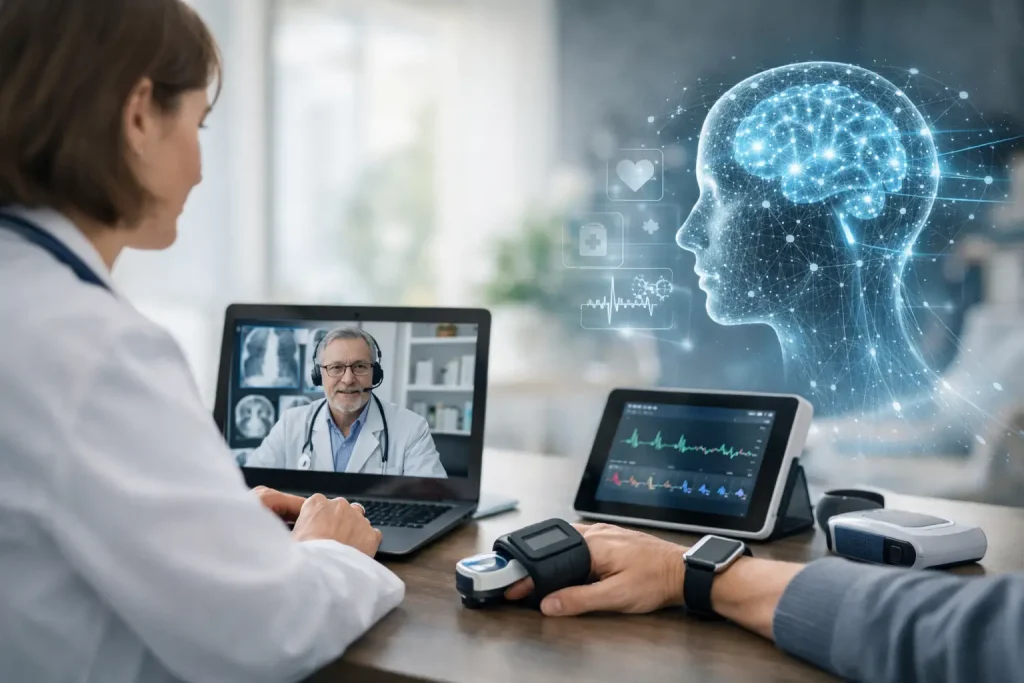
A missed follow-up appointment can mean very different things for different patients. For a family in a rural community, it may mean hours of driving and missed work. For an autistic child, it may mean navigating an unfamiliar clinical environment that creates distress before the visit even begins. For a patient managing multiple chronic conditions, it may mean a worsening symptom goes unnoticed between appointments. From telemedicine to remote patient monitoring, AI is transforming healthcare delivery by helping care teams identify needs sooner, extend clinical reach, and bring more of the care experience into the settings where patients live, learn, and recover.
The real change is not simply that more appointments happen by video. It is that virtual care is becoming more clinically informed, continuous, and operationally connected. When healthcare organizations combine clinician-directed virtual examinations, connected devices, remote patient monitoring, and carefully governed AI, they can create care pathways that are more responsive without treating technology as a substitute for clinical judgment.
Telemedicine Is Moving Beyond the Video Visit
Early telemedicine models solved an immediate access problem: they gave patients and clinicians a way to speak without being in the same room. That remains valuable, particularly for behavioral health, medication follow-up, care navigation, and triage. But video alone has limits when a clinician needs objective information to evaluate a patient confidently.
A high-quality virtual visit may require more than a visual conversation. Depending on the clinical use case, the provider may need vital signs, heart and lung sounds, ear images, throat images, skin observations, or other relevant findings. Device-enabled virtual physical exams help close that gap by allowing trained staff, caregivers, or patients to capture appropriate clinical data under a clinician-directed workflow.
This distinction matters for organizations building sustainable virtual primary care programs. A basic video platform can expand appointment availability, but a connected-care model can support clinical assessment, care coordination, and follow-up across homes, schools, community sites, long-term care settings, and rural clinics. The goal is not to replicate every in-person visit remotely. It is to determine which patients, conditions, and moments of care can be safely and effectively supported outside a traditional exam room.
How AI Supports Better Remote Patient Monitoring
Remote patient monitoring produces a stream of information that can be clinically useful but operationally difficult to manage. Blood pressure readings, weight trends, oxygen saturation, glucose values, symptom check-ins, and device-generated observations can quickly exceed what a care team can review manually at scale. AI can help organize this information so clinicians and care coordinators can focus their attention where it is most needed.
In practical settings, AI can identify trends, prioritize abnormal readings, flag missing data, and support outreach workflows. For example, a patient whose readings have changed gradually over several days may need attention even when no single measurement crosses a preset threshold. Pattern recognition can help surface that change earlier for clinical review.
AI can also improve the usability of remote monitoring programs by helping tailor patient communications. A reminder that reflects a patient’s preferred language, schedule, risk level, or care plan may be more effective than a generic message. For caregivers of children with special healthcare needs, guided prompts can clarify what information to capture and when to contact the care team.
None of this makes AI the clinician. It makes the workflow more capable of handling the volume and variability of data that connected care creates. Clinical teams still establish protocols, evaluate alerts, decide on treatment, and determine when an in-person assessment or escalation is appropriate.
AI Must Be Designed Around Clinical Governance
Healthcare leaders should be cautious of any claim that AI can independently diagnose, replace examination, or eliminate the need for accountable clinical oversight. Algorithms can reflect gaps in their training data, and remote measurements can be affected by device use, connectivity, patient adherence, and context. A concerning reading may be an urgent clinical signal, a technical error, or something that needs confirmation.
That is why deployment must include clear escalation pathways, clinician review standards, documented workflows, and ongoing performance monitoring. Organizations should understand what an AI-enabled feature does, what data it uses, how alerts are generated, and how staff are expected to respond. HIPAA compliance, role-based access, data security, and patient consent are not secondary implementation details. They are foundational to trust.
AI-Enabled Healthcare Delivery Must Work for Real Communities
The strongest virtual care programs begin with the realities of the populations they serve. Rural health clinics, federally qualified health centers, critical access hospitals, and community health organizations often face staffing constraints, specialist shortages, transportation barriers, and inconsistent broadband access. Technology that assumes every patient has a reliable connection, a private space, and high digital confidence can widen the very gaps it aims to address.
A practical model offers multiple ways to participate. Some patients may use connected devices at home with caregiver support. Others may receive virtual care through a school-based program, community clinic, mobile care setting, or local practice equipped to facilitate the encounter. A care coordinator may be central to helping patients complete onboarding, understand device instructions, and stay connected to their care plan.
Pediatric care makes this especially clear. Children are not simply smaller adult patients, and the circumstances of the visit matter. A child may communicate more openly at home, while a caregiver can provide observations that may not emerge during a short office visit. For autistic children and children with complex needs, familiar settings can reduce sensory stress and enable more meaningful caregiver participation. Virtual care should be designed to support families, not add another technical task to an already demanding care routine.
From Telemedicine to Remote Patient Monitoring: AI Changes the Care Model
The most meaningful opportunity is not one isolated application of AI. It is the connection between virtual access, clinical data, care coordination, and follow-through. A patient can begin with a telemedicine consultation, complete a clinician-directed virtual exam, enter a remote monitoring pathway, and receive timely outreach when the care team identifies a concern. Each element supports the next.
This connected approach can improve continuity for chronic care management and preventive services. It may help organizations monitor patients after discharge, support medication adherence, detect deterioration earlier, or reduce unnecessary travel for follow-up. It can also help care teams use their limited time more effectively by separating routine outreach from cases that need faster clinical attention.
The appropriate model depends on the patient population and service line. A pediatric practice may prioritize episodic virtual exams and caregiver engagement. A rural health system may focus on extending specialty access through local clinical partners. A community health center may build remote monitoring pathways for hypertension, diabetes, or post-discharge follow-up. Technology should adapt to the pathway, reimbursement environment, staffing model, and clinical goals rather than force every program into the same template.
Reimbursement and Workflow Determine Whether Programs Last
Virtual care cannot remain a pilot that depends on extraordinary staff effort. Sustainable programs need reimbursement-aware design, operational ownership, training, and measures that demonstrate value. CMS reimbursement policies and payer requirements can affect how remote patient monitoring, chronic care management, telehealth services, and care coordination are documented and delivered. Requirements evolve, so organizations need processes that keep clinical and billing workflows aligned.
Leaders should also measure more than enrollment. Useful indicators may include completed monitoring days, response time to clinically significant alerts, avoidable travel reduced, follow-up completion, patient and caregiver experience, staff workload, and outcomes tied to the specific condition being managed. A program with impressive enrollment but poor adherence or unclear escalation processes is not yet delivering its intended value.
The Dr. Miltie N9+ is designed for this broader connected-care need: clinician-directed virtual examinations, actionable patient data, and customizable workflows that can help organizations extend care beyond the facility. Within a Circle of Care™ model, the technology can connect clinicians, caregivers, local support staff, and patients around a coordinated pathway rather than a one-time virtual interaction.
A More Human Standard for Healthcare Technology
AI will be most valuable in healthcare when it makes care more attentive, not more distant. It should reduce the administrative burden that pulls clinicians away from patients, bring relevant changes to the surface sooner, and give families clearer ways to participate in care. It should also preserve the moments when a clinician needs to listen closely, examine carefully, and make a judgment that no automated system can make alone.
For healthcare organizations, the next step is to build virtual care around the patients who have the most to gain from it: people facing distance, mobility, workforce, transportation, or access barriers. When connected devices, remote patient monitoring, virtual exams, and AI are implemented with clinical rigor and compassion, care can reach farther while still feeling personal.
Move from information to action
See how the N9+ can fit your organization.
Explore the remote physical exam platform or request a focused demonstration.