
Virtual Care Delivery Models for Rural Communities
Virtual care delivery models for rural communities can extend clinical reach with exam-enabled visits, RPM, and coordinated local support for patients.
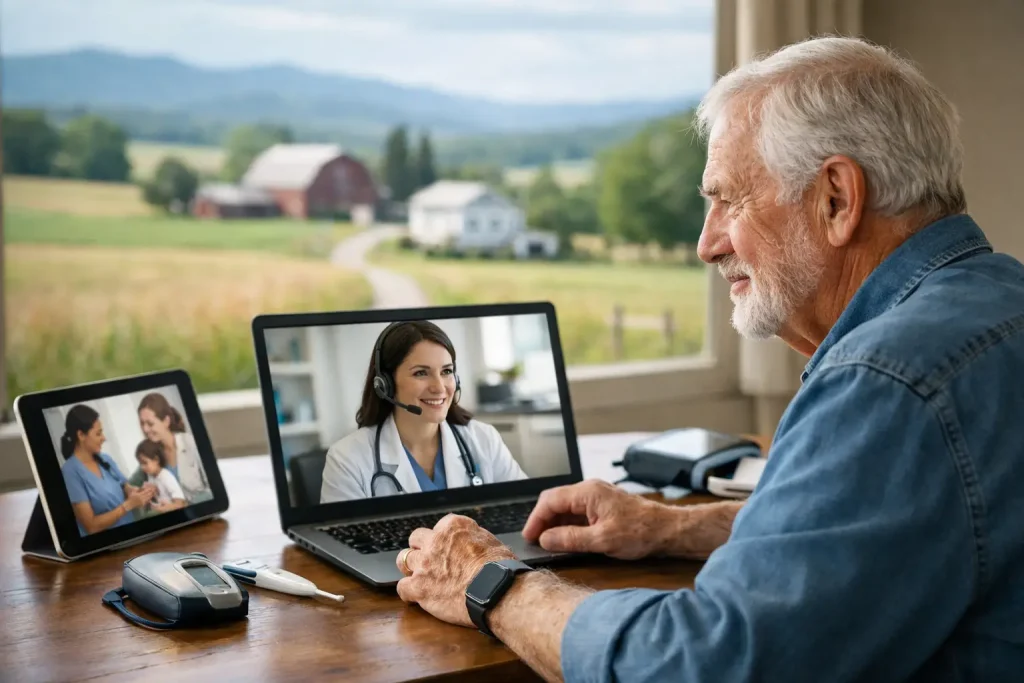
A rural patient’s missed follow-up is rarely just a missed appointment. It can mean several hours on the road, time away from work, limited access to transportation, a caregiver arranging child care, or a small clinic trying to fit an urgent need into an already constrained schedule. Virtual care delivery models for rural communities should be designed around those realities, not simply around the ability to place a video call.
For rural health clinics, critical access hospitals, federally qualified health centers, and community-based organizations, the goal is not to replace in-person care. It is to place the right clinical capability closer to the patient, while preserving clinician oversight, continuity, documentation, and an appropriate path to escalation. The most effective models combine virtual visits with remote examination, monitoring, local support, and workflows that fit the organization’s staffing and reimbursement environment.
What Makes Rural Virtual Care Different
Rural care delivery has distinct operational constraints. Specialty access may be limited, workforce shortages can leave little schedule flexibility, and patients may cross county or state lines for routine follow-up. Broadband availability also varies significantly by community, household, and care setting. A model that assumes every patient has reliable video connectivity, a private space, and confidence using digital tools will leave too many people behind.
Clinical scope matters as well. Video is valuable for behavioral health, medication management, education, and many follow-up encounters. But a clinician may need more than visual observation to make a sound decision about an ear complaint, respiratory symptoms, skin changes, vital signs, or chronic disease progression. When the virtual encounter cannot produce clinically useful information, providers face a familiar choice: defer the decision, send the patient to a higher-acuity setting, or require travel for an in-person exam.
That is why rural virtual care works best as a care delivery strategy rather than a standalone technology purchase. Each pathway should specify who initiates the encounter, what information is collected, which clinician reviews it, when the patient needs local or in-person follow-up, and how the care team closes the loop.
Virtual Care Delivery Models for Rural Communities
Organizations do not need one universal model. They need a mix of models that match patient populations, available staff, clinical services, and geography. The right combination may evolve as the program matures.
Hub-and-spoke virtual primary and specialty care
In a hub-and-spoke model, a central clinical team supports patients at rural clinics, community sites, schools, or other local access points. A trained nurse, medical assistant, community health worker, or other authorized staff member can help prepare the patient and operate connected examination tools while the remote clinician leads the visit.
This model is particularly useful when the patient needs a physical assessment that video alone cannot support. Device-enabled virtual exams can provide clinically relevant data such as vital signs and exam findings for clinician review. The local site remains an important part of the care experience: it offers a familiar setting, supports patients who need assistance with technology, and creates a dependable pathway for follow-up care.
The trade-off is operational. Hub-and-spoke programs require clear scheduling rules, role-based training, device management, and consistent documentation practices. They are most sustainable when the organization identifies high-volume use cases first, rather than trying to make every service line virtual on day one.
Home-based remote patient monitoring and chronic care management
Remote patient monitoring extends the care team’s visibility between visits for patients managing conditions such as hypertension, diabetes, heart failure, COPD, or complex pediatric needs. Patients use connected devices at home, while care teams review readings, identify trends, provide education, and intervene when thresholds or symptoms warrant outreach.
For rural populations, the value is not only convenience. Monitoring can help detect deterioration before it becomes an emergency, reduce avoidable travel for stable patients, and give clinicians a more complete picture than an occasional office measurement. It can also strengthen chronic care management by turning routine outreach into an informed clinical conversation.
Still, RPM is not passive care. Programs need defined enrollment criteria, patient and caregiver education, escalation protocols, staffing coverage, and a process for responding to missing or concerning data. Connectivity alternatives and low-burden device workflows are essential for households with inconsistent broadband or limited technical support. A smaller, well-managed cohort often creates more value than a large enrollment list without clinical follow-through.
School, home, and community-based pediatric care
Pediatric access is one of the strongest cases for distributed virtual care. Families in rural areas may travel long distances for developmental follow-up, acute concerns, care coordination, and specialty appointments. For autistic children and children with special healthcare needs, travel and unfamiliar clinical environments can add stress that affects both the child and the quality of the encounter.
Care delivered from a school-based program, a pediatric practice, a community clinic, or the home can reduce that burden when clinically appropriate. A caregiver can participate more easily, the child can remain in a familiar environment, and the care team can coordinate around school or family routines. Exam-enabled virtual visits can also help clinicians gather more actionable information than a video-only interaction when a physical assessment is needed.
The key is to protect the pediatric care experience. Organizations should build consent processes, privacy safeguards, caregiver communication standards, and age-appropriate workflows into the program from the start. Virtual care should not become a fragmented side channel. It should connect to the child’s primary care, specialists, school supports when applicable, and family-centered plan of care.
Virtual urgent assessment with local escalation
Rural clinics and critical access hospitals can use virtual assessment to expand clinical coverage during staffing gaps, after hours, or when local teams need specialist input. This approach can support triage, lower-acuity urgent concerns, post-discharge follow-up, and decisions about whether a patient can be managed locally or needs transfer.
Its success depends on boundaries. Programs should define which presentations are appropriate for virtual assessment, which require immediate emergency evaluation, and how local personnel access the clinician. When the encounter includes connected diagnostic tools, the remote provider can make decisions with more clinical context. When the situation exceeds virtual scope, the workflow must move quickly from assessment to in-person treatment or transfer.
Build the Operating Model Before Expanding Technology
Technology selection is consequential, but rural virtual care programs often struggle because workflow decisions were deferred. Before deployment, leaders should map the patient journey from referral through follow-up. That includes staffing, consent, scheduling, device preparation, clinical documentation, billing, data review, escalation, and patient outreach.
A practical design begins with a limited set of high-value use cases. For example, an FQHC may start with hypertension monitoring and pediatric follow-up. A critical access hospital may prioritize post-discharge monitoring and virtual specialty consults. A rural pediatric network may begin with school-based acute evaluations and developmental care coordination. Each use case should have measurable clinical, operational, and patient-access objectives.
Clinical governance should be explicit. Determine which clinician is responsible for the encounter, what local staff can collect or facilitate, how data enters the record, and how the organization handles urgent findings. HIPAA compliance, role-based access, device security, and policies for documentation are foundational requirements, not implementation details to solve later.
Financial planning also belongs at the beginning. Medicare, Medicaid, commercial payer policies, and state requirements can affect eligible services, provider types, originating sites, documentation, and reimbursement. Organizations should evaluate the applicable CMS reimbursement pathways and payer contracts alongside staffing costs, technology expenses, and anticipated patient volume. Reimbursement-aware deployment helps ensure the program can continue beyond pilot funding.
Measure What Access Actually Changes
Virtual care should be evaluated through more than visit counts. Rural leaders should measure travel avoided, appointment completion, time to specialty input, chronic disease control, emergency department utilization where relevant, clinician capacity, patient and caregiver experience, and the percentage of encounters resolved without unnecessary escalation.
Equity measures are equally important. Review enrollment and completion rates by geography, language, age, disability status, digital access, and insurance type. If patients with the greatest access barriers are least likely to complete a virtual encounter, the model needs adjustment. A local access point, caregiver training, a different communication channel, or scheduled support may matter more than another software feature.
Dr. Miltie’s Circle of Care™ approach reflects this broader view: virtual care is strongest when clinicians, caregivers, local staff, connected tools, and follow-up workflows work as one coordinated system. The opportunity for rural organizations is not to make every encounter remote. It is to make clinically appropriate care easier to reach, easier to continue, and more responsive to the daily realities of the communities they serve.
Move from information to action
See how the N9+ can fit your organization.
Explore the remote physical exam platform or request a focused demonstration.