
Virtual Care Programs for School Districts
Virtual care programs for school districts help students access timely clinical support, reduce travel barriers, and strengthen care coordination safely.
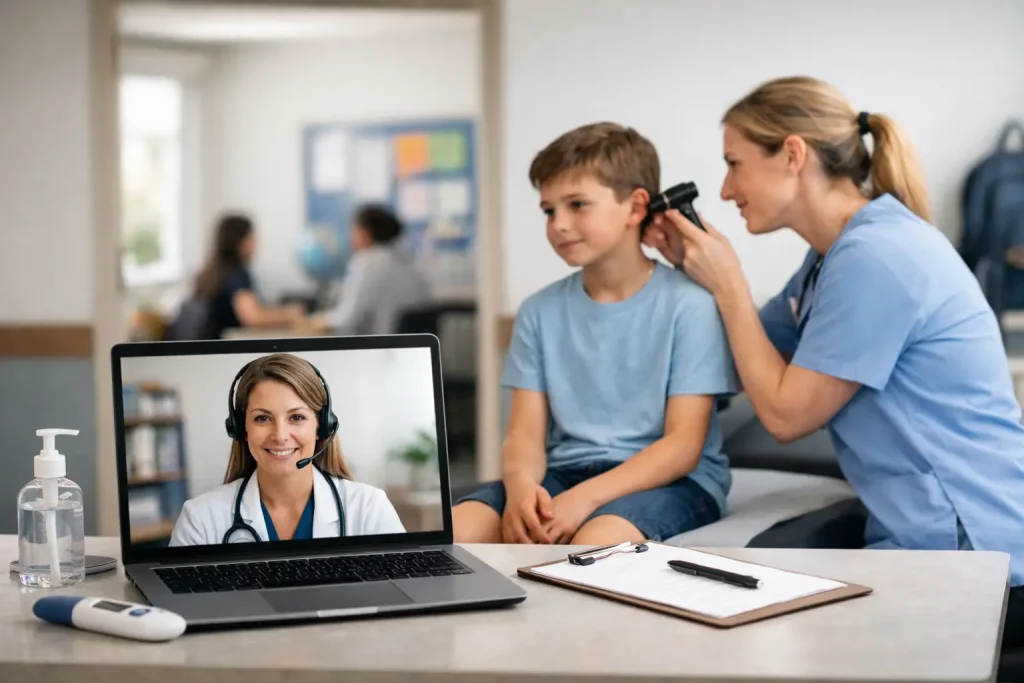
A student with asthma begins wheezing during the school day. A child with complex medical needs needs a follow-up that would otherwise require a caregiver to miss work and drive hours to a specialty clinic. A school nurse is managing a growing number of health needs with limited time and no on-site physician. These are the practical access gaps that virtual care programs for school districts can address when they are designed around clinical workflows, family involvement, and clear provider accountability.
For districts, virtual care should not be treated as a video visit added to the nurse’s office. The strongest programs connect students, caregivers, school health personnel, and licensed clinicians through a defined model of care. They bring clinically relevant information to the remote provider, clarify what happens before and after a visit, and create a sustainable path for services that students need repeatedly.
Why School-Based Virtual Care Has a Distinct Role
Schools are not hospitals, and they should not be asked to become one. Their role is to provide a safe, familiar setting where students can access appropriate support during the day while educators remain focused on learning. A virtual care program works best when a healthcare organization retains clinical responsibility and the district provides an agreed-upon access point, operational support, and communication pathway.
This distinction matters particularly in rural communities and areas with limited pediatric capacity. A family may face long drives, scarce appointment availability, unreliable transportation, or the loss of wages associated with taking time away from work. A school-based virtual encounter can reduce some of those burdens for appropriate conditions, especially follow-up care, chronic disease management, preventive conversations, and non-emergent concerns.
The benefit is not simply convenience. Earlier assessment can help a clinician determine whether a student can return to class, needs a same-day in-person appointment, requires medication follow-up, or should be referred for a higher level of care. That decision is stronger when the clinician can see and hear the patient and, when clinically indicated, review real-time physical assessment data rather than relying on a basic video connection alone.
What Effective Virtual Care Programs for School Districts Include
A district should begin with the care model, not the technology purchase. The first question is which clinical partner will provide services and for which student populations. A pediatric practice, community health center, federally qualified health center, rural health clinic, or health system may each have different capabilities, licensure structures, referral relationships, and reimbursement approaches.
The clinical partner should define eligible visit types, escalation criteria, documentation standards, hours of coverage, and follow-up responsibility. The school team should define the room, staffing expectations, student release process, caregiver communication process, and procedures for protecting privacy. These details prevent a well-intended program from becoming an added burden on school nurses and front-office staff.
A remote visit needs more than a camera
For many concerns, a video conversation can be useful. Yet school-based programs often serve students who need a more complete assessment before a clinician can make a confident decision. Connected examination tools can enable a remote provider to assess findings such as temperature, heart and lung sounds, ear and throat images, pulse oximetry, or other relevant data based on the presenting concern and clinical protocol.
This is where a device-enabled model can change the quality of a virtual encounter. The Dr. Miltie N9+ supports clinician-directed virtual examinations and patient monitoring, helping care teams gather actionable information while the student remains in a familiar setting. The value is not in collecting more data for its own sake. It is in giving the clinician the right information to determine the appropriate next step.
A dependable workflow for families and school teams
A practical workflow begins when a student presents with a health concern or is scheduled for a planned visit. Trained school personnel follow the agreed protocol, confirm consent and eligibility, notify the caregiver when required, and connect the student with the clinical team. The provider assesses the student, documents the encounter in the appropriate clinical record, and communicates the care plan to the caregiver and authorized school personnel.
The process must also state what happens when virtual care is not appropriate. Red-flag symptoms, acute emergencies, safeguarding concerns, and cases requiring hands-on care should trigger established school emergency procedures and referral pathways. Virtual care is a clinical access tool, not a substitute for emergency response or necessary in-person evaluation.
Pediatric Care Requires a Family-Centered Design
Children are not simply smaller adult patients, and school-based care cannot assume that a caregiver is available at every moment. Programs need an explicit consent model, a plan for caregiver participation, and clear boundaries around what information can be shared with the school. Depending on the student and the encounter, a caregiver may join by phone or video, participate before or after the visit, or receive a clinician follow-up call.
This approach is especially meaningful for autistic children and students with special healthcare needs. A clinic visit can involve sensory stress, transportation challenges, unfamiliar routines, and long waits. Care delivered at school may reduce some of those barriers when the student is supported by trusted staff and the care pathway has been tailored to the child’s communication, sensory, and clinical needs.
That does not mean every student will prefer a school-based visit. Privacy, comfort, developmental needs, and family preference all matter. Programs should offer options rather than treating the school setting as the default for every concern.
Compliance Is an Operational Requirement, Not a Final Checklist
School-based virtual care sits at the intersection of education and healthcare. That makes privacy, consent, data governance, and role clarity central to program design. Healthcare organizations must maintain HIPAA-compliant clinical processes, while districts must manage student information under applicable educational privacy requirements. The exact handling of records and communications depends on the relationship between the district and the clinical provider, the nature of the information, and applicable state and federal rules.
Before launch, partners should establish written procedures for consent, authorization, documentation, device access, user permissions, secure connectivity, and incident response. They should also determine where clinical documentation resides, how school health records are updated when appropriate, and how caregivers receive after-visit instructions.
Training deserves equal attention. Staff need to know how to prepare the student, use connected examination tools within their scope and training, protect confidentiality, recognize escalation triggers, and troubleshoot routine technical issues. A program that relies on one highly experienced nurse without cross-training is vulnerable from the start.
Build for Sustainability, Not a One-Time Pilot
Districts often begin with a pilot focused on a single school, grade range, or priority need. That can be a sensible approach if the pilot has clear measures and a path to scale. Metrics should go beyond visit volume. Partners may track time to clinical assessment, avoided travel, caregiver participation, referral completion, chronic care follow-up, absenteeism patterns, staff workload, patient experience, and clinical disposition.
Financial planning also needs to be addressed early. In many models, the healthcare provider bills for covered services when eligibility, documentation, and payer requirements are met. Other support may come through grants, community benefit investments, public health initiatives, or district-provider partnerships. CMS reimbursement considerations and state-specific payer policies can affect program design, so reimbursement specialists should be involved before workflows are finalized.
Technology alone cannot make a school program financially viable. Sustainability comes from aligning the service with a real access problem, using clinical staff efficiently, documenting care appropriately, and establishing a governance structure that can respond as needs change.
Start With the Students Who Face the Greatest Barriers
The most effective programs are not necessarily the ones with the largest launch announcement. They are the ones that identify a specific gap: students who repeatedly miss specialty follow-up, families traveling long distances for routine assessment, children with asthma or diabetes who need stronger care coordination, or communities where pediatric access is limited.
From there, the district and healthcare partner can build a measured pathway of care, test it with the people who will use it, and expand when the workflow proves useful. The goal is not to place healthcare technology in every school office. It is to bring timely, clinically appropriate care closer to students and families when distance, capacity, or circumstance has kept that care out of reach.
Move from information to action
See how the N9+ can fit your organization.
Explore the remote physical exam platform or request a focused demonstration.