
What remote patient monitoring means for heart failure

2016 research perspective: Remote monitoring showed potential benefits for some patients with heart failure.
February 10, 2016 by Jodi Askew
Editorial evidence update (November 3, 2026): This article presents a February 2016 perspective, not current clinical or reimbursement guidance. The 2015 Cochrane review found lower all-cause mortality and heart-failure-related hospitalizations in selected telemonitoring trials but no clear reduction in all-cause hospitalizations or consistent benefit in length of stay. A 2025 meta-analysis of randomized trials also found lower mortality and first heart-failure hospitalization risk, with substantial differences among program designs. These findings do not guarantee outcomes or savings for every patient or program. For current billing and payer rules, consult CMS remote patient monitoring guidance and the Center for Connected Health Policy state policy tracker.
Now more than ever, cardiovascular service line leaders are expressing interest in deploying telemonitoring technology to remotely manage their CV patients. Remote patient monitoring, or RPM, enables providers to virtually collect and transmit a patient’s data for the purposes of clinical assessment and care management. The health care IT community is largely in agreement about RPM’s potential to expand the geographic reach, clinical scope, and capacity for quality care—isn’t it about time our CV service line leaders joined the conversation?
We say “yes.” Just last year, our Health Care IT Advisor research team suggested that providers should deploy RPM for chronic disease patients. This has become more important in the last year, with mounting pressure from CMS and private payers to expand the timeframe for long-term accountable care management in the CV service line and escalating penalties associated with excess readmissions.
With this in mind, we examined the recent literature on the clinical and financial impacts of RPM for heart failure (HF) patients in five high-impact areas—length of stay, mortality, readmissions, cost effectiveness, and reimbursement—and have reported our most interesting findings below.
Length of stay
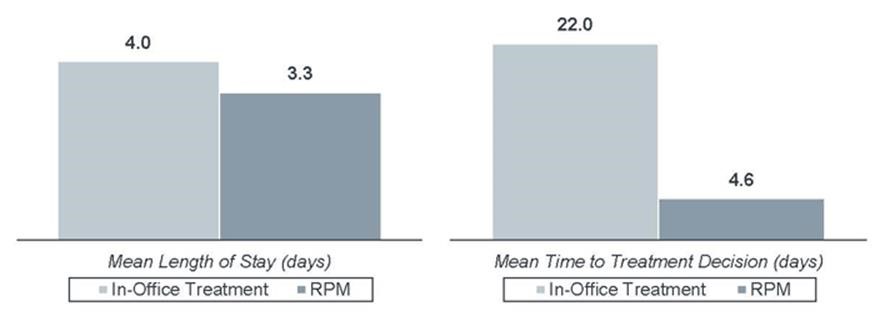
Early reports suggested that RPM might shorten some hospital stays, but results were not consistent across trials. The 2015 Cochrane review found that only one of nine telemonitoring studies reporting length of stay demonstrated a statistically significant reduction. This result should not be generalized to every heart-failure monitoring program.
Mortality
With an ever-growing focus on quality metrics, hospitals are increasingly accountable for patient outcomes—and now, there’s significant evidence that RPM can improve one key measure: mortality. A 2015 meta-analysis of 30 randomized controlled trials involving 10,193 participants found that telemonitoring was associated with 47% lower odds of death than usual care (odds ratio 0.53; 95% credible interval 0.36 to 0.80). A 2015 Cochrane systematic review, which included 18 studies evaluating telemonitoring, reported a 20% lower relative risk of all-cause mortality versus usual care (risk ratio 0.80; 95% confidence interval 0.68 to 0.94).
Readmissions
Some heart-failure telemonitoring programs reported fewer heart-failure-related admissions, but effects vary by program and measured outcome. Those findings do not establish that RPM will prevent readmissions or avert financial penalties for every hospital. A study of Geisinger Health Plan’s telemonitoring program, which began in 2008, found that enrolled Medicare Advantage members had 23% lower odds of all-cause hospital admission, 44% lower odds of 30-day readmission, and 38% lower odds of 90-day readmission during enrollment (odds ratios: 0.77, 0.56, and 0.62). The 2015 meta-analysis of thirty randomized trials further underscored the power of RPM to reduce readmissions, finding that telemonitoring was associated with 36% lower odds of heart failure-related hospitalization (odds ratio 0.64; 95% credible interval 0.39 to 0.95) compared with usual care.
Cost effectiveness
You may now be wondering—what about the money? A published evaluation of Geisinger Health Plan’s telemonitoring program reported an estimated return on investment of 3.3 for that program. A separate early model projected savings of $5,034 per cardiac patient annually. Those figures are program-specific or modeled historical estimates, not demonstrated savings that can be assumed for other providers or patients.
Reimbursement
In 2016, broader reimbursement for telehealth and RPM was still an emerging policy question. The following discussion reflects that period, not a current coverage determination; Medicare and other payers have since developed service-specific billing requirements.
RPM typically involves connected devices collecting and transmitting physiologic data for clinical review rather than a live video visit. It has distinct Medicare billing requirements, and coverage also depends on the payer and service. The earlier discussion of accountable care organizations and state-level reimbursement was specific to 2016; see CMS guidance for current Medicare information.
The 2016 claim that fifteen states reimbursed RPM was a historical snapshot and should not be used to determine current coverage. State Medicaid and commercial insurance requirements vary; the Center for Connected Health Policy’s state RPM tracker provides a more recent, state-by-state starting point. Readers should confirm individual payer rules before relying on reimbursement assumptions.
Move from information to action
See how the N9+ can fit your organization.
Explore the remote physical exam platform or request a focused demonstration.