Healthcare Access Solutions for Rural America
Healthcare access solutions for rural America help care teams extend virtual exams, monitoring, and follow-up while reducing distance and disruption today.
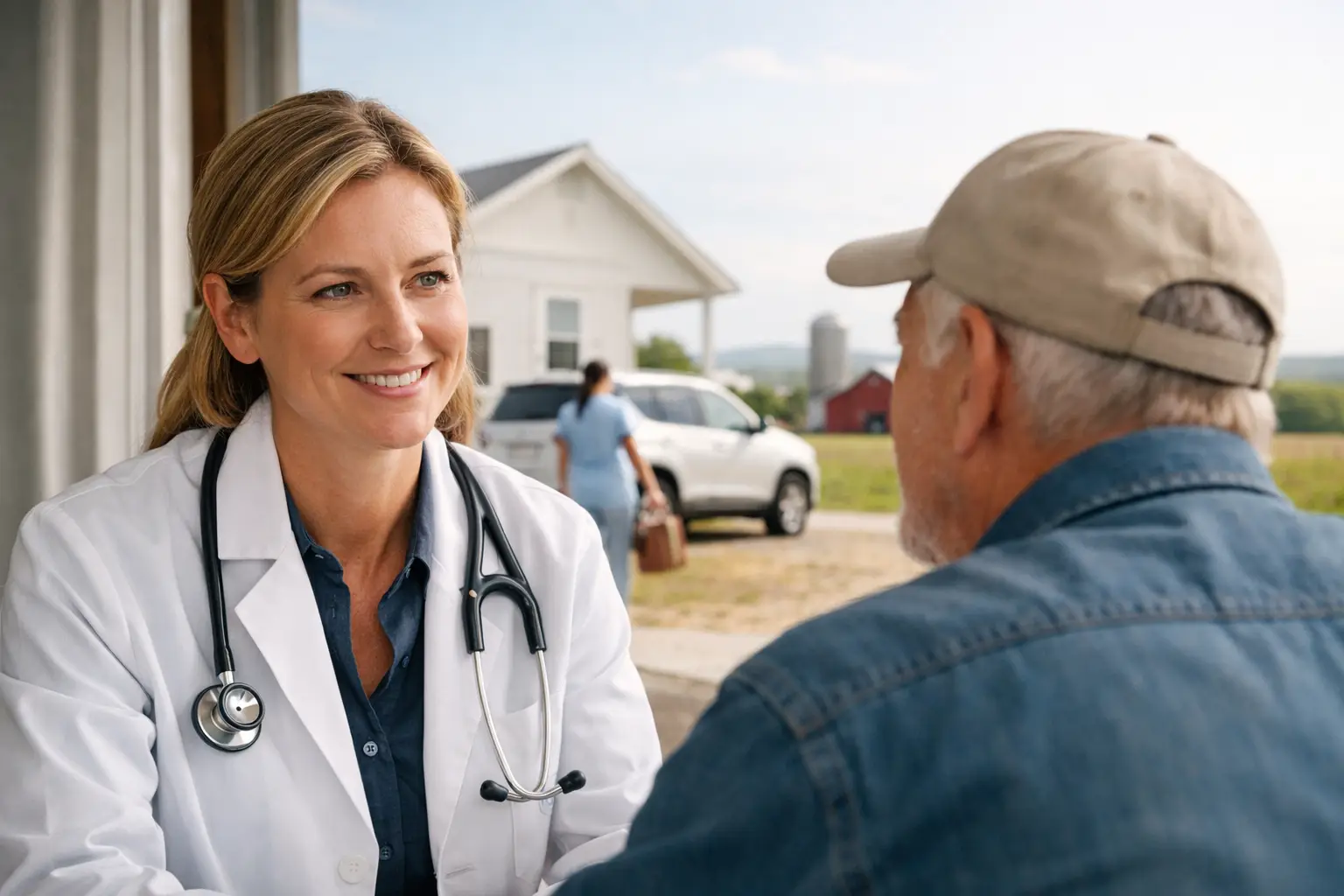
For a family in a remote county, a routine follow-up can mean taking unpaid time off, arranging childcare, and driving several hours to reach the nearest specialist or clinic. For rural providers, that same appointment can mean limited exam-room capacity, clinician shortages, and a difficult choice between referring a patient elsewhere or delaying care. Healthcare access solutions for rural America must address both sides of that equation: bringing clinically meaningful care closer to patients while helping local organizations use their workforce and resources more effectively.
Video visits alone can reduce travel, but they do not always give a clinician the information needed to make a confident decision. Rural access improves most when virtual care is designed as a connected clinical model, with virtual physical exams, remote patient monitoring, care coordination, and caregiver participation working together.
Why Rural Access Is a Clinical and Operational Challenge
Distance is only one barrier. Rural health clinics, critical access hospitals, federally qualified health centers, and community health centers often manage broad patient needs with fewer specialists, smaller care teams, and less redundancy when a clinician is unavailable. Patients may also face unreliable transportation, limited broadband, cost concerns, language barriers, or a lack of local services for behavioral health, pediatrics, and chronic disease management.
These pressures affect continuity. A child with asthma may miss a follow-up because the pediatric specialist is hours away. An older adult with heart failure may wait until symptoms become severe because an in-person check feels difficult to arrange. A patient discharged from a hospital may struggle to receive timely post-discharge monitoring. The result can be missed preventive care, delayed intervention, unnecessary emergency department utilization, and more burden on caregivers.
The answer is not to replace every in-person encounter. Some conditions require hands-on examination, diagnostic imaging, procedures, or immediate escalation. The practical goal is to determine which encounters can be safely supported beyond the traditional exam room and to give clinicians the data, workflows, and escalation pathways to act appropriately.
Healthcare Access Solutions for Rural America Need More Than Video
A connected-care strategy begins with a simple clinical question: what information does the provider need to assess this patient remotely? For many common use cases, a video conversation provides context but not enough objective data. Clinicians may need vital signs, heart and lung sounds, images of the ear or throat, pulse oximetry, or other clinically relevant findings to guide treatment and decide whether an in-person visit is necessary.
Device-enabled virtual examination expands what can happen during a remote encounter. A trained staff member, caregiver, school health professional, or patient support person can help capture data under clinician direction, depending on the care setting and workflow. This approach can support timely triage, follow-up, and care planning while keeping the local care team connected to the patient.
Remote patient monitoring adds another layer for patients who need observation between visits. Chronic conditions do not follow office schedules. Monitoring programs can help care teams identify concerning trends, reinforce treatment plans, and engage patients before a manageable issue becomes a crisis. Yet monitoring should never become a stream of unmanaged data. Programs need defined clinical protocols, appropriate staffing, patient education, documentation processes, and clear rules for when to contact the patient or escalate care.
A technology platform is valuable only when it fits the organization’s clinical model. Rural organizations should prioritize tools that support actionable assessments, integrate with care coordination processes, and allow pathways to be tailored by population, condition, and setting.
Pediatric Care Benefits From Familiar Settings
Pediatric access illustrates why location matters. A child may be more comfortable participating in an examination from home, school, a pediatric practice, or a community clinic than from an unfamiliar specialty office far from home. This can be especially meaningful for autistic children and pediatric patients with special healthcare needs, for whom travel, waiting rooms, and unfamiliar environments may create significant stress.
Care delivered closer to the child can also improve caregiver participation. Parents and guardians are often the people who observe symptom changes, manage medications, and coordinate appointments. When they can join a clinician-directed virtual visit without losing an entire day to travel, the conversation may be more complete and follow-up instructions more feasible.
This does not mean every pediatric visit is appropriate for virtual delivery. New or severe symptoms, a need for procedures, or findings that cannot be adequately assessed remotely should lead to in-person evaluation. The advantage is that a well-equipped virtual encounter can help a clinician make that determination sooner, with more information than a basic video call provides.
Build a Rural Care Model Around Workflows, Not Devices
Successful deployment requires operational discipline. Organizations often begin with the technology question, but the more useful starting point is the care pathway. Which patients have the greatest travel burden? Which referrals create the longest delays? Where are clinicians making decisions with incomplete information? Which post-discharge or chronic care populations need more consistent touchpoints?
From there, leaders can define who initiates visits, who assists the patient, which data are collected, where results are documented, and how a remote clinician communicates recommendations back to the local team. The workflow may look different in a school-based program than in a rural clinic or critical access hospital. Flexibility is a requirement, not a bonus.
Training deserves the same attention as hardware and software. Staff and caregivers need confidence using connected examination tools, preparing patients, troubleshooting basic issues, and knowing when a technical limitation affects clinical quality. Clinicians need protocols that clarify the boundaries of virtual assessment. Clear responsibilities reduce friction and help prevent virtual care from becoming an added burden on already stretched teams.
Connectivity remains a real constraint in some communities. Programs should account for varying bandwidth, cellular coverage, device availability, and digital literacy. A solution that performs well in a central office but fails in a patient’s home is not an access solution. Care models should include practical alternatives, such as community-based access points, assisted encounters, and asynchronous outreach when clinically appropriate.
Make Financial Sustainability Part of the Design
Rural virtual care programs need a financial model as well as a clinical rationale. Reimbursement rules vary by service, payer, patient location, provider type, and the documentation supporting the encounter. CMS reimbursement pathways for remote patient monitoring, chronic care management, and certain telehealth services can support eligible programs, but organizations should evaluate requirements carefully rather than assuming every virtual interaction is billable.
A reimbursement-aware deployment considers consent, time tracking where applicable, documentation, eligible practitioners, device requirements, and supervision or staffing rules. It also considers value that may not appear directly on a claim: reduced patient travel, improved appointment adherence, better care transitions, expanded specialist reach, and fewer avoidable escalations.
For safety-net and rural organizations, grants and rural health transformation initiatives can help launch new care capabilities. Long-term sustainability, however, depends on embedding those capabilities into daily operations. The strongest programs measure both clinical and operational outcomes, including completed follow-ups, time to specialist input, patient experience, staff workload, monitoring adherence, and avoidable utilization.
A Connected Circle of Care
Rural access is strongest when the patient is not left to navigate the system alone. The Circle of Care™ model recognizes that effective care can involve the remote clinician, local provider, nurse, care coordinator, caregiver, school personnel, and community-based support team. Each participant needs appropriate access to information and a clear role in the care plan.
Dr. Miltie supports this model with the N9+, a mobile wireless virtual examination and patient monitoring system designed to help organizations conduct clinician-directed remote assessments and extend care beyond conventional settings. The value is not simply a connected device. It is the ability to create customized pathways that bring examination data, monitoring, patient engagement, and care coordination into a practical program for rural and community-based care.
Leaders evaluating a solution should ask whether it can support the populations they actually serve, whether it gives clinicians clinically useful information, and whether it can be implemented without creating parallel workflows that staff cannot sustain. Security, privacy, HIPAA-aligned practices, integration needs, training, and reimbursement readiness should be part of that evaluation from the beginning.
The future of rural care does not depend on making every patient interaction virtual. It depends on making distance less decisive. When clinicians can see, hear, assess, monitor, and coordinate care in the settings where patients live and learn, rural communities gain more than convenience: they gain a more responsive path to care when it matters.
Move from information to action
See how the N9+ can fit your organization.
Explore the remote physical exam platform or request a focused demonstration.