
Virtual Examinations for Mobile Healthcare Programs
Virtual examinations for mobile healthcare programs help care teams extend clinical reach, capture exam data, and support connected care pathways safely.
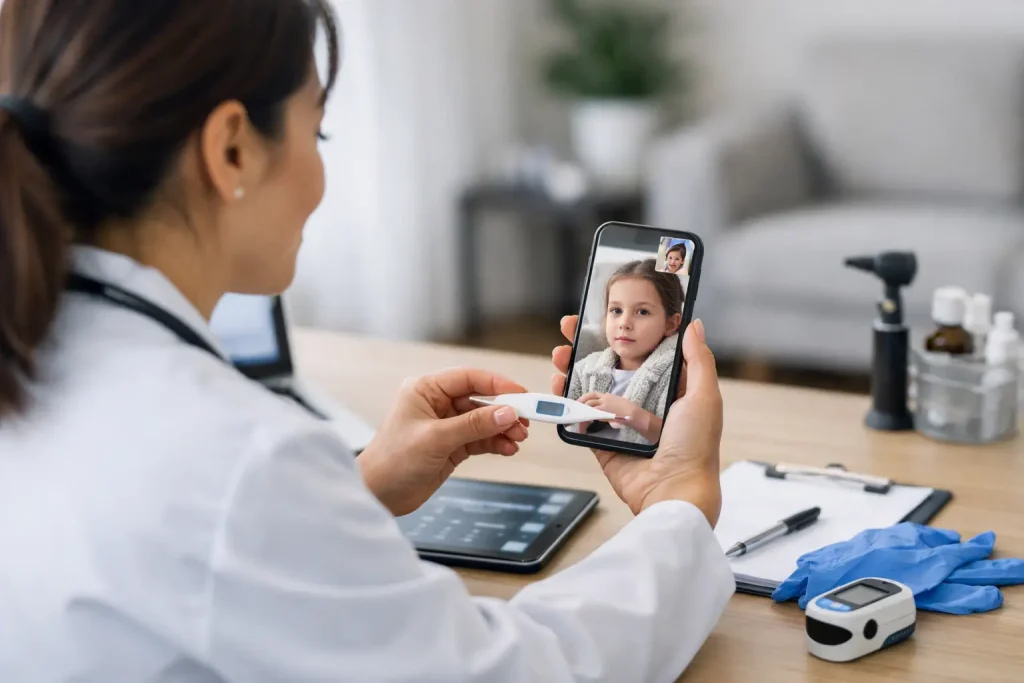
A video visit can establish connection, review symptoms, and guide a care plan. It cannot, by itself, provide the clinical information a provider needs to assess the ears of a child with recurring pain, listen to lung sounds for a patient with asthma, or evaluate changes in a chronic condition. Virtual examinations for mobile healthcare programs close that gap by bringing clinician-directed assessment tools and actionable patient data to where care is needed.
For health systems, rural health clinics, federally qualified health centers, pediatric practices, and community-based organizations, this is a practical shift in care delivery. The goal is not to replace every in-person encounter. It is to make appropriate examinations possible beyond the traditional exam room while preserving clinical judgment, care-team accountability, and continuity of care.
Why a Video Visit Alone Is Not a Virtual Exam
Traditional telehealth is valuable for consultations, medication follow-up, behavioral health, care coordination, and many routine questions. Yet clinicians often face a familiar limitation: the patient is visible, but the clinical assessment remains incomplete. When a provider cannot obtain relevant physical findings, the visit may lead to uncertainty, an unnecessary referral, delayed treatment, or a trip to an emergency department that could have been avoided.
A device-enabled virtual exam expands what can be assessed during a remote encounter. Depending on the care pathway and available tools, a trained caregiver, medical assistant, school nurse, community health worker, or other support person can help capture data such as vital signs, heart and lung sounds, images of the ear, throat, or skin, and other clinically relevant findings. The remote clinician directs the exam, interprets the information, and determines the next appropriate step.
That distinction matters. The technology does not make a remote encounter clinically equivalent to every in-person visit. Instead, it gives organizations a more useful middle ground between a video-only interaction and sending every patient to a brick-and-mortar site.
Where Mobile Healthcare Programs Benefit Most
Mobile care models serve populations for whom access is often shaped by distance, transportation, caregiver availability, staffing shortages, and comfort with clinical environments. A virtual examination capability can support care delivery in homes, schools, community clinics, long-term care settings, and partner locations.
Pediatric Care in Familiar Environments
For children, especially autistic children and pediatric patients with special healthcare needs, a familiar setting can change the quality of an encounter. Travel, waiting rooms, unfamiliar clinicians, sensory stimulation, and disrupted routines can make an in-person visit difficult for both the child and caregiver.
A clinician-directed exam conducted at home, at school, or in a pediatric practice can reduce those barriers when clinically appropriate. Caregivers can participate directly, provide context about symptoms and behavior, and help the child feel secure. The care team gains an opportunity to observe the child in an environment that may better reflect daily functioning.
This approach requires thoughtful workflow design. Not every child will tolerate every exam component, and a caregiver should never be expected to perform beyond their training or comfort level. Programs work best when they define clear protocols, provide coaching, and establish escalation paths for situations that require in-person assessment.
Rural and Community-Based Access
In rural communities, the nearest specialist, hospital, or pediatric office may be hours away. For critical access hospitals, rural health clinics, and community health centers, virtual exams can help extend scarce clinical resources across a wider service area.
The immediate benefit is often reduced travel. The longer-term benefit is stronger continuity. A local support person can facilitate the visit while a physician, advanced practice provider, or specialist participates remotely. Findings can be documented within the organization’s care process, follow-up can be scheduled promptly, and families can avoid navigating disconnected sites of care for issues that can be safely addressed locally.
For safety-net organizations, the model can also help preserve appointment capacity. When clinical teams have access to better remote assessment data, they can prioritize in-person slots for patients who truly need them.
What Makes Virtual Examinations for Mobile Healthcare Programs Work
A successful program is not defined by a device alone. It depends on the alignment of technology, people, workflows, governance, and financial planning. Organizations should begin with the care problems they are trying to solve rather than selecting tools first.
For example, a pediatric network may focus on acute symptom triage, asthma follow-up, and post-discharge monitoring. A rural organization may prioritize chronic disease management, specialty access, and school-based care. Each use case requires a defined clinical pathway: who initiates the encounter, what information is collected, which clinician reviews it, how decisions are documented, and when the patient is escalated to in-person or emergency care.
The most effective programs build those decisions into operations before broad deployment. That includes defining patient eligibility, consent procedures, device cleaning and inventory processes, training expectations, technical support, and communication standards between on-site and remote staff.
Clinician Direction and Data Quality
Remote physical assessment should remain clinician-directed. The clinician determines which findings are needed, guides the support person through the process, and applies professional judgment to the information received. This protects the integrity of the encounter while helping non-clinical or allied personnel contribute within appropriate roles.
Data quality deserves equal attention. A high-resolution image is only useful when captured correctly. Lung sounds must be collected in the right location and with enough clarity for clinical interpretation. Vital signs should follow validated processes and be reviewed in context, not treated as isolated numbers.
Training therefore cannot be a one-time product demonstration. Teams need role-based instruction, competency validation, refreshers, and practical guidance for common issues such as poor connectivity, anxious patients, incomplete readings, or equipment handling. Program leaders should also monitor utilization and clinical outcomes to identify where workflow adjustments are needed.
Technology That Fits the Care Model
Mobile programs need equipment that can travel, withstand frequent use, and support a consistent experience across varied settings. They also need a connected platform that helps coordinate encounters, route information to the appropriate clinician, and support documentation without creating a parallel administrative burden.
The Dr. Miltie N9+ is designed to support this kind of clinician-directed virtual examination and patient monitoring model, helping organizations bring connected assessment capabilities into distributed care settings. Its value is best understood as part of a broader care-delivery strategy, not as a stand-alone device deployment.
Integration expectations vary by organization. Some programs need close alignment with existing clinical documentation and scheduling processes; others begin with a focused pilot that proves workflow and patient acceptance before expanding. Either path can be effective, provided leadership is clear about ownership, measures of success, and the operational resources required to sustain the service.
Building a Reimbursement-Aware Program
Financial sustainability should be addressed at program design, not after launch. Reimbursement for telehealth, remote patient monitoring, chronic care management, and related services depends on payer rules, patient eligibility, provider type, documentation, supervision requirements, and the specific service delivered. Requirements also change over time.
Organizations should involve compliance, billing, and revenue-cycle leaders early. Their role is to evaluate how the proposed workflow aligns with applicable CMS guidance, state requirements, commercial payer policies, and internal documentation standards. Clinical leaders should avoid designing care solely around billing codes, but a clinically sound program must still be operationally and financially viable.
A reimbursement-aware approach also means measuring value beyond claims. Reduced missed appointments, fewer avoidable transfers, faster treatment decisions, improved caregiver engagement, better chronic disease follow-up, and staff time saved through coordinated workflows can all inform the business case. The right metrics will depend on the population and care model.
Start With a Focused, Measurable Use Case
Large virtual care initiatives can lose momentum when they attempt to serve every population and condition at once. A focused launch gives teams the chance to validate clinical protocols, train staff, understand patient adoption, and refine the service before scaling.
An organization might begin with pediatric respiratory complaints in selected school-based settings, post-discharge follow-up for rural patients, or chronic condition check-ins for a defined population. The use case should have a clear clinical owner, a realistic volume estimate, and measurable outcomes. It should also include an explicit answer to a basic question: what happens when the virtual exam indicates that remote care is not enough?
That escalation plan is a sign of program maturity, not a limitation. Virtual examinations are most valuable when they help clinicians make better decisions about who can be treated and monitored remotely, who needs a timely in-person appointment, and who requires urgent intervention.
The future of mobile healthcare is not care at a distance for its own sake. It is care organized around the patient, supported by the right clinical information, and connected to the people responsible for acting on it. For organizations serving children, rural communities, and underserved populations, that can mean bringing a more complete clinical encounter closer to home.
Move from information to action
See how the N9+ can fit your organization.
Explore the remote physical exam platform or request a focused demonstration.