
Digital Transformation in Rural Healthcare
Digital transformation in rural healthcare helps care teams extend access through virtual exams, remote monitoring, and patient-centered connected care.
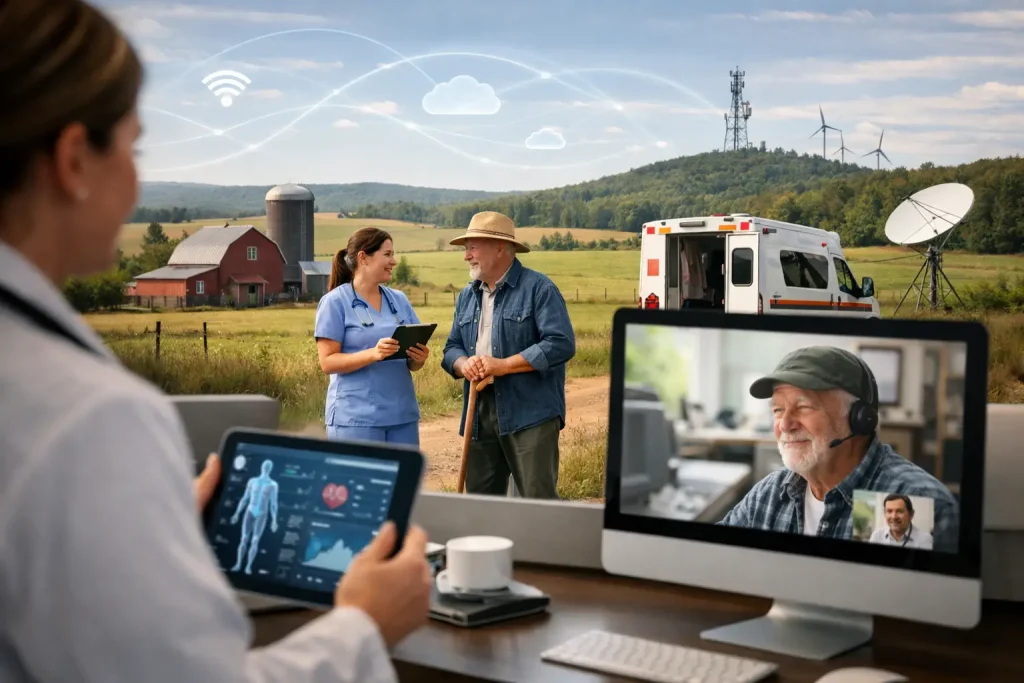
A patient with worsening heart failure should not have to choose between a three-hour drive and waiting for symptoms to become an emergency. Yet that is still the practical reality for many rural families. Digital transformation in rural healthcare changes the care model when it gives local teams, patients, and caregivers clinically useful ways to assess, monitor, and coordinate care closer to home.
For rural health clinics, critical access hospitals, federally qualified health centers, and community-based organizations, the goal is not simply to add a video visit. It is to create a dependable care pathway that connects remote clinical assessment, patient data, follow-up, documentation, reimbursement, and escalation when an in-person encounter is necessary. Technology matters only when it improves the work of care delivery.
Why Digital Transformation in Rural Healthcare Is Different
Rural care organizations operate with constraints that urban systems may not fully experience: persistent workforce shortages, long travel distances, limited specialty access, broadband variability, and patients who may face transportation, work, or caregiving barriers. A virtual care strategy that assumes every encounter can happen over a smartphone connection will leave too many patients behind.
That is why rural transformation requires more than a telehealth platform. It requires a clinical operating model. The model should account for who initiates the encounter, what information the clinician needs, where the patient is located, how the findings enter the record, and what happens next if a concern is identified.
A basic video connection can support conversation, education, behavioral health, and certain follow-up needs. But it has limits when a provider needs clinically relevant information beyond what a camera can show. Remote physical assessment tools and connected devices can help extend the clinician’s ability to evaluate vital signs and other patient data in homes, schools, community clinics, long-term care settings, and rural satellite locations.
The distinction is meaningful. Digital care should not ask clinicians to accept less information than a clinical decision requires. It should help them obtain the right information in the right setting, then act on it through a defined workflow.
Build Care Pathways Before Buying Technology
Healthcare leaders often begin with features: video quality, device inventory, dashboards, or integrations. Those considerations matter, but implementation is stronger when the organization starts with the patient populations and use cases that create the clearest clinical and operational value.
For one organization, that may mean post-discharge monitoring for patients with chronic obstructive pulmonary disease or heart failure. For another, it may be pediatric follow-up for children whose families struggle to travel to specialty appointments. A rural clinic may focus first on extending provider coverage to schools or community access points. Each pathway needs its own clinical criteria, staffing plan, escalation protocol, and documentation process.
A useful design question is: what can be safely and effectively done closer to the patient when the clinician has access to virtual examination capabilities and timely patient data? The answer will vary by population, acuity, staffing model, and local resources. Virtual care is not a replacement for every in-person visit. It is a way to reserve in-person capacity for the moments when it adds the greatest value.
Identify the moments where distance causes harm
Travel burden is not only an inconvenience. It can delay follow-up, reduce caregiver participation, interrupt school or work, and contribute to missed care. In pediatrics, the burden may be especially high for families supporting autistic children or children with special healthcare needs. A familiar environment can lower stress, while a caregiver can participate more fully in the encounter.
The best early use cases are often those where distance clearly affects access and where the care team can define measurable outcomes. These may include fewer missed appointments, faster post-discharge follow-up, improved chronic disease monitoring, shorter time to specialty input, or reduced avoidable transfers. Organizations should establish those measures before launch, not after.
Make Virtual Exams Clinically Actionable
A remote encounter becomes more valuable when it produces information a clinician can use with confidence. That is where connected examination and monitoring tools can support a more complete virtual visit. Depending on the clinical workflow, teams may capture vital signs and other relevant findings while the remote clinician guides the assessment.
The technology itself is only one part of the encounter. Staff, caregivers, or patients need clear instructions, and clinicians need confidence in how the data is captured, reviewed, documented, and escalated. Training should include both technical use and clinical workflow: when to repeat a reading, when to convert to an in-person assessment, and when to activate emergency services.
This approach can be particularly valuable when a local nurse, medical assistant, school health professional, or community health worker is available to support the patient. It enables a distributed care team rather than placing the entire burden on the patient or family. Still, organizations should avoid designing programs that depend on support personnel who are not consistently available. The right model depends on local staffing realities.
Connect Remote Monitoring to Real Clinical Response
Remote patient monitoring can create continuity between scheduled encounters, especially for people managing chronic conditions. But monitoring without a response plan can generate data without improving care. Patients and caregivers need to know what to do, and care teams need defined responsibilities for reviewing readings, contacting patients, documenting interventions, and escalating concerns.
A sustainable program identifies who owns each part of the workflow. Clinical leadership sets eligibility and escalation standards. Operations teams coordinate enrollment, logistics, and follow-up. Revenue cycle and compliance teams help align documentation and billing practices with applicable CMS, payer, and organizational requirements. IT and security teams support HIPAA-compliant implementation, user access, device management, and data governance.
This cross-functional design is not administrative overhead. It is the difference between a pilot that depends on a few enthusiastic individuals and a program that can scale across service lines and locations.
Design for caregivers, not just patients
Rural care often relies on informal caregiving networks. A spouse may help an older adult take a reading. A parent may assist during a pediatric virtual exam. A school staff member may help coordinate a visit during the day. These participants need simple, role-appropriate guidance and a clear understanding of privacy boundaries.
Caregiver involvement can improve adherence and provide clinicians with context that is difficult to capture in a brief office encounter. It can also create friction if the process is complicated or requires families to manage multiple apps, passwords, devices, and appointments. Programs should reduce that burden wherever possible.
Prepare for the Infrastructure You Actually Have
Broadband limitations remain a practical issue in many rural communities. Organizations should assess connectivity conditions in the places where care will occur, including patient homes, schools, community sites, and mobile care settings. A strategy built solely around ideal connectivity can fail at the point of care.
Planning should include backup procedures for interrupted visits, device charging and storage, technical support, and alternatives for patients with limited digital literacy. It should also account for language access, accessibility needs, and the reality that some patients prefer in-person care. Equity means providing meaningful options, not forcing every patient into a digital channel.
Interoperability deserves equal attention. Data should reach the clinician who needs it without creating duplicate documentation or separate work queues that staff cannot maintain. The ideal integration depth depends on the organization, but every deployment should establish a reliable process for documenting remote findings and closing the loop on follow-up.
Measure Value Beyond Visit Volume
Virtual visit counts can show adoption, but they do not show whether a rural transformation effort is working. Leaders should evaluate access, quality, experience, workforce impact, and financial sustainability together.
Access measures may include completed appointments, time to follow-up, travel avoided, and specialty reach. Clinical measures should reflect the selected use case, such as adherence to monitoring plans, control of chronic conditions, or timely intervention after concerning readings. Operational measures can include staff time, no-show rates, avoidable transfers, and referral completion. Financial evaluation should consider eligible reimbursement pathways alongside total program costs, including training, support, device logistics, and clinical staffing.
Dr. Miltie’s connected-care approach, including the Dr. Miltie N9+ and Circle of Care™ model, is designed around this broader need: helping organizations bring clinician-directed virtual exams, remote monitoring, and coordinated follow-up into practical care pathways rather than treating them as disconnected technologies.
Start Small Enough to Learn, Then Scale With Intent
The strongest rural transformation programs rarely launch everywhere at once. They begin with a defined population, a committed clinical champion, measurable objectives, and an implementation plan that includes frontline feedback. Early learning should shape the next phase, whether that means refining eligibility, adjusting staffing, improving patient onboarding, or expanding to another location.
The question is not whether rural care should become more digital. It already is. The more consequential question is whether each new capability will make care more clinically connected, more equitable, and easier for patients and care teams to use. When technology is designed around those outcomes, distance becomes less of a barrier and rural communities gain a more durable path to timely, patient-centered care.
Move from information to action
See how the N9+ can fit your organization.
Explore the remote physical exam platform or request a focused demonstration.