
Comparing Dr. Miltie N9+ vs. Zoom for Healthcare
Compare Dr. Miltie N9+ vs. Zoom for healthcare: see how virtual exams, clinical data, remote monitoring, and workflows differ for care teams and patients.
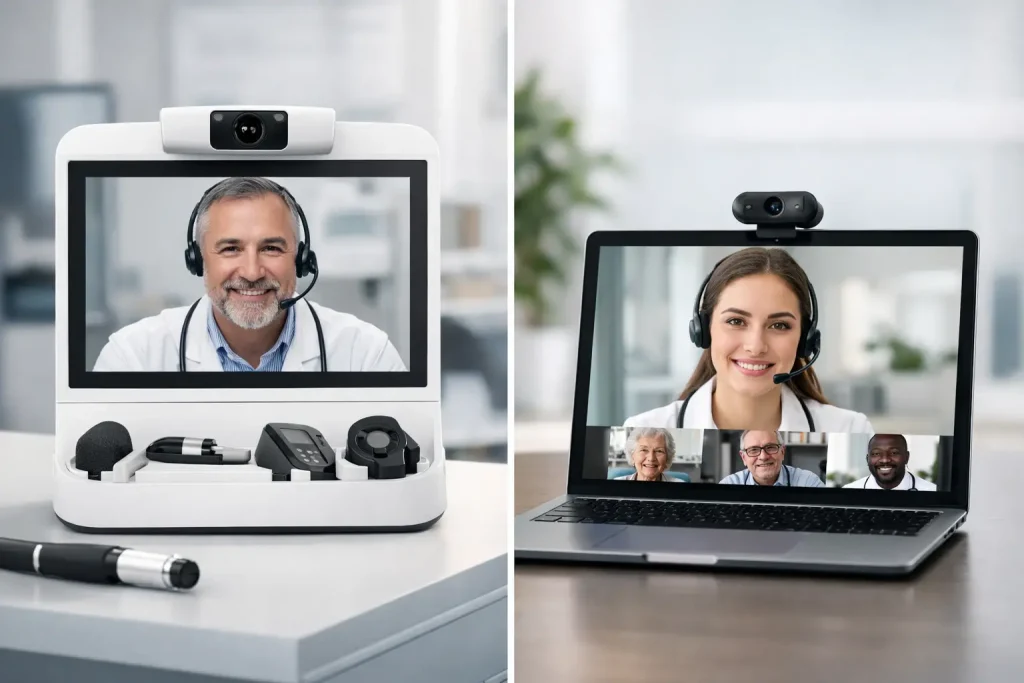
A video visit can solve the problem of distance, but it does not always solve the problem of clinical visibility. In a comparison of Dr. Miltie N9+ vs. Zoom for healthcare, that distinction matters most. Both can support virtual care strategies, yet they serve fundamentally different roles: one is built around video communication, while the other is designed to help clinicians conduct device-enabled virtual physical exams and collect actionable patient data beyond the exam room.
For health systems, pediatric practices, rural health clinics, federally qualified health centers, and community-based programs, the right question is not simply, “Which platform has video?” It is, “What level of clinical assessment does this patient population, care model, and workforce require?”
Dr. Miltie N9+ vs. Zoom for Healthcare: The Core Difference
Zoom for Healthcare is primarily a communications platform. It gives clinicians, patients, caregivers, and interdisciplinary teams a way to connect by secure video and audio when deployed with the appropriate healthcare agreements, configurations, and organizational policies. It can be an effective tool for follow-up conversations, behavioral health visits, care coordination, patient education, discharge planning, and consultations where visual observation and discussion are sufficient.
The Dr. Miltie N9+ is a mobile, wireless virtual examination and patient monitoring system. Its purpose is to extend a clinician-directed assessment into a patient’s home, school, community setting, rural clinic, or other distributed care location. Rather than relying on a camera conversation alone, the N9+ supports connected medical devices and clinically relevant data capture that can inform a more complete remote assessment.
That difference changes the care experience. A clinician using a video platform may be able to see that a child appears uncomfortable, hear a caregiver describe a cough, and discuss next steps. With a device-enabled virtual exam model, the care team may also be able to capture and review relevant examination findings and physiologic data based on the clinical pathway and available peripherals.
Neither approach replaces every in-person encounter. The decision depends on acuity, patient safety, diagnostic needs, local protocols, and clinician judgment. But organizations looking to move beyond video-only telehealth often need technology that supports more than conversation.
Video Visits Versus Virtual Physical Exams
The central operational question is whether the visit requires a remote physical assessment. Zoom for Healthcare can create a reliable meeting environment for a clinician and patient. It does not, by itself, turn a remote location into an examination setting. Clinical teams must determine what can be assessed visually, what patients or caregivers can report accurately, and when an in-person referral is necessary.
The Dr. Miltie N9+ is designed for workflows in which care teams need to bring connected examination capability closer to the patient. Depending on the configured care pathway, a trained caregiver, school nurse, medical assistant, community health worker, or other approved facilitator can help support a clinician-directed visit. This model can give the clinician access to information that is difficult to obtain from a standard video call alone.
This distinction has practical consequences for organizations serving patients who face transportation barriers. A rural patient may live hours from a specialty clinic. A medically complex child may find travel disruptive. An autistic child may tolerate an assessment better at home or in a familiar school environment, with a trusted caregiver present. In these settings, a virtual exam model can help reduce avoidable travel while preserving a clinically meaningful connection to the treating team.
Clinical Data, Monitoring, and Care Continuity
Video is valuable, but a longitudinal care program depends on more than a video feed. Chronic care management, remote patient monitoring, post-discharge follow-up, and preventive pediatric care all require a consistent way to collect, review, document, and act on patient information.
Zoom for Healthcare may fit well as one component of a broader digital health stack. It can support the conversation around patient data, and organizations may integrate it with other systems. The clinical data collection, device logistics, patient onboarding, escalation rules, and documentation workflows, however, generally require additional technology and operational design.
The Dr. Miltie N9+ is intended to support that connected-care layer. It combines virtual exam tools, patient monitoring capabilities, customized pathways of care, and care coordination functionality in a model designed for distributed service delivery. For healthcare leaders, this can reduce the fragmentation that occurs when video, devices, data review, scheduling, and care coordination are managed through separate processes.
The value is not in collecting more data for its own sake. It is in obtaining the right data for a defined clinical purpose, routing it to the appropriate care team, and establishing a clear response workflow. An elevated reading without an escalation process does not improve care. A virtual visit without a plan for follow-up may not improve continuity. Technology should reinforce clinical accountability rather than add another disconnected task to the day.
Pediatric and Caregiver-Centered Considerations
Pediatric telehealth is not adult telehealth in a smaller chair. Children often depend on caregivers to describe symptoms, operate technology, provide reassurance, and carry out follow-up instructions. The setting can influence whether a child participates successfully in the visit at all.
A video platform can be useful for counseling, behavioral health, medication follow-up, and conversations where the clinician mainly needs to observe and engage. It may also be the right choice when speed and simplicity are the priority. For some pediatric visits, that is enough.
When a child’s care requires more complete assessment, connected exam tools can change what is possible remotely. The Dr. Miltie N9+ supports clinician-directed care in settings familiar to the child, including homes, schools, pediatric practices, and community clinics. This can be particularly relevant for children with special healthcare needs and autistic children who may experience stress from unfamiliar environments, long waits, or extensive travel.
Caregiver participation is also more than a convenience. When a caregiver can join from the patient’s real environment, clinicians may gain a clearer understanding of symptoms, barriers to adherence, daily routines, and available support. The goal is not to transfer clinical responsibility to families. It is to create a care model that includes them appropriately and gives clinicians better context for decision-making.
Implementation and Reimbursement Are Part of the Decision
A common mistake is evaluating telehealth technology only through a feature checklist. Healthcare organizations also need to consider training, clinical governance, privacy and security practices, device management, workflow ownership, documentation, interoperability needs, and financial sustainability.
Zoom for Healthcare may be easier to deploy for organizations seeking a familiar video experience. That can make it a practical choice for virtual meetings or lower-complexity telehealth programs. Yet a simple launch does not automatically create a scalable clinical service. Teams still need policies for consent, visit types, staff workflows, technology support, and patient access.
A device-enabled care model requires more operational planning, particularly when devices are used across homes, schools, satellite sites, or community partners. The trade-off is greater clinical capability and a more structured foundation for remote monitoring and virtual examinations. Dr. Miltie supports organizations with workflow customization, training, and reimbursement-aware deployment so the model can align with clinical and operational realities.
For organizations evaluating CMS-aligned remote patient monitoring, chronic care management, or other virtual care services, reimbursement should be reviewed with compliance, billing, and legal teams before launch. Coverage rules, payer requirements, eligible services, documentation standards, and state-specific considerations can vary. Technology can enable the workflow, but it does not remove the need for disciplined program design.
Which Option Fits Your Care Model?
Zoom for Healthcare may be the appropriate choice when the care objective is primarily communication. Examples include care conferences, therapy sessions, behavioral health conversations, medication counseling, patient education, and follow-ups that do not require connected examination data. It can also serve organizations that already have separate tools for remote monitoring and virtual clinical assessment.
The Dr. Miltie N9+ may be a stronger fit when the organization needs to extend clinician-directed exams and monitoring into the places patients already are. This is especially relevant for rural care delivery, pediatric access programs, school-based services, safety-net organizations, post-acute follow-up, and chronic condition management where distance, workforce constraints, and patient mobility create persistent barriers.
Many organizations will not view this as an either-or technology decision. Video communication can remain an important part of a connected-care strategy. The more consequential choice is whether the program needs a video meeting tool or a clinical care-delivery model that can bring examination capability, patient data, coordination, and caregiver participation closer to the patient.
The strongest virtual care programs begin with the patient population and the clinical workflow, then select technology that can support both. When care teams can see, assess, monitor, and coordinate with greater confidence, distance becomes less of a barrier to delivering care that feels personal, practical, and clinically grounded.
Move from information to action
See how the N9+ can fit your organization.
Explore the remote physical exam platform or request a focused demonstration.