What Is Remote Patient Monitoring for Health Systems?
What is remote patient monitoring? Learn how connected devices, clinical workflows, and care teams extend support for chronic, pediatric, and rural care.
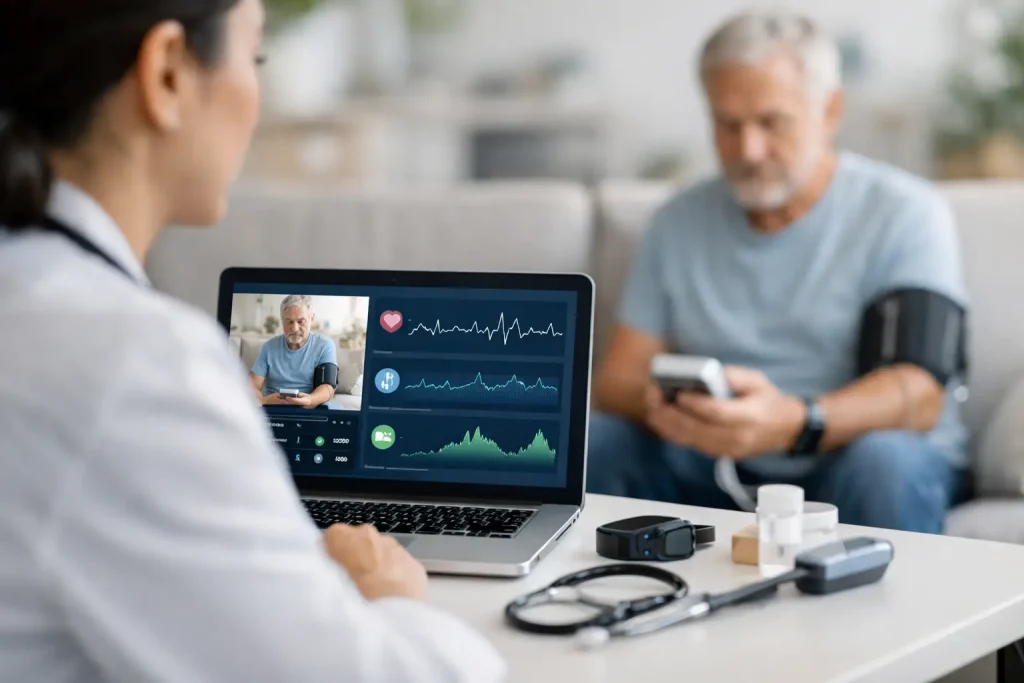
A child with asthma should not have to miss school, travel hours, and wait in an unfamiliar clinic simply to share symptom trends with a care team. A rural older adult managing heart failure should not need to wait for the next in-person appointment when weight or blood pressure changes may signal a problem. What is remote patient monitoring? It is a clinician-directed care model that uses connected devices, patient-reported information, and defined clinical workflows to help teams monitor relevant health data between visits.
Remote patient monitoring, often called RPM, is not simply a patient app or a device shipped to the home. It is an operating model for extending clinical observation beyond the exam room. When it is designed well, RPM gives care teams timely information, establishes clear escalation pathways, and gives patients and caregivers a more practical way to participate in ongoing care.
What Is Remote Patient Monitoring?
Remote patient monitoring is the collection and transmission of physiologic data from a patient in a nontraditional care setting to a clinical team for review and care management. Depending on the clinical pathway, that data may include blood pressure, weight, pulse oximetry, blood glucose, heart rate, temperature, or other relevant measures. Patients may collect the data at home, at school, in a community clinic, or another supported setting using connected medical devices.
The clinical value comes from what happens after a reading is captured. A care team needs protocols for reviewing data, identifying concerning trends, contacting the patient or caregiver, documenting the intervention, and coordinating follow-up. RPM therefore combines technology, clinical governance, patient education, and operational accountability.
A useful distinction is that RPM focuses on monitoring ongoing health information, while telehealth is a broader category that includes video visits, messaging, and other virtual services. The two often work together. A clinician may use RPM data to determine that a patient needs a telehealth visit, an in-person evaluation, medication adjustment, or urgent care.
How Remote Patient Monitoring Works in Practice
An RPM program starts with identifying patients whose conditions, barriers to access, and care goals make monitoring appropriate. Chronic disease management is a common use case, but it is not the only one. Pediatric follow-up, post-discharge monitoring, preventive care, and support for medically complex patients can all benefit when the pathway is clinically appropriate.
The organization then selects the measurements that matter. More data is not automatically better data. For a patient with hypertension, reliable blood pressure readings and a response plan may be more useful than an overly broad set of metrics. For a patient with heart failure, weight, blood pressure, symptoms, and timely clinician review may help the team recognize deterioration earlier.
Patients and caregivers receive devices, training, and clear instructions on when and how to take readings. Data flows to a platform where authorized staff can review it according to established protocols. When a threshold is exceeded or a trend changes, the program should define who responds, how quickly they respond, and when to involve the prescribing clinician or direct the patient to a higher level of care.
This workflow must fit the organization rather than sit beside it. Successful programs account for staffing, EHR documentation, consent, device logistics, patient support, HIPAA compliance, and reimbursement requirements. They also distinguish between an automated alert and a clinically meaningful event. Alert fatigue can undermine adoption if thresholds are not individualized and workflows are not carefully managed.
Why RPM Matters for Access and Continuity
For health systems, clinics, and community-based organizations, RPM can help close the gap between episodic appointments. A patient’s condition does not pause between office visits, and care teams often have limited visibility into how treatment plans are working in daily life. Regular, clinically relevant data can support more informed follow-up and earlier outreach when it is needed.
The access impact can be especially significant in rural and underserved communities. Travel distance, transportation availability, workforce shortages, and missed work can all make frequent in-person monitoring difficult. RPM can extend the reach of clinicians while preserving in-person care for situations that require hands-on assessment, diagnostic testing, or treatment.
For pediatric care, the setting matters as much as the technology. Children with chronic conditions, autistic children, and pediatric patients with special healthcare needs may experience less stress when portions of their care occur in familiar environments. Caregivers can be more actively involved in collecting observations, discussing changes, and reinforcing care plans. That said, pediatric RPM should be tailored to developmental needs, caregiver capacity, device usability, and the family’s comfort with the care model.
RPM Is Not a Replacement for Clinical Judgment
Remote monitoring expands clinical visibility, but it does not replace a physical exam, a clinician’s judgment, or emergency services. Device readings can be inaccurate because of improper technique, connectivity issues, equipment fit, or changes in a patient’s condition that a single measurement does not capture. Patients and caregivers need plain-language guidance about when to contact the care team and when to seek urgent or emergency care.
The best programs pair monitoring with appropriate virtual and in-person assessment options. A connected care platform that supports virtual physical exams can give clinicians additional context when RPM data raises a concern. For example, a clinician may need to observe respiratory effort, assess a symptom history, or conduct a guided examination before determining the next step.
This is particularly relevant for organizations caring for complex populations. A rising data point may be routine for one patient and urgent for another. Personalized thresholds, medication context, comorbidities, social barriers, and caregiver observations all influence the appropriate response.
Building an RPM Program That Can Scale
A scalable RPM program begins with a narrow, measurable care pathway rather than a broad technology rollout. Leaders should define the patient population, clinical objectives, enrollment criteria, monitoring frequency, escalation rules, and success measures before deploying devices at volume. Measures might include engagement, time to clinical response, avoided travel, follow-up completion, utilization patterns, and patient or caregiver experience.
Operational ownership is equally important. Clinical leadership should guide protocols and quality standards. Operations teams should manage enrollment, distribution, training, and support. Revenue cycle and compliance teams should evaluate documentation practices and applicable CMS reimbursement rules or payer requirements. Technology teams should assess security, integration, data governance, and the reliability of device connectivity.
Organizations should also plan for patients who need more support. Digital access, language, health literacy, housing stability, and caregiver availability can affect participation. Offering onboarding assistance, simple instructions, alternative communication methods, and community-based support can prevent RPM from becoming another access barrier.
Dr. Miltie approaches this challenge through connected care that combines remote monitoring with clinician-directed virtual examination, customized pathways, and the Circle of Care™ model. For organizations serving pediatric, rural, and community-based populations, this integrated approach can help make virtual care more clinically complete and operationally practical.
Questions Leaders Should Ask Before Deployment
Before selecting an RPM solution, healthcare leaders should ask whether it supports the conditions and workflows they intend to manage, not merely whether it can transmit readings. They should understand how data reaches the care team, how alerts are prioritized, how interventions are documented, and how the solution accommodates the organization’s compliance and reimbursement needs.
They should also evaluate the patient experience. Can a caregiver set up the device without repeated technical assistance? Is the equipment appropriate for children or patients with limited dexterity? Can the program support patients in homes, schools, long-term care settings, and community clinics? A technically capable platform that patients cannot use consistently will not produce dependable clinical insight.
Finally, leaders should consider how RPM connects to the broader care model. The strongest deployments create a practical bridge between home-based data, care coordination, telehealth, virtual exams, and in-person services. That bridge helps teams act on information rather than merely collect it.
Remote patient monitoring is most effective when it gives clinicians better context and gives patients a clearer path to support. Start with a care problem worth solving, build the workflow around the people responsible for solving it, and let the technology bring high-quality care closer to where patients live, learn, and heal.
Move from information to action
See how the N9+ can fit your organization.
Explore the remote physical exam platform or request a focused demonstration.