
Rural Telehealth Solution for Rural Hospitals Dr. Miltie N9+
Learn how a rural telehealth solution for rural hospitals Dr. Miltie N9+ supports virtual exams, remote monitoring, and scalable care access for all.
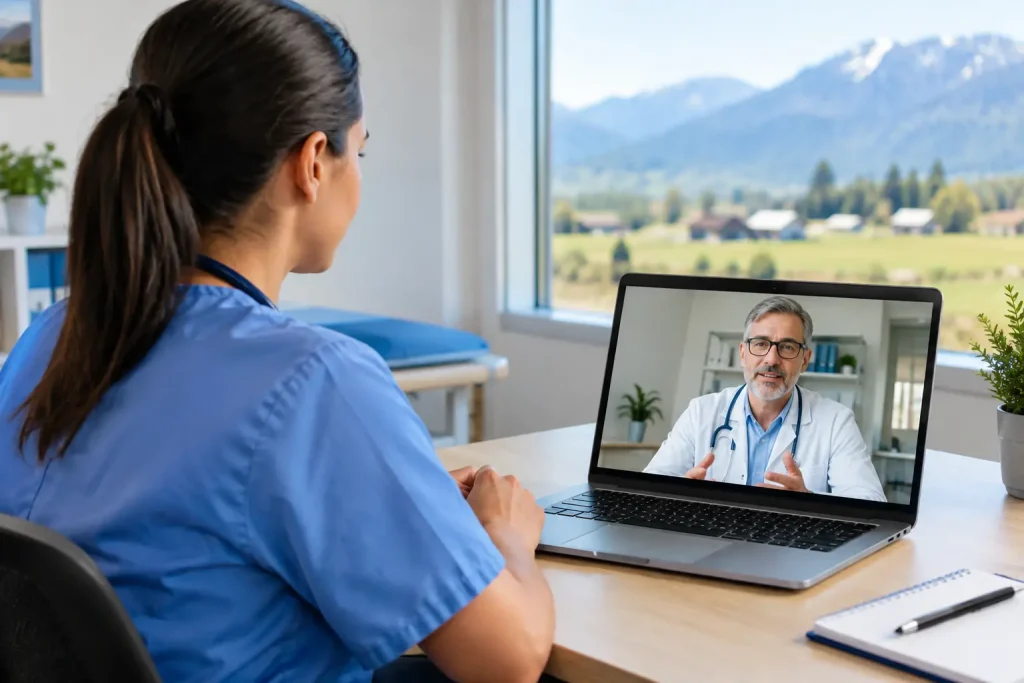
A child with asthma needs a follow-up after an urgent care visit. An older adult with heart failure needs a timely review of symptoms. A parent cannot take another unpaid day off to drive two hours to a specialty appointment. These are not edge cases for rural hospitals. They are routine barriers to continuity of care. A rural telehealth solution for rural hospitals, such as the Dr. Miltie N9+, can help clinical teams bring more of the examination, monitoring, and care coordination process closer to home.
Video visits alone can be valuable, but they do not always provide enough clinical information to support confident decisions. Rural hospitals and affiliated clinics need technology that complements clinician judgment with relevant patient data, supports a virtual physical exam, and fits the workflows that already hold care teams together.
Why rural hospitals need more than video visits
Rural communities often face overlapping access challenges: clinician shortages, long distances between patients and care sites, limited specialty coverage, unreliable transportation, and caregivers balancing work or family obligations. For critical access hospitals, rural health clinics, and community-based partners, the pressure is not simply to offer telehealth. It is to offer care that is clinically meaningful and operationally sustainable.
A standard video encounter can reveal how a patient appears, speaks, moves, and engages. That is useful context, but it may leave important questions unanswered. What are the patient’s current vital signs? Can a clinician hear concerning respiratory sounds? Has a chronic condition changed in a way that requires an in-person escalation? Without appropriate clinical data, the virtual visit may become only a triage conversation or lead to a second appointment that the patient still struggles to reach.
Connected-care technology changes the role of telehealth by helping organizations collect and share clinically relevant observations from distributed settings. Depending on the care model and clinical need, a trained staff member, caregiver, or participating patient can support data capture while a remote clinician guides the encounter. This enables the care team to make a more informed decision about treatment, follow-up, referral, or escalation.
A rural telehealth solution for rural hospitals using the N9+
The Dr. Miltie N9+ is a mobile, wireless virtual examination and patient monitoring system designed to support clinician-directed care beyond the traditional exam room. It gives rural hospitals a way to extend clinical reach into affiliated clinics, schools, homes, community sites, and other settings where patients can access care with less disruption.
The distinction matters. A connected virtual exam is not intended to replace every in-person visit. Patients with emergencies, complex diagnostic needs, or conditions that require hands-on intervention still need the appropriate level of in-person care. The value lies in determining which patients can safely receive assessment, follow-up, chronic disease support, and care coordination closer to where they live.
For a rural hospital, this can support several practical care pathways. A care team might use virtual examination capabilities for post-discharge follow-up, helping identify symptoms that warrant prompt intervention before they progress. A rural clinic could connect a patient with a remotely located clinician while capturing data needed for the visit. A pediatric practice could provide follow-up in a familiar setting, reducing stress for children who struggle with unfamiliar clinical environments.
The N9+ also supports a broader connected-care strategy rather than a one-time technology purchase. Its role can be paired with remote patient monitoring, chronic care management, patient engagement, and care coordination workflows. That creates a stronger foundation for organizations working to improve access while managing workforce constraints and financial accountability.
Better access should also mean better clinical context
Rural telehealth programs succeed when they preserve clinical quality, not when they simply increase the number of completed video calls. The most useful virtual care models give clinicians enough context to act and give local teams clear next steps.
For example, a patient with chronic obstructive pulmonary disease may report increased shortness of breath during a video visit. A clinician can ask targeted questions, observe the patient, review available data, and determine whether medication adjustment, expedited in-person assessment, or emergency evaluation is appropriate. The clinical pathway should define who captures information, how it reaches the provider, what thresholds trigger action, and how follow-up is documented.
This is where technology, protocols, and team training must work together. A device alone cannot solve fragmented care. Rural hospitals need a model that defines responsibilities across nurses, medical assistants, community health workers, remote clinicians, caregivers, and local referral partners.
Pediatric care benefits from familiar settings
Pediatric access is especially sensitive to geography and family logistics. Missed appointments can result from transportation limitations, work schedules, childcare needs, weather, or the difficulty of traveling with a child who experiences sensory, behavioral, or medical challenges. These burdens can be particularly significant for autistic children and pediatric patients with special healthcare needs.
Virtual examination and monitoring capabilities can help organizations design lower-stress pathways for appropriate follow-up care. A child may be more comfortable participating from home, a school-based setting, or a familiar pediatric practice. Caregivers can join the conversation more easily, share observations in real time, and better understand the plan of care.
Clinical appropriateness remains essential. Programs should establish clear rules for when virtual pediatric care is suitable, when an in-person exam is necessary, and how urgent concerns are escalated. When these safeguards are in place, rural hospitals can reduce avoidable travel without reducing the rigor of clinical decision-making.
Building a program that staff can sustain
The strongest rural telehealth deployment starts with a defined use case, not a technology inventory. Leaders should identify a patient population and care gap where virtual examination and remote monitoring can make a measurable difference. Post-discharge follow-up, chronic disease management, pediatric access, specialty support, and care coordination are common starting points.
From there, the organization should map the full workflow. That includes patient identification, consent, scheduling, device access, clinical staffing, documentation, escalation protocols, data review, and follow-up. If any of these steps are unclear, the burden often falls on frontline staff, which can slow adoption and undermine confidence in the program.
Reimbursement planning should be part of the design phase rather than an afterthought. Medicare, Medicaid, commercial payer policies, state requirements, and site-specific billing processes can differ. Organizations need to evaluate applicable CMS rules, payer guidance, documentation standards, supervision requirements, and coding practices with their compliance and reimbursement teams. A reimbursement-aware approach helps leaders connect clinical goals to a financially sustainable operating model.
HIPAA compliance and security practices also need to be built into implementation. Rural programs often involve distributed locations and multiple care partners, making role-based access, staff education, device management, and documented policies especially important. Technology should support the organization’s compliance program, not force teams to create workarounds.
Measure what changes for patients and operations
Utilization alone is not a meaningful outcome. A rural hospital should measure whether the program improves the access and continuity problems it was created to address. Relevant indicators may include appointment completion, time to follow-up, avoided patient travel, no-show rates, emergency department utilization, readmissions, caregiver participation, clinician capacity, and patient experience.
Measures should be selected by use case. A pediatric program may focus on family participation and completed follow-up. A chronic care program may focus on timely intervention, symptom tracking, and adherence to the plan of care. An executive team will also need visibility into staffing requirements, reimbursement performance, and the cost of maintaining services across a distributed footprint.
Dr. Miltie’s Circle of Care™ model supports this connected view of care by bringing clinicians, patients, caregivers, and community-based touchpoints into a more coordinated pathway. For rural organizations, that coordination can be as consequential as the virtual visit itself.
Rural hospitals do not need to choose between local relationships and technology-enabled care. The right program strengthens the relationship by helping clinical teams show up sooner, with better information, in the settings where patients and families can realistically participate. Start with one care gap that patients feel every day, build the workflow around the people delivering care, and let the results guide responsible expansion.
Move from information to action
See how the N9+ can fit your organization.
Explore the remote physical exam platform or request a focused demonstration.