
Telehealth Equipment for Home Health That Works
Choose telehealth equipment for home health that supports virtual exams, remote monitoring, caregiver engagement, and scalable clinical workflows safely.
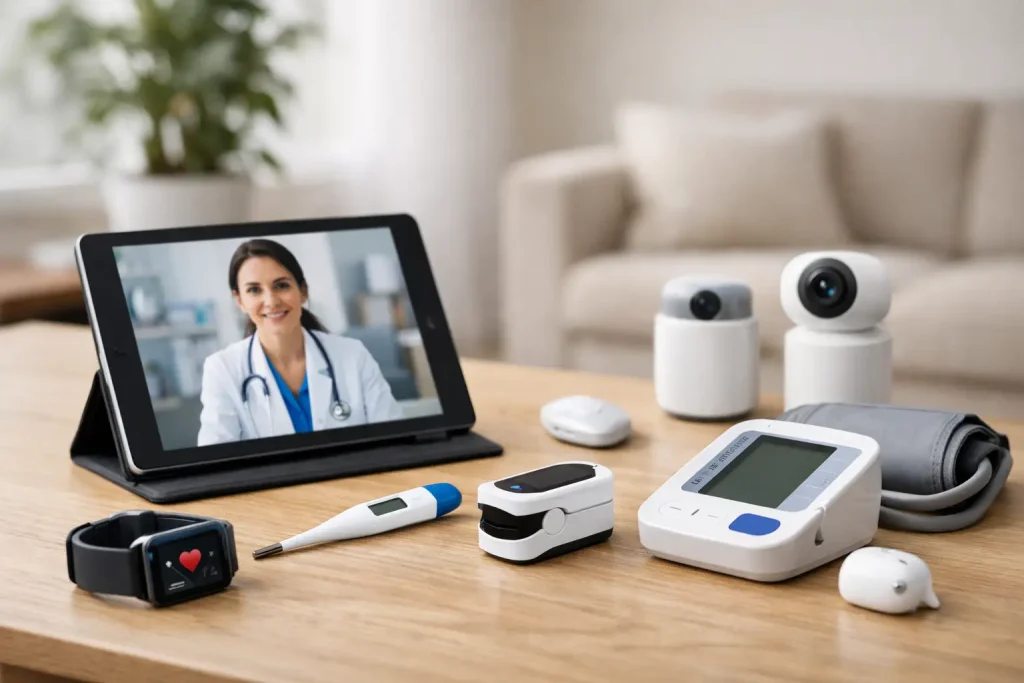
A home health visit can reveal more than a clinic appointment: whether a child is comfortable, whether medications are within reach, whether a caregiver understands the plan, and whether a rural patient can realistically return for follow-up. But video alone cannot provide the clinical data needed to make confident decisions. Telehealth equipment for home health must help care teams move from conversation to meaningful assessment while fitting the realities of patients, caregivers, and field-based workflows.
For organizations expanding virtual care, the central question is not simply which devices to buy. It is how to equip clinicians, patients, and caregivers with a connected model that supports appropriate evaluation, continuity, documentation, and reimbursement-aware care delivery.
What Home Health Telehealth Equipment Must Accomplish
Home health programs serve patients with very different clinical, technical, and social circumstances. A patient with heart failure may need regular weight, blood pressure, pulse oximetry, and symptom review. A child with special healthcare needs may benefit from a clinician-guided virtual exam in a familiar environment, with a parent or caregiver participating in real time. A rural patient may need specialty access without a multi-hour trip to a distant facility.
That range of needs makes isolated devices a limited solution. A connected care program requires equipment that captures clinically relevant information, transmits it securely, and places the information in a usable workflow for the care team. The equipment should support the clinical purpose of the visit, not create another portal, manual process, or disconnected stream of data.
The right configuration depends on the population and care model. Still, most organizations need to address four practical capabilities: video-based clinician interaction, virtual physical assessment, remote patient monitoring, and coordination among clinicians, patients, and caregivers.
Core Telehealth Equipment for Home Health Programs
Connected virtual examination tools
A standard video visit is valuable for check-ins, counseling, medication reconciliation, and visual observation. It is not always sufficient when a clinician needs to hear heart or lung sounds, look inside an ear or throat, assess skin concerns, or gather other physical findings.
Connected examination tools can extend the reach of the clinician by enabling a trained facilitator, caregiver, or patient to support a guided exam. Depending on the clinical pathway, organizations may use digital stethoscopes, otoscopes, examination cameras, dermatoscopes, or other peripherals that transmit findings during the encounter.
Usability matters as much as device capability. In home health, equipment must work for people who are not medical device specialists. A complicated setup can add stress for caregivers and consume clinician time. Programs should consider guided workflows, clear instructions, cleaning requirements, accessibility needs, and the level of assistance a household will require.
Remote patient monitoring devices
Remote patient monitoring provides a structured way to follow physiological measures between visits. Common devices include connected blood pressure cuffs, scales, pulse oximeters, glucometers, thermometers, and activity or symptom-monitoring tools. The appropriate set should follow the care pathway, not a generic device bundle.
For example, a chronic cardiopulmonary program may prioritize weight trends, oxygen saturation, blood pressure, and symptom escalation. A diabetes initiative may focus on glucose data, medication adherence, nutrition coaching, and timely clinician review. Sending every patient the same equipment can increase cost and complexity without improving care.
Data collection is only the starting point. Organizations need clinical protocols that define who reviews readings, what constitutes an alert, how quickly the team responds, and when an in-person evaluation is needed. Without these operational decisions, a remote monitoring program can generate noise rather than actionable intelligence.
Reliable communications and connectivity
The home is not a controlled clinical environment. Broadband access may be inconsistent, cellular service may vary, and patients may not have compatible devices or digital confidence. Rural and underserved communities can face these barriers more often, but they appear in urban settings as well.
A deployment plan should account for connectivity before the first visit. That may mean cellular-enabled equipment, devices with simple pairing processes, offline data storage where appropriate, technical support, and alternative pathways for patients who cannot reliably participate by video. Technology selection should not unintentionally exclude the people a program is designed to reach.
Patient-facing tools that reduce friction
Home health telehealth succeeds when patients and caregivers can use the equipment consistently. Large displays, intuitive prompts, language access, accessible design, and straightforward charging or storage processes can be more consequential than an advanced feature that few households use correctly.
For pediatric care, the setting and experience are particularly important. Children, including autistic children and those with special healthcare needs, may be more comfortable participating from home than in a crowded waiting room or unfamiliar exam space. Equipment that enables a calm, clinician-directed assessment can reduce travel burden while allowing caregivers to share observations that might not emerge during a brief office visit.
Choosing Telehealth Equipment for Home Health by Use Case
Procurement should begin with the care problem. A post-discharge program has different requirements than a school-linked pediatric access program, hospice support model, or rural primary care network. Organizations should define the target population, clinical objectives, staffing model, escalation process, and expected visit cadence before selecting equipment.
A useful decision framework considers clinical relevance, patient usability, workflow integration, security, and financial sustainability. Clinical leaders should confirm that devices provide data they can act on. Operations teams should test provisioning, inventory control, replacement processes, cleaning, and support. Information technology and compliance leaders should evaluate HIPAA-aligned data handling, identity controls, role-based access, and interoperability requirements. Finance and reimbursement teams should assess how the program aligns with applicable remote patient monitoring, chronic care management, telehealth, and payer requirements.
No single device model is right for every home health organization. A high-touch service with trained field staff may support a broader examination kit. A large population health program may need simple, scalable monitoring devices and centralized clinical review. The most effective design matches equipment intensity to patient acuity and available care-team capacity.
Avoid the Device-First Deployment Trap
A common mistake is treating telehealth equipment as the program itself. Shipping devices to patients without enrollment criteria, education, clinical ownership, and follow-up workflows often produces low utilization. It can also frustrate patients who expected responsive care after submitting readings or joining a virtual visit.
Successful organizations build a pathway around the equipment. They determine which patients are appropriate, who introduces the service, how consent and education are handled, what support is available, and how findings enter the care plan. They also establish clear exceptions. A concerning remote finding should trigger a defined action, whether that is same-day outreach, an in-person visit, emergency guidance, or coordination with another member of the care team.
Training is not a one-time event. Clinicians need confidence in conducting virtual physical exams and interpreting device-generated information. Care coordinators need consistent outreach scripts and escalation guidance. Patients and caregivers need practical coaching, with extra support for those facing language, disability, literacy, or technology barriers.
Building a Connected Circle of Care
Home-based virtual care works best when it strengthens relationships rather than replacing them. The patient, caregiver, home health clinician, primary care provider, specialist, and care coordinator may all hold part of the clinical picture. Equipment should make it easier to share relevant information across that circle of care, with clear accountability for next steps.
This is especially meaningful for families managing pediatric complexity. A virtual encounter can bring a caregiver’s observations into the clinical conversation while reducing missed work, transportation demands, and the stress of repeated travel. For rural clinics, community health centers, and critical access hospitals, connected examination and monitoring capabilities can extend access without asking limited clinical staff to be in multiple places at once.
Dr. Miltie’s N9+ platform reflects this broader approach by combining mobile, wireless virtual examination capabilities with patient monitoring and care coordination. For healthcare organizations, the value lies not in adding another device, but in supporting customized pathways of care that connect clinical insight, caregiver participation, and operational execution.
Measure What Changes for Patients and Operations
A mature program should track more than device distribution and completed video visits. Leaders should evaluate enrollment, activation, adherence, time to clinical review, alert resolution, visit completion, avoidable travel, patient and caregiver experience, and appropriate utilization of in-person services. The right measures vary by program, but each should answer whether access and care quality are improving.
Equity should be measured as well. If patients with limited connectivity, limited English proficiency, disability-related access needs, or lower digital literacy are less likely to complete virtual care, the program needs adjustment. Home health technology can narrow access gaps, but only when implementation recognizes the realities people bring into the home.
The most valuable telehealth equipment does not attempt to turn every home into an exam room. It gives clinicians enough trusted information to deliver the right next step, while helping patients receive care in a setting that respects their daily lives.
Move from information to action
See how the N9+ can fit your organization.
Explore the remote physical exam platform or request a focused demonstration.