
Dr. Miltie N9+ vs. BestBuy Health
Compare dr. miltie n9+ vs. bestbuy health for virtual exams, RPM, pediatrics, rural care, workflow fit, and reimbursement-ready deployment.
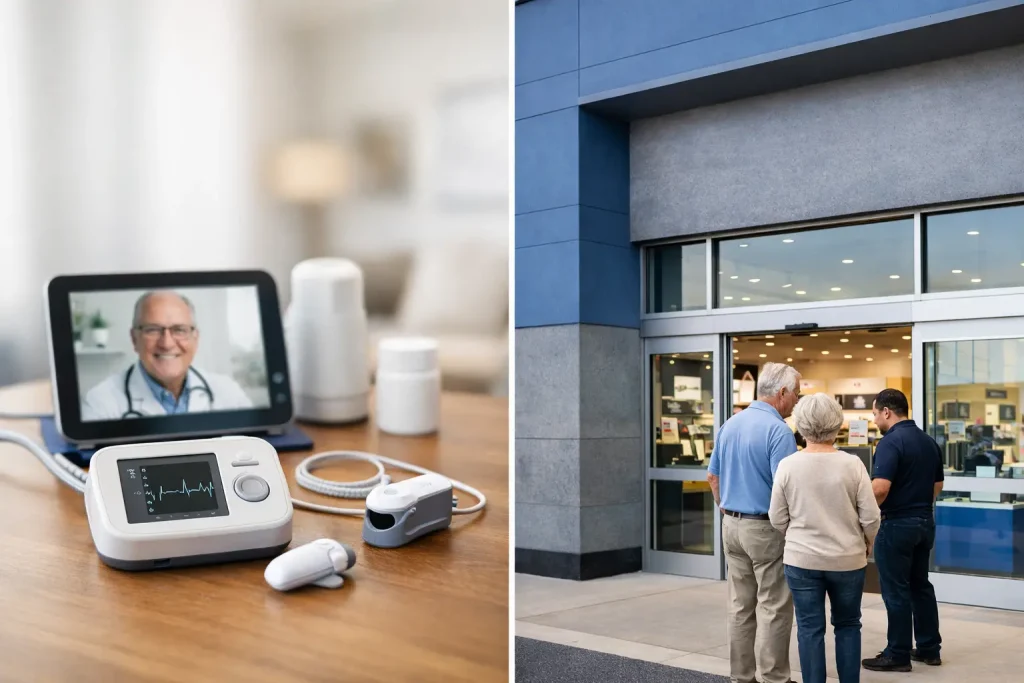
A telehealth program can look strong on paper and still fall short at the point of care. That is often where the real question behind dr. miltie n9+ vs. bestbuy health begins – not with branding, but with whether your organization needs clinician-directed virtual exams, broad consumer monitoring, or a more tailored connected-care model for pediatric, rural, and community-based settings.
This comparison matters because these solutions can serve very different operational goals. For health systems, rural clinics, federally qualified health centers, pediatric programs, and community-based care teams, the right choice depends less on which name is more familiar and more on which platform fits clinical workflow, staffing realities, reimbursement strategy, and patient population.
Dr. Miltie N9+ vs. BestBuy Health: what are you actually comparing?
At a high level, Best Buy Health is widely associated with connected care, remote monitoring, and in-home health support. Its market presence tends to align with large-scale health monitoring, consumer health technology familiarity, and broader home-based care initiatives.
The Dr. Miltie N9+, by contrast, is built around mobile wireless virtual examination and patient monitoring with a stronger emphasis on clinician-directed assessment. That distinction is not minor. It changes how the technology is used, who can use it effectively, and what type of care model it supports.
If your objective is to extend a provider’s ability to assess a patient beyond a standard video visit, the conversation shifts quickly from general remote monitoring to clinical exam capability. That is especially relevant in pediatrics, rural outreach, school-based care, chronic care follow-up, and safety-net environments where a basic video call may not provide enough clinically useful information.
Clinical depth versus general connected care
The biggest difference in dr. miltie n9+ vs. bestbuy health is often the level of clinical exam support an organization needs.
Some connected-care platforms are well suited for collecting data points over time, supporting home-based engagement, or helping care teams track ongoing conditions. That can be valuable for population health and chronic disease management. But many provider organizations need more than trend data. They need a way to bring parts of the physical exam into virtual care encounters.
That is where the Dr. Miltie N9+ stands apart. It is designed to help clinicians perform more complete remote evaluations by capturing clinically relevant patient data during virtual care interactions. For organizations trying to reduce unnecessary transfers, avoid travel burdens, or improve access in distributed settings, that capability can materially change care delivery.
This is an important trade-off. If your primary need is broad home monitoring at scale, a general connected-health model may be sufficient. If your need is to support decision-making during clinician-guided virtual encounters, exam-enabled technology becomes much more important.
Why pediatric and special-needs care changes the equation
Healthcare leaders evaluating virtual care tools for adults sometimes underestimate how different pediatric deployment can be. Children, especially autistic children and pediatric patients with special healthcare needs, often benefit when care can be delivered in familiar, lower-stress environments. A solution that works adequately for adult remote monitoring may not address the workflow and engagement realities of pediatric care.
In that context, dr. miltie n9+ vs. bestbuy health is not just a product comparison. It is a care-model comparison.
The Dr. Miltie N9+ aligns more naturally with pediatric environments that need caregiver participation, clinician-guided assessments, and flexibility across homes, schools, pediatric practices, and community clinics. That can help reduce transportation challenges, support follow-up compliance, and create a more manageable experience for families who would otherwise face repeated in-person visits.
For organizations serving children with developmental, behavioral, or complex medical needs, the ability to bring care closer to the child is often tied directly to access, continuity, and family engagement. Technology that supports that model has strategic value beyond the encounter itself.
Rural and safety-net deployment is about workflow, not just hardware
Rural health clinics, critical access hospitals, community health centers, and federally qualified health centers rarely choose technology based on feature lists alone. They need solutions that can work across staffing constraints, connectivity limitations, outreach settings, and reimbursement realities.
This is another place where broad consumer-facing health technology and provider-directed virtual exam systems can diverge.
Best Buy Health may appeal to organizations looking for established connected-care infrastructure or monitoring support in home-based settings. But rural and safety-net providers often need tighter alignment with frontline clinical workflow. They may require tools that support a remote exam in a school, a community site, a mobile clinic, or a patient home while still keeping the clinician at the center of assessment and decision-making.
That is the operating environment where Dr. Miltie has particular relevance. Its connected-care model is built to help organizations extend clinical reach into underserved communities while supporting care coordination and practical deployment. For leaders focused on rural access, the question is whether the platform simply gathers information or truly helps providers examine, triage, monitor, and follow up in distributed care settings.
Reimbursement and operational sustainability
No virtual care platform succeeds for long if it creates administrative burden without a path to financial sustainability. That is why reimbursement should be part of the comparison early, not after implementation.
When organizations assess dr. miltie n9+ vs. bestbuy health, they should ask whether the solution supports reimbursement-aware deployment, including alignment with remote patient monitoring, chronic care management, and related virtual care pathways where appropriate. They should also consider whether implementation guidance is tailored to regulated provider environments rather than treated as a secondary concern.
This is where a healthcare-specific platform can have a meaningful advantage. A solution designed for care delivery organizations typically speaks more directly to compliance, workflow adoption, and sustainable service-line development. That matters for health systems and community providers alike, especially when leadership needs measurable outcomes and a realistic operational model.
A lower-friction consumer health experience may sound appealing at first. But if it does not map cleanly to clinical protocols, care-team roles, and reimbursement planning, the long-term burden can shift back to the provider organization.
Integration with care teams and the Circle of Care
Another practical difference lies in how each solution fits into the broader care ecosystem around the patient.
Many health organizations are no longer evaluating virtual care as a standalone tool. They are looking for platforms that support a connected model across clinicians, caregivers, coordinators, community sites, and follow-up pathways. That is especially true in pediatrics and chronic care, where engagement beyond a single encounter affects outcomes.
The Dr. Miltie approach is notable because it frames virtual care as part of a Circle of Care™ rather than a one-off technology transaction. That model can be particularly useful for organizations coordinating among pediatric specialists, primary care teams, caregivers, school-based personnel, rural outreach teams, and community health workers. It recognizes that care access is often limited not by clinical knowledge, but by geography, logistics, and the difficulty of keeping everyone connected around the patient.
For buyers comparing vendors, this means the decision should include service design and implementation support, not just devices and dashboards. A platform that fits into your care pathways is usually more valuable than one with a broader but less tailored feature set.
Which option fits which organization?
If your organization wants general connected health support, brand familiarity, or broader in-home monitoring infrastructure, Best Buy Health may fit the model you are building. That may be particularly relevant in programs centered on longitudinal home monitoring or consumer-oriented engagement.
If your organization needs clinician-directed virtual physical exams, mobile wireless assessment tools, pediatric-friendly deployment, and a platform built for rural, community-based, and underserved settings, the Dr. Miltie N9+ is likely the more aligned option. That is especially true when success depends on extending provider capability rather than simply expanding device access.
The most important insight is that these are not interchangeable solutions. One may be better for generalized connected-care initiatives, while the other may be better for organizations that need clinically meaningful remote examination, caregiver-inclusive workflows, and flexible deployment across nontraditional care environments.
Before making a selection, leadership teams should pressure-test the use case. Ask where the patient is, who is present, what the clinician must be able to assess, how follow-up is managed, and whether the model can scale financially. Those answers usually make the right choice clearer than any feature comparison chart.
Virtual care works best when technology matches the reality of care delivery. For organizations serving children, rural communities, and patients who need care brought closer to home, the strongest platform is the one that helps clinicians do more – not just monitor from a distance.
Move from information to action
See how the N9+ can fit your organization.
Explore the remote physical exam platform or request a focused demonstration.