
Telehealth Solutions for Rural Healthcare
Telehealth solutions for rural healthcare help providers expand access, support virtual exams, improve follow-up, and make care delivery more sustainable.
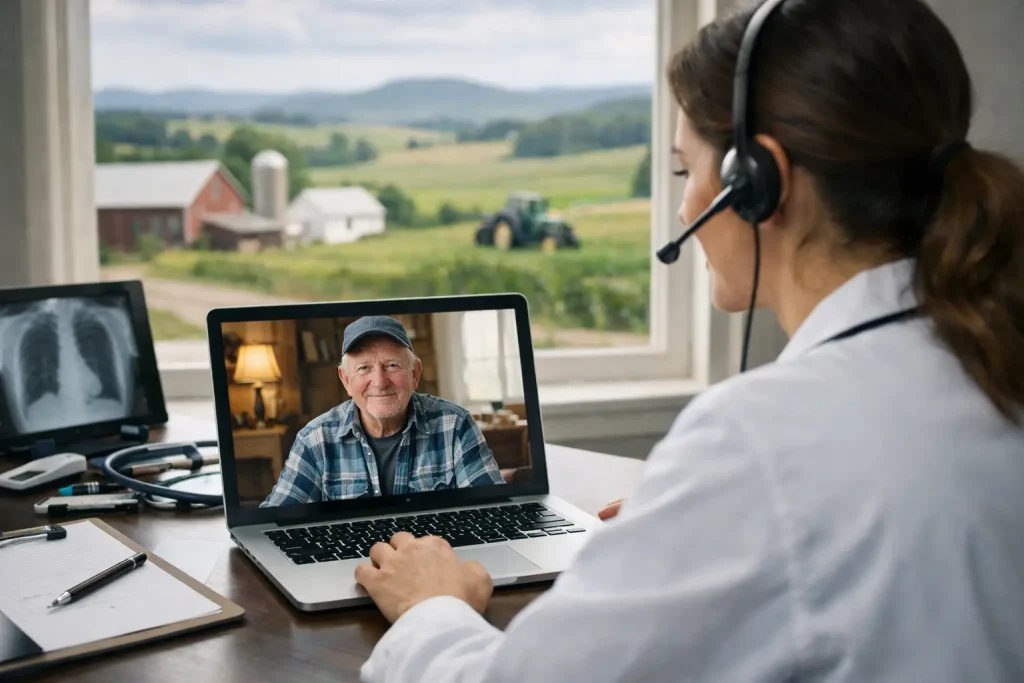
A pediatric patient misses a specialty follow-up because the nearest clinic is two hours away, a parent cannot leave work again, and the local team has limited backup. That is the daily reality telehealth solutions for rural healthcare are meant to change. For rural hospitals, community health centers, federally qualified health centers, and school-based programs, the issue is not whether virtual care matters. It is whether the model can support clinically relevant care, fit existing workflows, and hold up financially.
That distinction matters. Rural care delivery is rarely solved by video visits alone. A successful strategy has to account for workforce shortages, transportation barriers, broadband variability, caregiver availability, and the fact that many patients need more than a conversation on a screen. They need assessment, monitoring, follow-up, and coordination across settings that may include the home, the school nurse’s office, a primary care clinic, and a critical access hospital.
Why telehealth solutions for rural healthcare need more than video
Basic telehealth expanded access, but it also exposed its limits. When a provider cannot listen to heart and lung sounds, review oxygen saturation trends, or guide a more complete virtual physical exam, the visit may still end in a transfer, a repeat appointment, or delayed treatment. In rural settings, those gaps carry more weight because alternatives are farther away and local resources are often stretched.
That is why many organizations are shifting from simple teleconferencing to connected-care models. The stronger programs combine clinician-directed virtual examination, remote patient monitoring, chronic care management, and patient engagement tools in one operational framework. Instead of treating telehealth as a digital front door only, they use it as an extension of the care team.
For rural leaders, the practical question is not just what technology to buy. It is what clinical problems the technology should solve. If the goal is reducing avoidable travel for pediatric follow-up, the requirements look different than they do for managing COPD, hypertension, or post-discharge monitoring. If the organization serves autistic children or pediatric patients with special healthcare needs, care delivery may need to happen in lower-stress environments where caregivers can participate more fully.
What effective rural telehealth programs actually include
The most durable telehealth solutions for rural healthcare usually share a few traits. First, they support clinically useful data capture, not just face-to-face communication. Second, they fit distributed care settings, including homes, schools, outreach sites, and satellite clinics. Third, they align with reimbursement and staffing realities.
A connected virtual exam capability can make a major difference here. When clinicians can remotely guide assessments and capture medically relevant data, the virtual encounter becomes more actionable. This does not eliminate the need for in-person care. It helps organizations reserve in-person visits for cases that truly require them.
Remote patient monitoring also plays an important role, especially for chronic disease management and post-acute follow-up. Rural populations often face delayed intervention because symptom escalation is not identified early enough. Monitoring programs can help surface risk sooner, but only if the data flows into a workflow someone owns. Technology without clear clinical accountability tends to underperform.
Care coordination is the third piece that often determines success or failure. Rural patients frequently move between primary care, specialty care, emergency departments, schools, and home-based support. Telehealth works best when it strengthens that circle rather than creating one more disconnected platform. Organizations that define escalation pathways, documentation standards, and caregiver communication upfront usually see better adoption.
Rural use cases where virtual care delivers real value
Pediatrics is one of the clearest examples. Rural families often travel long distances for specialist input, developmental follow-up, or recurring visits that could be handled closer to home if clinicians had better virtual exam tools. For children who are anxious in unfamiliar clinical environments, or for autistic children who do better in familiar settings, remote care can improve the quality of the encounter, not just convenience. The visit may be calmer, caregivers may provide better context, and follow-up is more likely to happen on time.
Chronic care is another area where telehealth can move the needle. Patients with hypertension, diabetes, CHF, or COPD often need regular touchpoints, trend review, and reinforcement of care plans more than they need frequent travel to a distant clinic. Remote monitoring paired with chronic care management can help rural organizations intervene earlier and use nurse care managers and clinical staff more efficiently.
Urgent assessment in community-based settings is also gaining traction. A rural clinic, school health program, or community site equipped for virtual examination can connect patients with a remote clinician who can assess the situation with more confidence than a standard video call allows. That can improve triage decisions and reduce unnecessary transfers while still escalating quickly when higher-acuity care is needed.
Behavioral health remains important, but it should not overshadow the value of hybrid physical and virtual care. Many rural organizations already offer telebehavioral health. The next step is building programs that also support physical assessment, longitudinal monitoring, and care coordination for medically complex patients.
The operational realities behind adoption
Rural executives and program leaders know the barrier is rarely interest. It is implementation. Broadband limitations, staffing constraints, onboarding burden, and uncertain reimbursement can all slow momentum. That is why enterprise-ready telehealth strategy has to be operational, not aspirational.
Workflow design should come before large-scale deployment. Who starts the visit? Who supports the patient at the originating site or in the home? What data is captured during the encounter? How is it documented in the record? What triggers escalation to in-person care, emergency transfer, or specialty referral? These questions sound basic, but they are where many programs either stabilize or stall.
Training matters just as much. Rural teams cannot afford technology that takes months to learn or depends on highly specialized staff to run every interaction. The best implementations support clinicians, nurses, medical assistants, and care coordinators in ways that match their actual day-to-day responsibilities. That usually means role-based workflows and practical education, not generic onboarding.
Reimbursement also has to be part of the design from the start. Rural telehealth programs are more likely to last when they align with CMS pathways, remote patient monitoring opportunities, chronic care management models, and payer requirements that make the service financially supportable. Not every use case reimburses the same way, and not every state or payer behaves alike. A reimbursement-aware deployment strategy is often the difference between a pilot and a durable service line.
Choosing the right technology partner
Healthcare organizations evaluating rural telehealth platforms should look beyond feature lists. The real test is whether the partner understands clinical workflows, distributed care environments, and the needs of underserved populations. A device alone is not a rural health strategy. A video platform alone is not a virtual care strategy.
It helps to ask harder questions early. Can the platform support clinician-directed virtual physical exams? Can it serve pediatric and adult populations? Can it adapt to care in schools, homes, outreach settings, and community clinics? Does the implementation model account for training, customization, and reimbursement planning? Can the organization scale from one use case to several without starting over each time?
This is where connected-care platforms stand apart. Solutions such as the Dr. Miltie N9+ are designed to support remote examination and patient monitoring in settings where access, staffing, and follow-up are ongoing challenges. That matters for rural providers because they need tools that extend clinical reach without reducing the quality of clinical decision-making.
A smarter way to think about rural virtual care
The strongest rural telehealth strategies do not try to replace local care. They strengthen it. They give rural clinicians more ways to assess, monitor, and coordinate. They help families stay engaged. They reduce avoidable miles on the road while making it easier to identify the patients who truly need escalation.
There are trade-offs, of course. Some visits will still require hands-on evaluation. Some communities will need infrastructure support before advanced virtual care can scale. Some service lines will justify investment faster than others. But that is normal. Rural transformation is rarely one big launch. It is usually a series of practical decisions that build a more flexible care model over time.
For organizations planning the next phase of virtual care, the opportunity is not simply to add telehealth. It is to build care pathways that bring clinically meaningful services closer to where patients live, learn, and recover. That is how access improves in a way patients can actually feel.
Move from information to action
See how the N9+ can fit your organization.
Explore the remote physical exam platform or request a focused demonstration.