
Virtual Examinations for Employer Health Programs
Virtual examinations for employer health programs can expand access, reduce disruption, and support clinically sound, scalable workforce care.
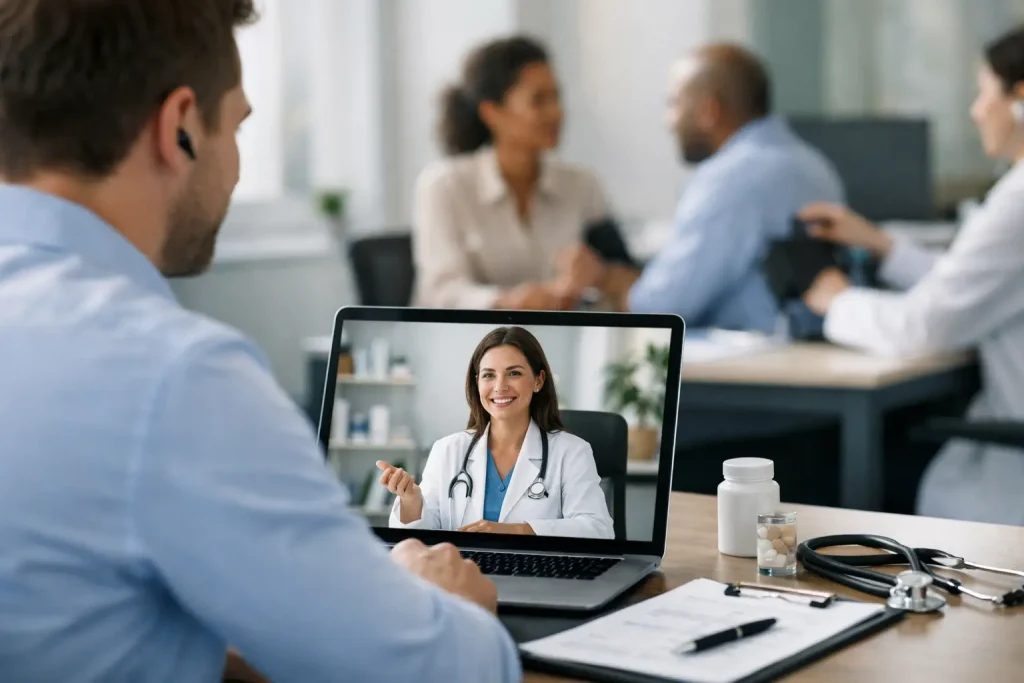
A workforce clinic that only works when employees can leave the job site, drive across town, and sit in a waiting room is not much of a workforce strategy. For employers trying to improve access, reduce avoidable absenteeism, and support preventive care, virtual examinations for employer health programs offer a more practical model – especially when those exams are backed by clinically relevant devices and workflows instead of video alone.
That distinction matters. Many employer health leaders have already tested telehealth as a convenience benefit, only to find that basic video visits do not always support the level of assessment needed for occupational health, chronic condition follow-up, pediatric family coverage, or care delivery in rural and distributed workforces. The conversation is now shifting from virtual visits to virtual exams.
Why virtual examinations are different from standard telehealth
A virtual visit can be useful for straightforward conversations, medication refills, or low-acuity triage. But employer-sponsored care programs often need more. They may need a clinician to evaluate respiratory symptoms, inspect the throat or ears, review heart and lung sounds, assess skin concerns, or capture vital signs that can guide next steps.
Virtual examinations for employer health programs are designed to close that gap. When a program includes connected exam tools, remote patient monitoring capabilities, and clinician-directed workflows, the virtual encounter becomes more clinically actionable. That changes the value proposition for employers, health systems, and care partners alike.
For an employer, the benefit is not simply convenience. It is the ability to extend care access into workplaces, community settings, schools, or employees’ homes while preserving clinical quality. For providers, it creates a way to reach populations who might otherwise delay care because of travel, scheduling strain, caregiver responsibilities, or limited local access.
Where employer health programs are seeing the strongest fit
The strongest use cases tend to be programs with distributed populations, limited onsite clinical staff, or a strong need for care continuity. Rural employers are an obvious example. When employees live far from primary care or specialty services, small symptoms can become untreated problems because the logistics of care are too difficult.
There is also a strong fit in industries with hourly workforces, multiple shifts, and operational pressure to minimize time away from work. In those settings, a virtual exam supported by connected devices can help a clinician make a more informed assessment without requiring every employee to leave the work site.
Family-centered employer plans can also benefit. Many employers are looking more closely at pediatric access, especially for dependents who need frequent follow-up, behavioral support, or lower-stress care environments. Virtual exams can be particularly valuable for autistic children and pediatric patients with special healthcare needs who may do better in familiar settings with caregiver participation.
That does not mean every clinical scenario belongs in a virtual pathway. Emergencies, high-acuity presentations, and certain diagnostic workups still require in-person escalation. The point is not to replace the exam room in every case. It is to use virtual care where it improves access without lowering standards.
What makes virtual examinations clinically meaningful
The success of virtual examinations for employer health programs depends on whether the model supports a real assessment, not just a conversation. That starts with device-enabled exams. If a clinician can capture key physical exam data remotely, the visit becomes far more useful for triage, treatment planning, follow-up, and care coordination.
It also depends on workflow design. A good employer health program has to account for who initiates the visit, where the exam happens, who supports the patient if assistance is needed, how data is documented, and how care transitions are handled if additional services are required. Without that operational structure, even strong technology can underperform.
Clinical oversight is another non-negotiable. Employer health programs sit at the intersection of access, workforce operations, privacy, and reimbursement. Virtual exam pathways should be clinician-directed, HIPAA compliant, and aligned with the realities of documentation, coding, and escalation protocols.
This is where many organizations underestimate the challenge. Buying telehealth software is easier than building a care model that clinicians trust and administrators can scale.
Operational gains are real, but they are not automatic
There is a reason health systems, community-based providers, and employer groups continue to revisit virtual care strategy. When implemented well, virtual examinations can reduce unnecessary travel, shorten the time from symptom onset to assessment, and support better follow-up for employees and covered family members.
They can also improve workforce continuity. An employee who can be evaluated quickly may avoid a full day lost to a low-acuity issue. A care manager who can check in virtually on chronic conditions may catch a problem earlier. A pediatric dependent who can be seen from home or school may receive care with less disruption for caregivers.
Still, the return on investment depends on fit. If the employer population has low digital readiness, poor connectivity, or inconsistent access to facilitated exam locations, adoption may lag. If the program is not integrated with care navigation and referral pathways, virtual exams can create activity without resolving problems. Operational gains come from design, training, and clinical alignment – not from technology alone.
Reimbursement and compliance shape the model
Employer health decision-makers cannot treat reimbursement as an afterthought. Some virtual services can align with established reimbursement pathways, including remote patient monitoring, chronic care management, and other virtual care services, but the details vary by care setting, payer structure, and program design.
For self-funded employers, the equation may include direct cost avoidance, improved access, lower disruption, and employee experience, not just fee-for-service reimbursement. For provider-led employer health models, coding and documentation standards remain central. Either way, compliance has to be built into the program from the start.
That includes HIPAA requirements, secure data handling, role-based access, clinical documentation standards, and clear separation between healthcare delivery and employer-facing reporting. Employers may want population-level insight, but individual clinical privacy must remain protected.
This is one reason institution-facing buyers increasingly favor connected-care partners over point solutions. A platform that supports workflow customization, training, documentation needs, and reimbursement-aware implementation is more likely to hold up under real operating conditions.
Virtual examinations for employer health programs in pediatric and rural settings
Pediatric and rural populations highlight both the promise and the complexity of this care model. In rural communities, access barriers are often structural. There may be long travel distances, clinician shortages, or limited specialty support. In that environment, a virtual exam can bring timely assessment closer to where the patient already is – at home, at school, in a local clinic, or in a community setting.
For pediatric populations, the benefit is often tied to environment and caregiver participation. Children may be more comfortable in familiar surroundings, and caregivers can be more directly involved in the encounter. That can be especially meaningful for children with sensory sensitivities, developmental differences, or chronic conditions that require ongoing monitoring.
These are not fringe use cases. They are exactly the kinds of scenarios where employer-sponsored health access and community-based care begin to overlap. An employer trying to support working families is often trying to solve for more than adult urgent care. The real question is whether the care model can extend beyond the individual employee and support the broader circle around that employee.
Connected virtual exam platforms are increasingly relevant here because they make it easier to combine remote physical assessment, monitoring, and care coordination in one operational framework. Dr. Miltie approaches this through a Circle of Care™ model that helps organizations support patients, caregivers, and clinicians across distributed settings rather than treating each virtual encounter as an isolated event.
What leaders should evaluate before launching a program
The best starting point is not the device list. It is the care objective. Leaders should be clear on whether they are trying to improve preventive access, support chronic disease follow-up, reduce unnecessary travel, expand pediatric support, extend occupational health services, or strengthen care access in rural or underserved communities.
From there, technology selection should follow clinical need. Some programs need lightweight virtual triage. Others need remote physical exam capability with clinically relevant data capture. Some require school-based or home-based deployment. Others need workflows that support community clinics, employer-sponsored care sites, or mobile teams.
Vendor evaluation should also include training, implementation support, customization, and administrative fit. Can the model align with existing care teams? Can it support compliance expectations? Can it scale without creating extra burden for staff? These questions matter more than feature counts.
The organizations that get this right tend to view virtual exams as part of care delivery redesign, not as an isolated digital benefit. They build around access, clinical integrity, and long-term sustainability.
Employer health programs are under pressure to deliver more than convenience. They are expected to support access, workforce stability, family well-being, and measurable value. Virtual examinations can help meet that standard when they are clinically grounded, operationally realistic, and designed for the populations an organization actually serves. The opportunity is not to digitize the old model. It is to bring better care closer to the people who would otherwise struggle to reach it.
Move from information to action
See how the N9+ can fit your organization.
Explore the remote physical exam platform or request a focused demonstration.