
Virtual Examinations for Skilled Nursing Facilities
Virtual examinations for skilled nursing facilities improve access, triage, and continuity while supporting staff efficiency and clinician-directed care.
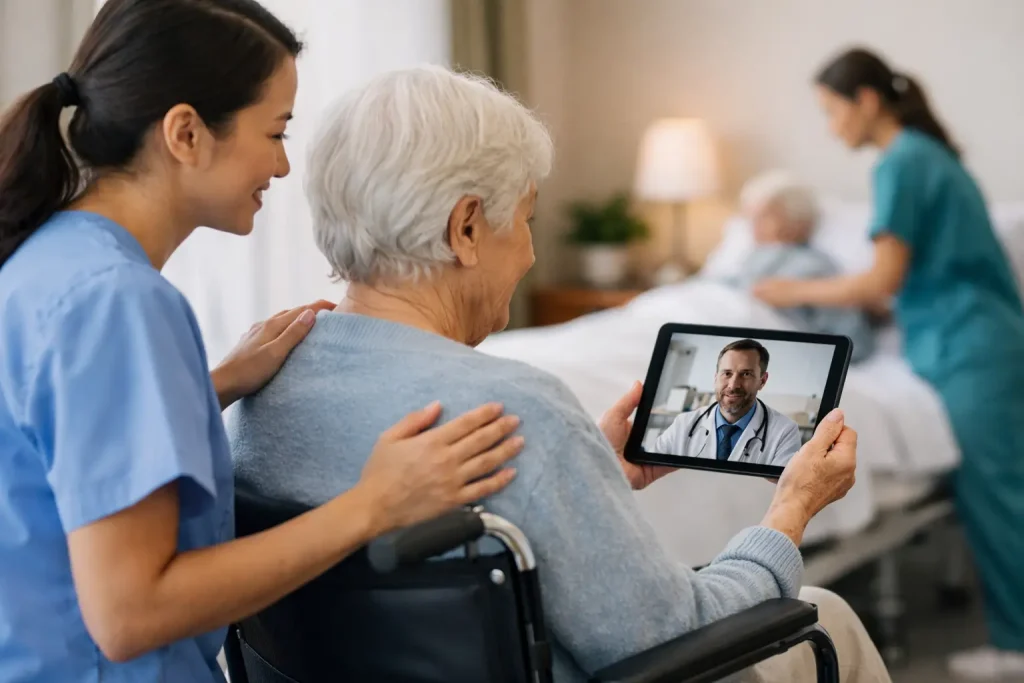
A resident develops new shortness of breath after dinner. The nurse has vital signs, a medication list, and clinical instincts that say this needs timely attention, but getting the right clinician eyes on the patient is not always straightforward. That gap is exactly where virtual examinations for skilled nursing facilities can change the pace and quality of care.
For many SNFs, the issue is not whether telehealth has value. It is whether virtual care can support real clinical decision-making in a setting where residents are medically complex, staff are stretched, and avoidable transfers carry both financial and human costs. Basic video visits have limited value when the clinician cannot hear lung sounds, inspect the throat clearly, assess the skin, or review current physiologic data in context. A more clinically useful model pairs live virtual access with connected exam capabilities that allow a remote provider to perform a meaningful physical assessment.
Why virtual examinations for skilled nursing facilities matter now
Skilled nursing facilities sit at the intersection of post-acute care, chronic disease management, rehabilitation, and long-term support. Residents often have multiple comorbidities, high medication burdens, cognitive impairment, mobility limitations, and changing conditions that do not wait for a scheduled rounding window. When assessment is delayed, the result can be an ED transfer that might have been prevented with earlier intervention.
Virtual examinations for skilled nursing facilities help address a practical problem – how to extend clinician reach without lowering clinical standards. In the right workflow, a remote physician, advanced practice provider, or specialist can assess the resident earlier, collaborate with on-site staff, and determine whether the situation calls for treatment in place, close monitoring, medication adjustment, or escalation to a higher level of care.
That matters operationally as well. SNFs are under pressure to improve quality metrics, manage readmissions, support survey readiness, and maintain staffing resilience. A virtual exam model can strengthen each of those priorities, but only if it is designed for the realities of long-term and post-acute care rather than adapted from consumer telehealth.
What a clinically useful virtual exam actually looks like
A virtual encounter in an SNF should do more than document that a video call occurred. It should help the clinician answer a real clinical question. Is this a CHF exacerbation, early pneumonia, medication-related sedation, dehydration, cellulitis, delirium, or a change that can be safely monitored overnight?
To get there, the encounter typically combines several elements. There is synchronous video communication between the remote clinician and the bedside team. There is access to current resident information such as symptoms, vital signs, medication history, and recent clinical events. And there are connected tools that support remote physical examination, such as digital auscultation, high-quality visual inspection, and capture of clinically relevant patient data.
This distinction is important. A standard webcam visit may be enough for a routine follow-up or care planning discussion. It is usually not enough when the goal is acute assessment, differential thinking, or treatment decisions that hinge on exam findings. In skilled nursing, that difference can determine whether telehealth is seen as a strategic clinical asset or just another administrative layer.
The bedside team remains central
Virtual care in an SNF does not replace nurses or facility staff. It works best when it amplifies their role. The bedside nurse or trained staff member becomes the clinician’s hands in the room, helping position the resident, collect measurements, guide the encounter, and communicate subtle changes that do not always show up in the chart.
That is why implementation matters as much as technology. If the process adds friction, requires excessive setup, or does not align with real nursing workflows, adoption will stall. If it supports staff with clear protocols, training, and escalation pathways, it can improve both efficiency and confidence.
Where skilled nursing facilities see the strongest use cases
Not every resident interaction needs a virtual physical exam. The strongest use cases are the moments when earlier clinical input can alter the course of care.
A common example is a change in condition. New respiratory symptoms, altered mental status, blood pressure instability, possible infection, edema, or skin concerns often trigger uncertainty. Virtual examinations can help determine whether the resident can be managed in place with closer observation and treatment, or whether transfer is necessary.
Another valuable area is after-hours and weekend coverage. Many facilities know the pattern well – a resident declines outside normal rounding hours, staff call for guidance, and limited exam capability leads to conservative decisions. Remote examination tools can improve the quality of those off-cycle assessments.
Specialty support is another strong fit. Cardiology, pulmonology, wound care, behavioral health, and other specialties may not be physically available on the cadence residents need. Virtual access can extend specialist input while reducing transportation burden on medically fragile patients.
Post-discharge follow-up also deserves attention. Residents arriving from the hospital are often at elevated risk for complications and readmission. A timely virtual exam can support medication reconciliation, symptom review, early detection of deterioration, and stronger continuity with the broader care team.
The operational case for virtual examinations for skilled nursing facilities
Clinical value is the starting point, but SNF leaders also need to evaluate workforce impact, reimbursement implications, and implementation burden. Virtual examinations for skilled nursing facilities are most compelling when they improve care without creating a parallel system that staff must struggle to maintain.
From an operations standpoint, the upside usually appears in three areas. First, facilities may reduce avoidable transfers by improving triage and treatment-in-place decisions. Second, they can make better use of limited clinician capacity by allowing remote providers to assess residents without travel time. Third, they can support documentation and care coordination in a way that aligns with quality and compliance priorities.
There are trade-offs. A poorly chosen platform may offer video but not clinically relevant exam capability. A strong device set without workflow integration can sit unused. Reimbursement can also vary depending on service model, provider type, payer mix, and documentation practices. SNF leaders should expect that success depends on both technology selection and deployment discipline.
What to evaluate before implementation
The most useful questions are practical. Can the solution support clinician-directed virtual physical exams rather than video only? Is it HIPAA compliant? Does it fit bedside nursing workflows? Can it capture and transmit clinically relevant data in real time? How will the facility train staff, define use cases, and document encounters? And how will the organization align the program with CMS reimbursement, staffing plans, and medical director expectations?
It also helps to be specific about goals. Some facilities want to focus on reducing avoidable hospital transfers. Others need stronger specialist access, better after-hours coverage, or more consistent management of chronic conditions. The right model depends on which problem the facility is trying to solve first.
Why device-enabled exams outperform video-only telehealth
The phrase telehealth covers a wide range of experiences, and that broad label can be misleading. In skilled nursing, the difference between a simple video check-in and a device-enabled virtual exam is not minor. It is often the difference between a conversation and an assessment.
When remote clinicians can listen to heart and lung sounds, examine the ear or throat, visualize skin issues more clearly, and review objective patient data, they can make better-informed decisions. That does not eliminate every need for in-person care. Some residents will still require hands-on evaluation, imaging, lab work, or hospital transfer. But better remote assessment can narrow uncertainty and support more appropriate next steps.
This is where organizations should think beyond telehealth as a convenience feature. A clinically credible virtual exam platform can become part of the facility’s broader care delivery strategy, especially when paired with remote patient monitoring, chronic care management, and coordinated follow-up.
For organizations building more connected models of care, platforms such as the Dr. Miltie N9+ point to what that future can look like – clinician-directed virtual examination supported by connected devices, customized workflows, and a broader Circle of Care™ approach that brings caregivers, staff, and remote providers into a more coordinated clinical process.
Making adoption stick in a skilled nursing environment
The facilities that gain the most from virtual examinations usually avoid treating them as a side project. They define when to use the technology, who initiates the visit, what data should be collected before the clinician joins, and how the outcome is documented and acted on.
They also start with use cases that are easy for staff to recognize. Change-in-condition calls, respiratory concerns, skin issues, and post-discharge follow-up are often better starting points than trying to digitize every resident interaction at once. Early wins matter because they help staff see that the technology is solving a real problem, not adding another task.
Leadership alignment matters too. Nursing leadership, medical directors, IT, compliance, and finance should all have a role in program design. In regulated care settings, a strong clinical concept can still fail if operational ownership is vague.
The bigger opportunity is not just faster access to a clinician on a screen. It is a more capable model of bedside-supported remote assessment that helps facilities treat more residents appropriately where they are. For skilled nursing leaders balancing acuity, staffing pressure, and quality expectations, that is not a marginal improvement. It is a practical step toward more responsive, patient-centered care.
Move from information to action
See how the N9+ can fit your organization.
Explore the remote physical exam platform or request a focused demonstration.