
Healthcare Access Challenges for Children in Rural Areas
Healthcare access challenges for children in rural areas demand more than video visits. Learn how connected care can extend clinical reach and continuity.
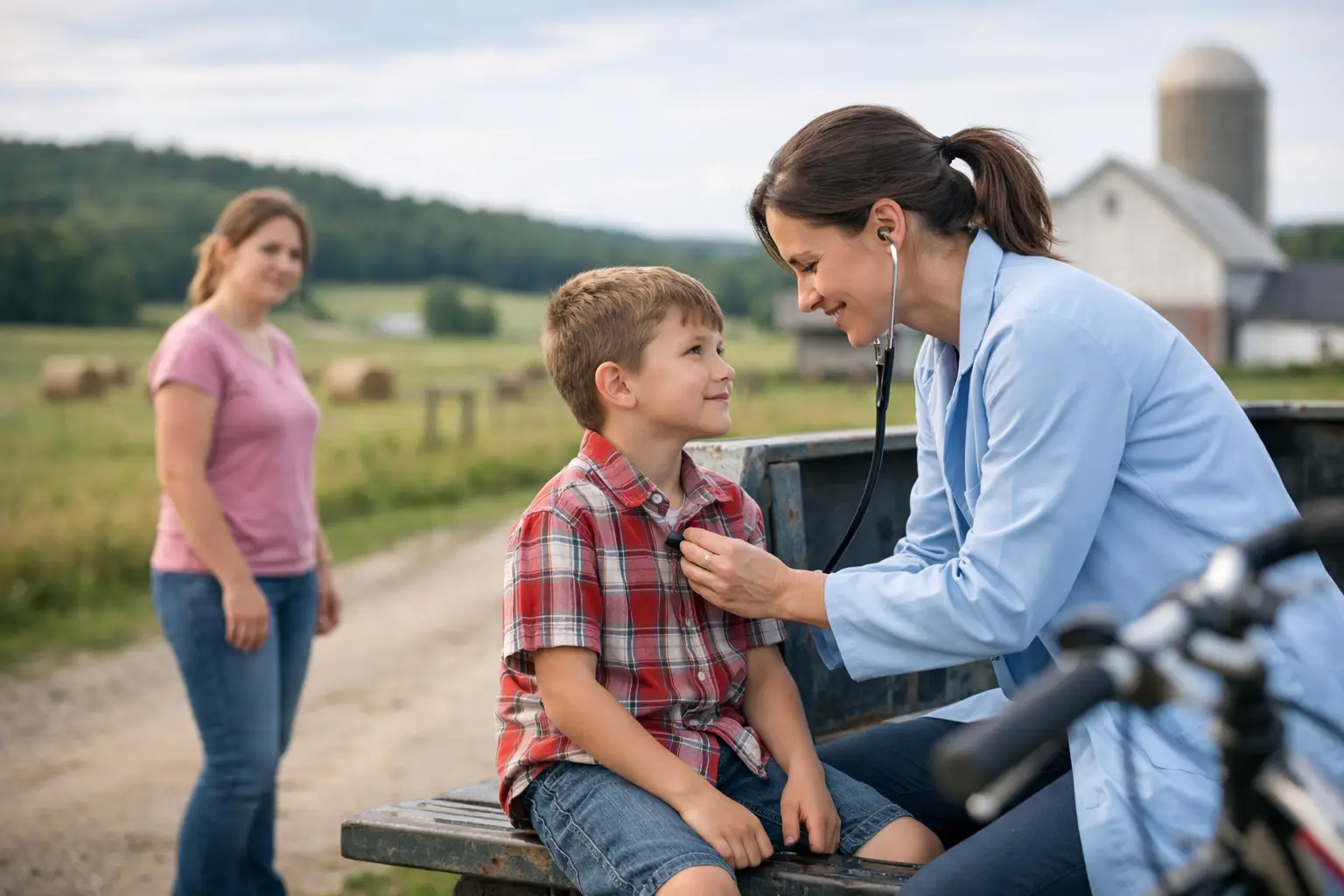
A child with recurring ear pain may need to travel hours for an evaluation. A parent managing a child’s asthma may postpone follow-up because leaving work, arranging transportation, and missing school are too difficult. For families of autistic children or children with complex medical needs, an unfamiliar clinical setting can add another layer of distress. These are the daily realities behind healthcare access challenges for children in rural areas.
For rural health leaders, the issue is not simply a shortage of appointments. It is a care-delivery problem involving distance, limited workforce capacity, fragmented follow-up, connectivity constraints, and the need to involve caregivers in every decision. Addressing it requires a model that brings clinically meaningful care closer to where children live, learn, and receive support.
Why rural pediatric access is uniquely complex
Rural communities often face broad access barriers, but pediatric care has distinct operational and clinical demands. Children are not smaller adults. Their care depends on developmental context, caregiver observations, school participation, preventive visits, and timely escalation when symptoms change.
A limited local specialist supply can force families to travel long distances for pediatric cardiology, behavioral health, developmental services, pulmonology, or other specialty care. Even when a primary care appointment is available nearby, a clinic may not have the equipment, staffing, or workflow capacity to complete the assessment needed during that visit. The result can be delayed diagnosis, avoidable emergency department use, missed preventive care, and greater caregiver burden.
The burden is rarely limited to a single appointment. A child with a chronic condition may need repeated monitoring, medication adjustments, education, and coordination across primary care, specialty care, school staff, and family members. When every touchpoint requires travel, continuity becomes difficult to sustain.
Distance affects more than transportation
Travel is often treated as a logistical challenge, but its clinical effects are wider. Families may defer nonurgent symptoms until they become more serious. Parents may be unable to take unpaid leave, find child care for siblings, or afford fuel and overnight stays. Severe weather and limited public transportation can make a planned visit impossible.
For children with sensory sensitivities, mobility limitations, or behavioral health needs, the journey itself can be disruptive. A familiar environment such as home, school, a community clinic, or a local pediatric practice may allow the child to participate more comfortably in care. That setting can also give clinicians better context about the child’s daily functioning and support system.
Workforce shortages create continuity gaps
Rural health clinics, critical access hospitals, federally qualified health centers, and community health centers frequently operate with constrained clinical staffing. Recruitment is difficult, and specialty coverage may be intermittent. A visiting specialist may be available only on certain days, while local clinicians are left managing follow-up between appointments.
Virtual care can help extend specialist and primary care reach, but a basic video connection does not resolve the central clinical question: can the remote clinician obtain enough relevant information to make a sound decision? For many pediatric concerns, the answer depends on the ability to conduct a clinician-directed virtual physical exam and capture reliable patient data rather than relying on conversation alone.
Healthcare access challenges for children in rural areas require clinical-grade virtual care
Telehealth has value for education, behavioral health, medication follow-up, care planning, and triage. Yet organizations should be careful not to frame video visits as a complete replacement for in-person pediatric care. Some situations require hands-on evaluation, testing, imaging, emergency intervention, or specialist procedures. A responsible virtual care strategy needs clear escalation pathways.
Where virtual care is clinically appropriate, connected examination and remote patient monitoring tools can strengthen the encounter. A trained caregiver, school nurse, medical assistant, community health worker, or local clinic team can support a remote clinician in collecting relevant findings. This may include vital signs and examination data appropriate to the care pathway, allowing the clinician to assess the child with more confidence and determine whether in-person care is needed.
That distinction matters operationally. A provider organization is not merely increasing appointment volume. It is creating a distributed care model that supports assessment, documentation, follow-up, and coordination across settings.
Build care pathways around the child and caregiver
The strongest programs begin with a specific access problem, not a device purchase. For example, a rural organization may identify frequent travel for asthma follow-up, delayed evaluations for common pediatric complaints, gaps in chronic disease monitoring, or difficulty connecting school-based teams with pediatric providers.
Each use case should define which children are appropriate for virtual care, who facilitates the encounter, what data the clinician needs, and when the child must be seen in person. Care teams should also establish how results are documented, communicated to caregivers, and shared with the child’s primary care provider.
For children with special healthcare needs, customization is particularly valuable. One family may benefit from home-based monitoring and caregiver education. Another may need an appointment at school with a familiar nurse present. A third may require a community clinic visit supported by a remote specialist. The right setting depends on the child’s condition, family capacity, available local staff, broadband access, and clinical risk.
What healthcare organizations need to operationalize rural pediatric care
A scalable program requires more than technology. Clinical leadership, operations, compliance, finance, and frontline staff all need a shared model for how virtual pediatric services will work.
First, organizations should select high-value care pathways where travel burden and delayed access are measurable. Starting with a limited population or condition can help leaders refine workflows before broader deployment. Success measures might include appointment completion, time to clinical evaluation, travel avoided, caregiver participation, follow-up adherence, escalation rates, and staff utilization.
Second, the organization needs clear training and role definition. A virtual exam is only as effective as the workflow surrounding it. Staff and caregivers must understand how to prepare the child, use connected tools, communicate findings, manage technical issues, and recognize when to escalate. Training should account for pediatric communication, family-centered care, and the needs of autistic children and children with sensory or developmental differences.
Third, the program must fit the organization’s documentation, privacy, and reimbursement requirements. HIPAA-compliant technology, appropriate consent processes, credentialing considerations, and documentation standards should be addressed before launch. Reimbursement policies vary by payer, service type, provider type, care setting, and state. Rural organizations need a reimbursement-aware implementation plan that aligns clinical value with long-term financial sustainability.
Finally, care coordination cannot be an afterthought. A remote specialist consult that does not reach the primary care team, caregiver, school nurse, or care manager may add another disconnected encounter. The goal is a complete loop: assessment, decision, plan, follow-up, and shared accountability.
Extending the rural care team without replacing local relationships
Connected care works best when it strengthens the role of local clinicians and trusted community partners. A rural primary care team still knows the family, understands local resources, and manages the child’s broader health needs. Virtual specialists and remote clinicians can add expertise without requiring every child to leave the community for routine follow-up.
This approach also creates opportunities for schools, community clinics, and home-based services to become supported access points for care. The value is not that every location becomes a medical office. It is that the right people, tools, and clinical oversight can come together when and where a child needs them.
Dr. Miltie’s connected-care approach, including the Dr. Miltie N9+ and Circle of Care™ model, is designed to help healthcare organizations support clinician-directed virtual exams, remote monitoring, and coordinated pediatric care beyond the traditional exam room. For rural providers, this can create a more practical path to extending clinical reach while preserving the relationships that families rely on.
A better standard for rural pediatric access
The most meaningful measure of access is not whether a family can join a video call. It is whether a child can receive timely, clinically appropriate care without unnecessary travel, disruption, or delay.
Rural healthcare organizations can move closer to that standard by designing care around real pediatric workflows: trusted local support, active caregiver participation, clinically relevant data, clear escalation, and continuity after the visit. When those pieces are in place, virtual care becomes more than a convenience. It becomes a durable way to bring capable, compassionate care closer to children and the communities raising them.
Move from information to action
See how the N9+ can fit your organization.
Explore the remote physical exam platform or request a focused demonstration.