
Remote Child Exams for School-Based Care Programs
See how remote child exams for school-based care programs with Dr. Miltie N9+ can expand access, support clinicians, and reduce care delays.
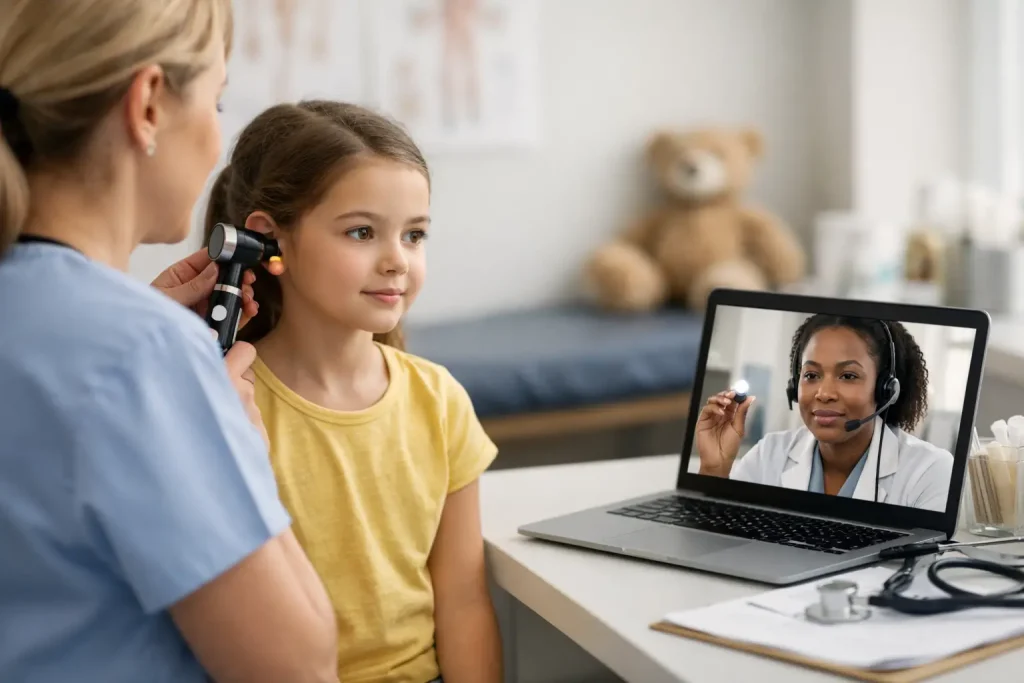
A school nurse sees the same pattern every week – a child with asthma symptoms, a student with an ear complaint, a parent who cannot leave work, and a provider schedule that is already full. In that gap between concern and access, remote child exams for school-based care programs Dr. Miltie N9+ can change what is possible.
For healthcare organizations serving children in schools, the question is no longer whether virtual care belongs in pediatric access strategy. The real question is whether the virtual model can support clinically useful exams, fit school workflows, involve caregivers, and stand up to operational realities like staffing, documentation, and reimbursement. That is where device-enabled virtual exams matter.
Why school-based pediatric access needs more than video
Basic video visits can help with triage and follow-up, but school-based care programs often need more than conversation and observation. A child with a sore throat, rash, cough, ear pain, or chronic condition may require clinically relevant data that a standard webcam cannot provide. When the program depends only on video, the remote clinician may still need to defer care, send the child out for another appointment, or ask the family to travel for an in-person assessment.
That is a weak outcome for the child, the caregiver, the school, and the care team. It can also undermine trust in school-based virtual care programs because the encounter feels incomplete.
A stronger model extends the clinician’s senses into the school setting. With connected exam capabilities, the provider can assess more than symptoms alone. That creates a different level of clinical confidence and supports more informed decision-making within the school-based care environment.
How remote child exams for school-based care programs work
In a practical model, a trained staff member at the school site helps facilitate the visit while the remote clinician directs the examination. The goal is not to turn school personnel into diagnosticians. The goal is to give licensed providers a way to perform virtual physical exams with better visibility into the child’s condition.
This matters especially in pediatric populations, where symptoms can be subtle, communication may be limited, and a calm familiar environment can improve participation. For autistic children and pediatric patients with special healthcare needs, being seen in a school or community setting may reduce stress compared with sending the child to an urgent care center or specialty office.
The Dr. Miltie N9+ is designed for this type of clinician-directed virtual examination. In school-based programs, that means care teams can gather clinically relevant information during the encounter rather than treating the visit as a simple screening call. The difference is operational as much as clinical. Better data at the point of care can reduce unnecessary transfers, avoidable absences, and delays in follow-up.
Where the Dr. Miltie N9+ fits in school-based care
School-based care programs sit at the intersection of healthcare delivery, family logistics, and educational continuity. They often serve children who face transportation barriers, limited local specialty access, or gaps in preventive and follow-up care. Rural and safety-net settings feel this most sharply, but the challenge is not limited to remote areas.
The Dr. Miltie N9+ fits when an organization wants to expand clinical reach without lowering the quality of the exam. It supports provider-led assessment in distributed environments such as schools, community clinics, and other familiar settings where children already are. For health systems, federally qualified health centers, pediatric groups, and community-based programs, that creates a pathway to bring care closer to the patient while keeping the clinician at the center of decision-making.
That said, not every school-based encounter needs advanced exam capability. Medication counseling, behavioral health check-ins, and some routine follow-ups may work well through standard telehealth. The value of a connected exam platform becomes clearer when the program is trying to manage common acute complaints, monitor pediatric chronic conditions, or support children who struggle with access to traditional clinic visits.
Clinical and operational benefits for pediatric programs
The first benefit is improved access, but access alone is not enough. School-based care programs need access that leads to action. If a virtual encounter allows the provider to evaluate the child more thoroughly, the organization is in a better position to make timely care decisions, coordinate next steps, and keep families engaged.
The second benefit is caregiver participation. Families often miss school-based or outpatient visits because of work schedules, transportation issues, or distance from the clinic. A connected virtual exam model can make it easier to include parents or guardians in the encounter without requiring them to leave work or move the child across town. That is particularly valuable in pediatric care, where family context often shapes treatment plans and follow-through.
The third benefit is continuity. School-based programs are most effective when they are not operating as isolated access points. They need to connect to broader care pathways such as primary care, chronic care management, specialist follow-up, and community support services. A connected-care approach supports that continuity by helping organizations capture clinically meaningful data and integrate school-based encounters into a larger model of care coordination.
What health system leaders should evaluate before rollout
A school-based virtual exam program succeeds or fails on workflow design. The technology matters, but it is only one part of the model.
Clinical leaders should define which pediatric use cases belong in the program and which still require in-person escalation. Ear complaints, respiratory symptoms, skin concerns, chronic disease follow-up, and select urgent assessments may be strong candidates. Others may not be. Setting those boundaries early protects both quality and staff confidence.
Operational leaders should also assess who will facilitate the encounter at the school site, how consent will be handled, how caregiver engagement will occur, and how documentation will flow back into the organization’s existing systems. If those questions are left vague, adoption slows and the burden shifts to already stretched staff.
Reimbursement and compliance deserve equal attention. School-based virtual care cannot be built as a pilot that ignores financial sustainability. Programs need a reimbursement-aware deployment model that accounts for payer mix, care setting, clinician type, documentation standards, and the applicable rules surrounding telehealth, remote patient monitoring, and related services. HIPAA compliance, device management, and staff training are not side issues. They are part of the implementation foundation.
Why pediatric and special-needs populations need a different lens
Children are not small adults, and school-based care programs should not be designed as generic telehealth deployments. Pediatric workflows need to account for developmental stage, communication style, family involvement, and sensory needs.
This is especially true for autistic children and those with special healthcare needs. A rushed workflow, unfamiliar setting, or fragmented care process can make the encounter harder for the child and less useful for the clinician. By contrast, a familiar school environment combined with clinician-directed remote exam tools can support a calmer interaction and a more complete understanding of the child’s needs.
There is also a practical equity dimension. Children with complex needs often require more frequent touchpoints, and their caregivers often carry a higher logistical burden. When school-based care programs can provide meaningful exams and follow-up support closer to where the child already is, the organization is not just adding convenience. It is reducing friction that often leads to missed care.
Remote child exams for school-based care programs and long-term strategy
For many organizations, school-based pediatric access begins as a response to unmet need. Over time, it becomes part of a broader care transformation strategy. Remote child exams for school-based care programs can support preventive care, episodic care, chronic condition monitoring, and stronger links between schools, families, and clinical teams.
That is where the model becomes more valuable than a standalone telehealth tool. A connected-care platform can help organizations extend clinical capacity into communities, support workforce efficiency, and create more consistent pathways for children who might otherwise cycle through delayed or fragmented care.
Dr. Miltie’s Circle of Care model is relevant here because school-based care works best when the child is not treated as a one-time encounter. The school, caregiver, provider, and care coordinator all influence outcomes. Technology should strengthen that circle, not complicate it.
School-based care leaders do not need more promises about innovation. They need tools that help clinicians examine children more effectively, help families participate more easily, and help organizations build programs that can scale responsibly. When the virtual exam is clinically useful and operationally realistic, school-based care can become a dependable extension of pediatric access rather than a workaround. That is a meaningful shift for providers trying to bring high-quality care closer to the children who need it most.
Move from information to action
See how the N9+ can fit your organization.
Explore the remote physical exam platform or request a focused demonstration.