
How the N9+ Brings Telemedicine Into Classrooms
Here's how telemedicine brings healthcare right to the classroom with the N9+: connected virtual exams and coordinated care where students learn each day.
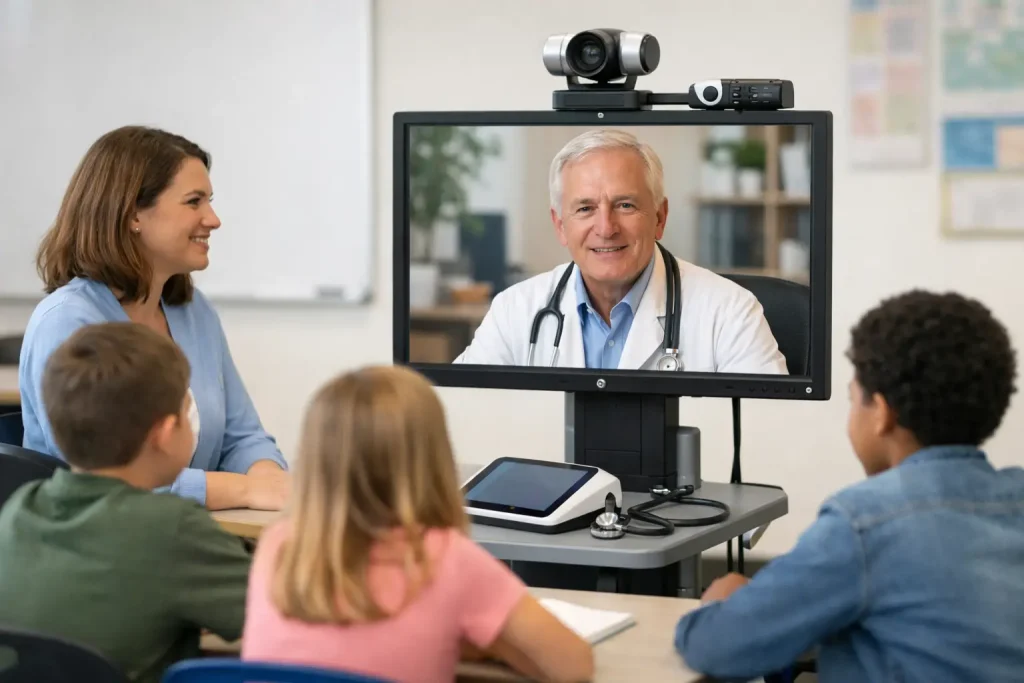
A student develops an earache midway through the school day. A parent cannot leave work, the nearest pediatric clinic is 45 minutes away, and the school nurse must decide whether the child needs urgent evaluation or can safely remain at school. This is where here’s how telemedicine brings healthcare right to the classroom with the N9+ becomes more than a headline. It becomes a practical care-delivery model that gives clinicians the information needed to guide care without asking families to make an unnecessary trip.
For schools, pediatric practices, rural health organizations, and community health centers, connected telemedicine can turn the school health office into an extension of the clinical care team. The goal is not to replace hands-on care when it is needed. It is to make a clinically directed virtual assessment possible sooner, in a familiar setting, with the right people connected around the student.
How the N9+ brings telemedicine into the classroom
A typical video visit can be useful for conversation, observation, medication follow-up, or behavioral health support. But video alone has limits when a clinician needs objective data to assess a child with a physical concern. A caregiver or school staff member may be able to describe symptoms, yet description is not the same as hearing lung sounds, viewing an ear canal, or reviewing a temperature and other relevant measurements.
The Dr. Miltie N9+ is designed to extend a clinician-directed virtual physical exam beyond the traditional exam room. With connected examination and patient-monitoring capabilities, an authorized on-site facilitator can support the visit while the remote clinician directs the assessment and receives clinically relevant findings. The clinician remains responsible for medical decision-making, while the school-based team helps create access at the point of need.
That distinction matters. A school nurse is not being asked to function as a remote physician, and a device is not making a diagnosis. Instead, the technology supports a structured workflow in which the right information can move to the right clinician at the right time.
A school-based visit that supports clinical decisions
The most effective classroom telemedicine programs are built around a clear operating model. A student may be referred by the school nurse, identified through a care plan, or scheduled for preventive or follow-up services. Consent, eligibility, documentation requirements, and escalation pathways should be established before the first visit.
When a child needs evaluation, the on-site facilitator prepares the student and connects the encounter. The remote provider can speak directly with the student when appropriate, observe symptoms, ask targeted questions, and guide use of the N9+ to capture the data needed for the presenting concern. Findings can inform the next clinical step: a care plan delivered at school, a prescription sent through the appropriate process, parent guidance, follow-up monitoring, or referral for in-person evaluation.
This approach is especially useful when the clinical question is time-sensitive but not necessarily an emergency. Common examples may include respiratory symptoms, ear pain, rashes, sore throat, minor injuries, medication concerns, chronic condition follow-up, and post-discharge check-ins. The appropriate use cases depend on provider protocols, staff training, student needs, and the capabilities of the participating care organization.
The value of a familiar setting for pediatric patients
For many children, a school-based encounter removes practical barriers. Families may avoid missed work, transportation costs, arranging childcare for siblings, and lengthy travel to a distant clinic. The student can receive an evaluation without losing an entire day of instruction.
The familiar environment can be even more meaningful for autistic children and pediatric patients with special healthcare needs. Unfamiliar waiting rooms, sensory stimulation, disrupted routines, and long travel can make a routine appointment difficult. A virtual exam facilitated by trusted school personnel may reduce stress while giving parents and caregivers a clearer role in the encounter.
That does not mean school is always the right location. Some children need a fully equipped in-person exam, laboratory testing, imaging, or immediate treatment. A strong telemedicine program makes those decisions easier by helping clinicians determine when a child can be supported remotely and when escalation is necessary.
Extending the care team, not creating another silo
School health programs often operate alongside pediatric offices, health systems, federally qualified health centers, and public health resources. Without deliberate coordination, a school-based telemedicine visit can become another disconnected event in a child’s record.
Connected care should instead strengthen continuity. Dr. Miltie’s Circle of Care™ model centers the student within a coordinated network that can include the remote clinician, school nurse, parent or caregiver, primary care provider, specialists, care coordinators, and community supports. Each participant has a distinct role, but the experience should feel coherent to the family.
For clinical and operational leaders, this means defining how information is documented, how caregivers are notified, how follow-up is assigned, and how urgent concerns are escalated. It also means determining whether the school-based program is connected to an existing pediatric practice, a rural health clinic, a community health center, or a health system virtual care service.
The technology is only one layer. Sustainable programs also require training, workflow design, privacy safeguards, governance, and shared expectations between the education and healthcare organizations involved.
Why this model matters in rural and underserved communities
In rural communities, the distance between a school and a pediatric provider can be substantial. Even where services exist, appointment availability and transportation can delay care. For critical access hospitals, rural health clinics, and community-based organizations, school-enabled telemedicine can help extend scarce clinical capacity without requiring a clinician to travel to every site.
The opportunity is not limited to rural settings. Urban and suburban safety-net communities also face access barriers related to work schedules, insurance navigation, limited transportation, and long waits for specialty services. A connected virtual exam pathway can give organizations another place to meet families where they already are.
This can support broader population health goals, including earlier intervention, chronic disease management, preventive care, and reduced avoidable utilization. However, organizations should avoid assuming that virtual access automatically produces those outcomes. Results depend on adoption, referral patterns, provider capacity, family trust, and the consistency of follow-up.
Designing a reimbursement-aware school telemedicine program
Financial sustainability deserves attention at the beginning, not after the pilot succeeds. Reimbursement may vary according to payer policy, provider type, service location, state requirements, documented clinical elements, and the services delivered. Organizations should involve reimbursement and compliance leaders early to evaluate applicable telehealth, remote patient monitoring, chronic care management, and care coordination pathways.
A reimbursement-aware design also considers the operational cost of running the program. Leaders should account for device deployment, connectivity, staff time, training, clinical coverage, consent management, documentation, and technical support. The strongest model may differ by community. One organization may prioritize same-day acute access, while another focuses on chronic pediatric follow-up or services for students with complex care needs.
Before implementation, healthcare leaders should establish at least four practical foundations:
- Clinical protocols that define eligible concerns, remote exam workflows, and escalation criteria.
- School and caregiver processes for consent, scheduling, privacy, and communication.
- Training that helps on-site facilitators use the technology confidently and within their scope.
- Reporting that tracks utilization, referral outcomes, missed school time, family experience, and clinical follow-up.
These foundations help leaders distinguish a meaningful care program from a collection of isolated virtual visits.
Bringing care closer without lowering the clinical standard
The promise of telemedicine in schools is not that every health issue can be handled through a screen. Its value is that a qualified clinician can be brought into the decision earlier, supported by connected examination tools and an on-site care partner.
For healthcare organizations serving children, rural communities, and underserved populations, the N9+ can help create a more practical path to evaluation, monitoring, and coordinated follow-up. When the program is clinically governed, workflow-ready, and designed around families, the school health office can become a trusted access point rather than a temporary stop between illness and care.
The next useful question for leaders is not simply whether telemedicine belongs in schools. It is which students face the greatest barriers today, and how a connected care model can help their clinical team reach them sooner.
Move from information to action
See how the N9+ can fit your organization.
Explore the remote physical exam platform or request a focused demonstration.