
Rural Health Care for Federally Qualified Health Centers
Rural health care for federally qualified health centers needs scalable virtual care, better workflows, and reimbursement-aware technology.
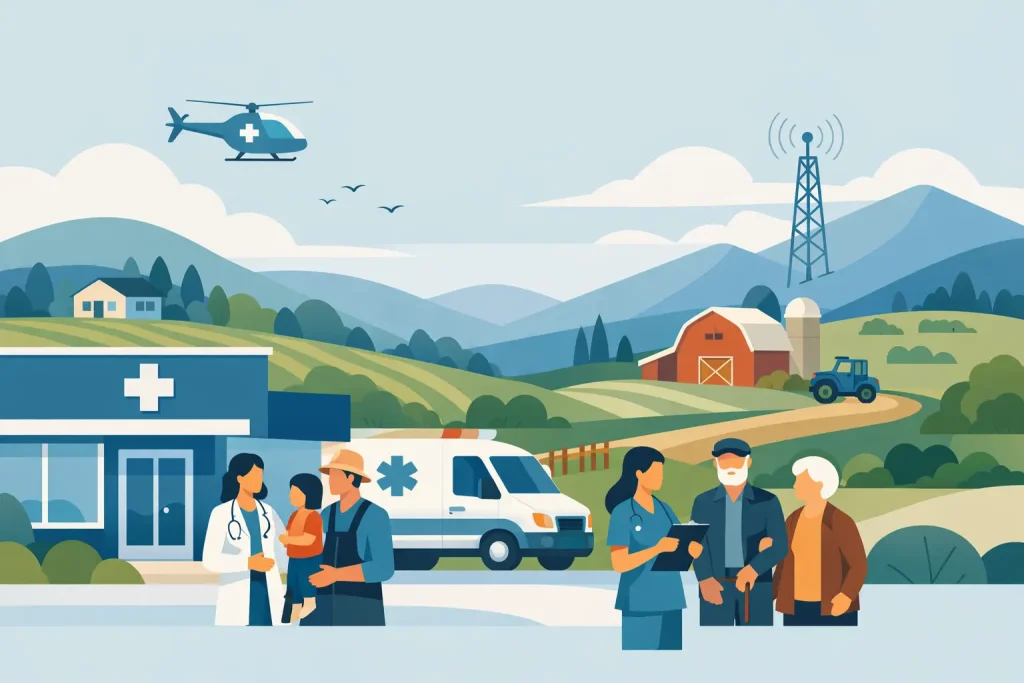
A patient who lives 45 miles from the nearest clinic does not experience care gaps as an abstract policy problem. For federally qualified health centers, those gaps show up as missed follow-ups, delayed chronic disease management, medication confusion, and families choosing between a workday and a medical visit. Rural health care for federally qualified health centers has to work in the real conditions patients face – distance, staffing shortages, limited specialty access, inconsistent transportation, and higher social risk.
That reality is why many FQHC leaders are rethinking what access actually means. It is not just about adding appointments. It is about building a care model that can reach patients in schools, community sites, satellite locations, and homes while still supporting clinical quality, documentation, care coordination, and reimbursement.
Why rural health care for federally qualified health centers is different
Rural FQHCs carry a uniquely difficult mandate. They are expected to deliver comprehensive primary care, preventive services, chronic disease support, and care coordination for populations that often have higher medical and behavioral health needs. At the same time, they operate with lean teams and limited room for inefficiency.
The challenge is not simply geography. Rural patient populations often include older adults managing multiple chronic conditions, children with limited access to pediatric specialists, agricultural workers with constrained schedules, and families who may delay care until symptoms worsen. In many service areas, broadband access is inconsistent and in-person specialty referral networks are thin. A standard telehealth strategy built for urban systems may not hold up under those conditions.
For FQHCs, the practical question is this: how do you extend clinical reach without adding operational complexity that staff cannot sustain? The answer usually is not one more point solution. It is a connected model that supports virtual exams, remote patient monitoring, caregiver participation, and structured follow-up in a way that fits existing workflows.
Access is only useful if it is clinically meaningful
There is a difference between a basic video call and a visit that helps a clinician make a better decision. Rural health access programs can fail when they expand convenience but not clinical value. If a provider still needs an in-person visit to assess the patient properly, the virtual interaction may create another step rather than resolve the issue.
That is where connected-care infrastructure matters. FQHCs need tools that support clinician-directed virtual examination, capture relevant patient data, and allow teams to monitor patients between visits when appropriate. This is especially important for hypertension, diabetes, respiratory conditions, post-discharge follow-up, and pediatric care where timely observation can prevent deterioration or unnecessary travel.
A stronger model also improves the patient experience. Families are more likely to participate when care can happen closer to home, when caregivers can join more easily, and when the visit feels complete rather than partial. For pediatric populations, that benefit can be even more significant. Children, including autistic children and those with special healthcare needs, may tolerate assessments better in familiar, lower-stress environments than in a crowded clinic after a long drive.
The operational case for virtual care in rural FQHC settings
Most FQHC leaders are not asking whether virtual care has value. They are asking whether it can be deployed in a way that improves throughput, supports staff, and aligns with payment realities.
That concern is justified. A poorly designed telehealth program can create scheduling confusion, fragmented documentation, and uneven clinical adoption. But a reimbursement-aware, workflow-based approach can do the opposite. It can help organizations triage more effectively, reduce avoidable in-person utilization, support chronic care management, and improve continuity for patients who tend to fall out of follow-up.
In rural settings, virtual care is often most effective when it is not treated as a separate service line. It works better as an extension of primary care, care management, school-based outreach, and community-based services. A nurse can review remote patient monitoring trends before the clinician visit. A care coordinator can close the loop with a caregiver after a virtual assessment. A satellite site can facilitate a clinician-directed exam without requiring a specialist to be physically present.
That integration matters because rural care teams do not have excess capacity. Every new program must justify itself in labor, not just technology.
What successful rural health care for federally qualified health centers requires
The most effective strategies usually share the same foundation. They are built around clinical utility, operational fit, and financial sustainability rather than novelty.
Clinically relevant virtual exams
If the goal is to extend access, the remote encounter has to support meaningful assessment. FQHCs benefit from tools that allow clinicians to gather more than patient-reported symptoms alone. The more complete the remote exam, the more likely the organization can use virtual care for follow-up, triage, chronic disease support, and community-based assessments without sacrificing confidence.
Remote patient monitoring with a clear use case
RPM can be powerful in rural populations, but only when the program is targeted. Monitoring every patient is rarely realistic. Monitoring the right patients, with a defined escalation pathway, can help teams identify problems earlier and manage chronic conditions more consistently. Hypertension, heart failure, diabetes, and respiratory disease are common entry points, but local population needs should drive the program design.
Care coordination that includes caregivers and community settings
Rural care often happens through relationships that extend beyond the exam room. Parents, school nurses, family caregivers, and community health workers may all play a role. Technology should make that participation easier, not harder. That is particularly valuable in pediatrics and in populations where transportation barriers or work schedules limit who can attend a clinic visit.
Workflow design, training, and adoption support
Implementation can stall when technology is clinically sound but operationally awkward. Rural FQHCs need staffing models, documentation processes, and escalation protocols that fit real-world capacity. Training cannot stop at device setup. Teams need to know when to use virtual exams, how to route patient data, how to support patients with low digital confidence, and how to align services with reimbursement requirements.
Pediatrics and special populations deserve a different lens
Rural pediatric access is often discussed as a subset of primary care, but that framing can miss the complexity. Many FQHCs serve children who need follow-up that is difficult to coordinate locally, whether because of specialist shortages, behavioral health needs, developmental concerns, or family transportation constraints.
Virtual care can help, but only if it respects how children and families actually engage with healthcare. A rushed video check-in may not help a clinician assess a child with sensory sensitivities or support a parent trying to explain subtle symptom changes. A more complete, clinician-directed virtual care model can make a meaningful difference by improving observation, reducing travel burden, and allowing children to be seen in environments where they are calmer and more cooperative.
For organizations serving autistic children or pediatric patients with special healthcare needs, that flexibility is not a convenience feature. It can be the difference between a successful encounter and one that has to be rescheduled, escalated, or abandoned.
Technology is only part of the answer
There is a tendency in healthcare transformation to over-focus on the platform. For FQHCs, the better question is whether the technology strengthens the care model they are already accountable for delivering.
That means looking at interoperability, HIPAA compliance, documentation requirements, CMS-aligned reimbursement pathways, and the degree of workflow customization available. It also means asking whether the vendor understands safety-net care. Rural FQHCs do not need generic telehealth language. They need a partner that understands distributed care delivery, constrained staffing, community-based workflows, and the realities of sustaining programs after the launch period.
This is where a connected-care approach stands out. When virtual exams, remote monitoring, patient engagement, and follow-up workflows are designed as part of one coordinated model, organizations are better positioned to scale without creating fragmented operations. Platforms such as Dr. Miltie are increasingly relevant in this space because they are built around extending clinical reach while supporting implementation, training, and reimbursement-aware deployment.
Where FQHC leaders should focus next
For many organizations, the next step is not a large-scale overhaul. It is choosing one or two high-impact use cases and building from there. That might mean remote follow-up for high-risk chronic care patients, virtual pediatric assessments from school or community settings, or post-discharge monitoring for patients at elevated readmission risk.
The right starting point depends on local realities. A center with strong care management capacity may prioritize RPM. A pediatric-heavy organization may focus on virtual exams that reduce family travel. A multi-site FQHC may want to use connected tools to extend scarce clinician expertise across locations. There is no single blueprint, and that is exactly the point.
Rural health transformation works when it is practical enough for staff, credible enough for clinicians, and accessible enough for patients to use consistently. Federally qualified health centers already carry the trust of the communities they serve. With the right virtual care infrastructure, that trust can extend far beyond the clinic walls and bring better care within reach of the patients who have waited too long for it.
Move from information to action
See how the N9+ can fit your organization.
Explore the remote physical exam platform or request a focused demonstration.