
Technology Solutions for Special Needs Pediatric Care
Technology solutions for special needs pediatric care can improve access, reduce stress, and support remote exams, monitoring, and follow-up.
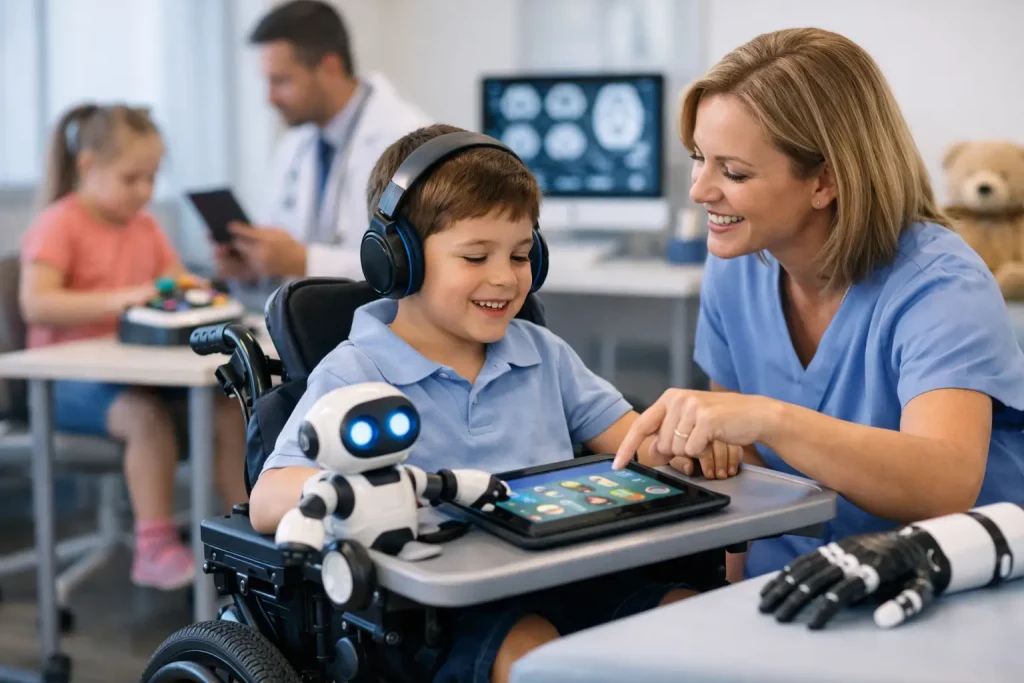
A child with autism who becomes overwhelmed in a waiting room, a family driving three hours for a follow-up that lasts 15 minutes, a school nurse trying to coordinate care for a student with complex needs – these are exactly the moments when technology solutions for special needs pediatric care move from nice-to-have to operationally necessary.
For healthcare organizations, the question is no longer whether digital tools belong in pediatric care. The real question is which technologies actually improve clinical access, caregiver participation, and continuity of care for children who need more flexible, lower-stress care pathways. In special needs pediatrics, the best technology does not replace in-person care. It helps providers extend it with more precision.
Why technology solutions for special needs pediatric care matter
Children with special healthcare needs often require more touchpoints, more coordination, and more adaptation than a standard clinic model can comfortably deliver. That is especially true for autistic children, children with developmental delays, medically complex pediatric patients, and families managing chronic conditions across multiple specialists.
Traditional care models can create friction at every step. Travel may be difficult, sensory environments may be destabilizing, and caregiver schedules may limit attendance. For rural providers, staffing shortages and geographic barriers add another layer of complexity. When a child misses care because the setting is stressful or the logistics are too burdensome, the result is not just inconvenience. It can mean delayed assessment, fragmented follow-up, and less complete clinical information.
Technology helps when it is designed around those realities. A video visit alone may support conversation, but many pediatric cases require more than conversation. Clinicians need ways to assess physical findings remotely, track meaningful health data between visits, and involve caregivers, schools, and community-based teams without creating extra administrative burden.
What effective technology looks like in special needs pediatrics
Not all virtual care tools are built for pediatric complexity. For this population, effectiveness depends on clinical relevance, workflow fit, and whether the technology supports care in familiar environments such as the home, school, community clinic, or pediatric practice.
Virtual examination capability
A basic telehealth platform may support face-to-face interaction, but it often stops short of a true clinical assessment. In special needs pediatric care, that gap matters. Providers may need to visualize the throat or ear, assess heart and lung sounds, review skin conditions, or capture other clinically relevant data without requiring the child to travel into a higher-stress setting.
Connected virtual exam tools make remote visits more actionable because they bring elements of the physical assessment into the encounter. That can be particularly useful for follow-up visits, school-based assessments, community outreach programs, and rural pediatric access models. It also creates a better experience for children who regulate more effectively in familiar spaces.
Remote patient monitoring
For children with chronic conditions or ongoing symptom management needs, remote patient monitoring can improve visibility between visits. Depending on the patient population, that may include vital signs, oxygen saturation, weight trends, or other condition-specific measures.
The value is not in collecting data for its own sake. The value comes from giving care teams timely, actionable information that supports earlier intervention and more tailored follow-up. For special needs pediatric populations, remote monitoring can also reduce the frequency of disruptive travel while helping organizations maintain continuity of care.
Caregiver-centered communication
In pediatrics, the caregiver is often a core part of the care model. That is even more true when a child has developmental, behavioral, or medical complexity. Technology should make it easier for parents and caregivers to participate, not harder.
That means platforms need to support clear communication, simple onboarding, and flexible engagement across care settings. If a caregiver cannot easily join a visit, understand next steps, or contribute observations from home, the care model becomes less effective. Strong pediatric programs recognize that caregiver insight is often clinically significant, particularly when the child cannot fully self-report symptoms or tolerate traditional exams.
The operational case for remote and connected care
Healthcare leaders evaluating technology solutions for special needs pediatric care are not only asking whether the tools work clinically. They are also asking whether the model can be deployed, sustained, and reimbursed.
That is where many programs either gain traction or stall. A promising pediatric telehealth initiative can lose momentum if it creates duplicate workflows, depends on one champion, or lacks reimbursement alignment. The stronger approach is to treat connected care as a service delivery model, not a stand-alone technology purchase.
Workflow and staffing realities
Special needs pediatric care often involves coordination across clinicians, caregivers, schools, and community-based programs. Technology should reduce fragmentation, not add another disconnected layer. Implementation works better when workflows are designed around who captures the data, who reviews it, how follow-up is triggered, and which encounters qualify for reimbursement.
For example, a school-based program may need one workflow, while a rural pediatric clinic may need another. The platform should be flexible enough to support both without forcing organizations into a one-size-fits-all design. Customization matters because pediatric populations are heterogeneous, and so are the care environments that serve them.
Reimbursement-aware deployment
Clinical value alone does not guarantee sustainability. Organizations need a reimbursement-aware approach that aligns remote patient monitoring, chronic care management, virtual visits, and care coordination with billing requirements and documentation standards.
This is particularly relevant for safety-net providers, community health centers, and rural organizations working under tight financial constraints. The right technology partner helps programs think through not only adoption, but also financial durability. That includes training, documentation support, and pathways that fit regulated care environments.
Compliance and trust
In pediatric care, trust is built through reliability, privacy, and clinical quality. Any technology used in this setting must support HIPAA compliance, secure data handling, and appropriate role-based access. But compliance is only part of the equation.
Families and providers also need confidence that the technology can support a clinically meaningful interaction. If the platform is difficult to use, produces poor-quality data, or interrupts the visit flow, trust erodes quickly. Special needs pediatric care leaves little room for tools that work well in theory but poorly in practice.
Where these solutions create the most value
The strongest use cases are often the least dramatic. They are the follow-up visits that happen sooner because travel is no longer a barrier. The care plans that improve because caregivers can participate more fully. The rural programs that expand pediatric access without requiring every child to come to a distant specialty center.
Organizations often see value in developmental and behavioral follow-up, chronic disease management, post-discharge check-ins, school-based pediatric support, and community-based access models. Children who experience sensory overload in conventional clinical settings may also benefit when parts of their care can be delivered in a more familiar environment.
That said, not every pediatric encounter should be remote. Some children need in-person diagnostics, procedures, or hands-on examination that cannot be replicated virtually. The point is not to force virtual care where it does not belong. The point is to use technology strategically, so in-person capacity is reserved for the encounters that truly require it.
Choosing a technology partner, not just a platform
For decision-makers, one of the biggest mistakes is evaluating pediatric virtual care as a software selection exercise alone. In practice, outcomes depend just as much on implementation support, device integration, training, and program design.
A connected-care partner should understand pediatric workflows, rural access barriers, caregiver engagement, and reimbursement mechanics. The most useful solutions combine virtual exam capability, monitoring tools, configurable care pathways, and operational support. That is especially important for organizations serving medically underserved communities, where every new program must deliver both access gains and practical efficiency.
In this context, platforms such as Dr. Miltie’s connected-care model are gaining attention because they support clinician-directed virtual exams, remote monitoring, and distributed care delivery in homes, schools, clinics, and community settings. That broader model matters more than a device spec sheet because special needs pediatric care rarely fits inside a single encounter type.
A better standard for pediatric access
Technology should not ask children with special needs to adapt to the limitations of the healthcare system. It should help the healthcare system adapt to them.
That shift has meaningful implications for pediatric practices, health systems, rural clinics, federally qualified health centers, and community-based care organizations. When virtual exams, remote monitoring, and caregiver-connected workflows are implemented thoughtfully, they can reduce avoidable travel, improve follow-up, and make care more tolerable for children who need a different approach.
The most effective programs start with a simple premise: care works better when it reaches the child in the setting where that child can best participate. For special needs pediatrics, that is not a convenience feature. It is often the difference between delayed care and care that truly happens.
Move from information to action
See how the N9+ can fit your organization.
Explore the remote physical exam platform or request a focused demonstration.