
Telehealth Programs for Underserved Populations
Telehealth programs for underserved populations can expand access, support pediatric and rural care, and improve outcomes with the right model.
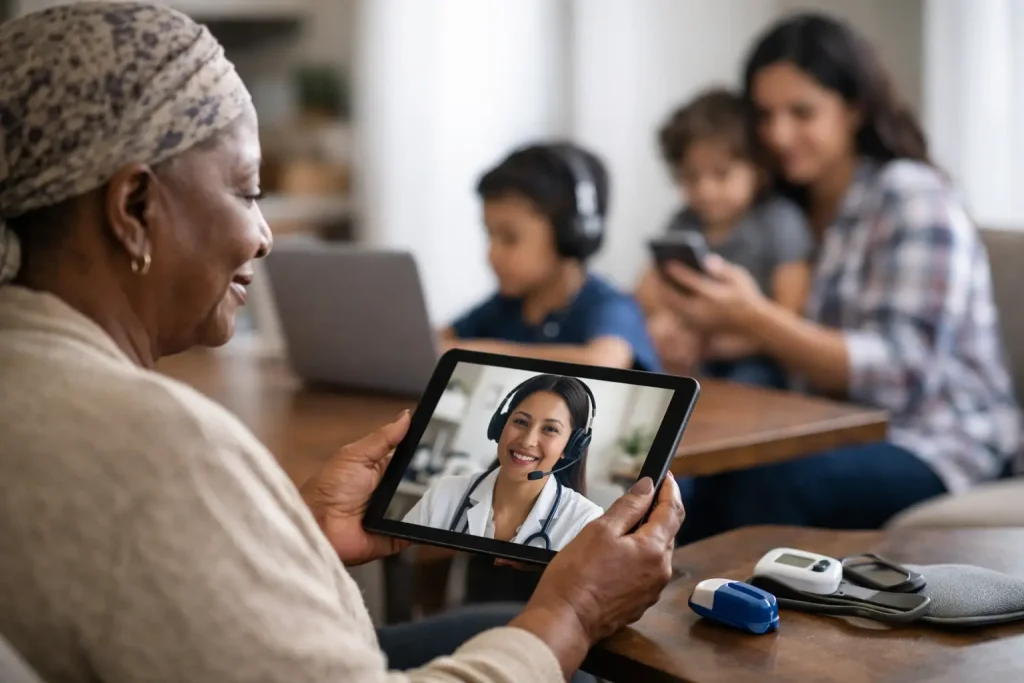
A child with sensory sensitivities may miss needed follow-up care because the clinic visit itself is the barrier. A rural patient with heart failure may delay evaluation because the nearest specialist is hours away. These are the practical care gaps telehealth programs for underserved populations are being asked to solve, and the answer is rarely a basic video visit alone.
For healthcare leaders, the real question is not whether virtual care matters. It is whether a telehealth model can support clinically relevant assessment, fit operational workflows, include caregivers, and hold up under reimbursement and compliance requirements. Programs that succeed tend to be the ones built around care delivery realities, not just technology adoption goals.
What makes telehealth programs for underserved populations different
Underserved populations are often grouped into one category, but the barriers vary widely. A federally qualified health center serving agricultural workers faces different constraints than a pediatric practice supporting autistic children or a critical access hospital managing specialist shortages. The common thread is that access problems are layered. Transportation, broadband, workforce availability, health literacy, caregiver burden, and fragmented follow-up all affect whether care actually happens.
That is why telehealth programs for underserved populations need to do more than create remote appointment slots. They have to reduce friction across the entire episode of care. In many cases, that means giving clinicians a better way to perform virtual physical exams, capture patient data remotely, monitor chronic conditions between visits, and engage caregivers who are essential to adherence and continuity.
This is also where program design becomes more strategic. If a health system launches telehealth only for convenience, it may improve patient satisfaction for already engaged patients while leaving the hardest-to-reach groups behind. If it launches telehealth as an access infrastructure, the model changes. The care team starts thinking about schools, homes, community clinics, rural spokes, and safety-net settings as active care sites rather than referral endpoints.
Access improves when virtual care is clinically usable
One of the biggest reasons telehealth programs underperform is that the clinical encounter is too limited. A video platform may be enough for medication review or a straightforward follow-up, but it often falls short when the provider needs to assess heart and lung sounds, examine the ear or throat, review skin findings, or collect objective monitoring data.
For underserved populations, that limitation matters more, not less. Patients who already face travel and scheduling barriers are the least well served by a virtual model that still requires an in-person visit for basic clinical clarification. When remote care includes clinician-directed virtual examination tools and connected devices, the encounter becomes more actionable. The provider can make a decision, not just defer one.
This is especially relevant in pediatrics. Children with special healthcare needs, including autistic children, may tolerate care better in familiar environments such as home, school, or a trusted community site. In those settings, a more complete virtual exam can reduce stress for the patient and family while improving the quality of the encounter. It also gives caregivers a more active role, which often strengthens follow-through after the visit.
Why pediatric and rural use cases often lead adoption
Pediatric and rural programs tend to expose both the promise and the limits of telehealth quickly. In pediatrics, the need is often less about convenience and more about reducing disruption. Families may be balancing school, work, transportation, behavioral needs, and specialist access all at once. Virtual care that supports examination, follow-up, and monitoring in lower-stress settings can meaningfully improve attendance and continuity.
In rural care, the pressure points are often capacity and distance. A rural health clinic or critical access hospital may have strong local care teams but limited access to specialists, pediatric expertise, or ongoing chronic disease support. Telehealth can extend clinical reach, but only if the workflow is realistic. If local staff need to manage multiple disconnected tools, or if referral coordination remains manual, the program can add burden instead of reducing it.
That is why successful rural and community-based deployments usually pair technology with workflow design, training, and reimbursement planning. A telehealth platform is only one part of the service model. The operating question is whether it helps existing teams do more with the staff and resources they already have.
The operational choices that determine success
Healthcare organizations often start with technology selection, but the more useful starting point is patient population and care objective. Is the goal to improve pediatric follow-up after hospital discharge? Expand virtual primary care in rural communities? Support chronic care management for high-risk patients? Reduce avoidable transfers? Each objective points to a different operational design.
The next issue is who participates in the encounter. Some models are direct-to-home. Others work better through supported sites such as schools, community clinics, long-term care facilities, or mobile outreach programs. For underserved populations, assisted telehealth can be especially effective because it addresses digital literacy, device access, and hands-on support during the visit.
Clinical scope also matters. Programs are stronger when they define what can be safely and effectively managed remotely, what data must be captured, and when escalation is required. That creates confidence for clinicians and reduces inconsistent practice patterns.
Then there is reimbursement. Telehealth leaders know that sustainability depends on more than grant funding or pilot enthusiasm. Programs need alignment with CMS and payer rules, appropriate use of remote patient monitoring and chronic care management where applicable, and documentation that supports compliant billing. It depends on state and payer specifics, but reimbursement-aware implementation is often the difference between a short-lived pilot and a scalable care model.
Technology should support the care model, not dictate it
There is a tendency in digital health to overvalue platform breadth and undervalue clinical fit. For underserved populations, practical fit is what counts. Can the care team capture useful data without adding complexity? Can a pediatric specialist evaluate a child remotely with enough confidence to guide treatment? Can a community health center use the same infrastructure across multiple use cases without rebuilding workflows each time?
The strongest programs are usually built on integrated capabilities rather than isolated features. Virtual exams, remote patient monitoring, care coordination, and patient engagement work better when they are part of the same connected pathway. That does not mean every patient needs every feature. It means the organization can tailor care to the patient and setting instead of forcing every scenario into a standard video encounter.
This is one reason connected-care models are gaining traction in safety-net and rural environments. They create a broader Circle of Care that includes clinicians, caregivers, community staff, and remote specialists. For a child receiving follow-up care at school, or a medically complex patient being monitored at home, that connected structure can improve both responsiveness and accountability.
Equity requires more than broadband access
Broadband is a real barrier, but access equity is not solved once a patient has internet service. Language access, caregiver confidence, housing instability, device familiarity, scheduling flexibility, and trust all shape whether a telehealth program reaches the people it is meant to serve.
This is why organizations should be careful about using utilization alone as a success metric. Low use may reflect poor awareness, weak referral workflows, inadequate patient support, or a model that does not match the realities of the community. High use can still mask low clinical value if encounters are incomplete or frequently converted to in-person care.
A better approach is to measure access and care effectiveness together. That includes appointment completion, time to evaluation, avoided travel, caregiver participation, remote data capture, escalation rates, follow-up adherence, and condition-specific outcomes. For health centers and hospitals serving vulnerable communities, those measures give a clearer picture of whether telehealth is actually reducing disparities or simply digitizing existing gaps.
A practical path forward for healthcare organizations
Organizations planning telehealth expansion do not need to solve everything at once. In fact, the safer approach is usually to start where need, workflow readiness, and reimbursement opportunity overlap. That might be pediatric specialty follow-up, school-based virtual assessment, rural chronic disease monitoring, or post-discharge support for high-risk patients.
From there, scale should be deliberate. Standardize clinical protocols. Train staff on role clarity. Build caregiver communication into the workflow rather than treating it as an extra step. Choose technology that supports remote assessment and monitoring where clinical value depends on more than conversation.
This is where a connected-care partner can add real value. A platform such as Dr. Miltie, which combines clinician-directed virtual examination, remote monitoring, workflow customization, and reimbursement-aware deployment, is better aligned with the realities of community-based and underserved care than a visit-only model. For provider organizations, that kind of flexibility matters because patient needs, staffing patterns, and care settings are rarely uniform.
Telehealth works best when it brings care closer without making it thinner. For underserved populations, that standard is worth keeping. The goal is not to replace in-person medicine wherever possible. It is to extend meaningful clinical care to the places, families, and communities that have had to go without it for too long.
Move from information to action
See how the N9+ can fit your organization.
Explore the remote physical exam platform or request a focused demonstration.