How school-based telehealth programs scale care
School-based telehealth programs expand pediatric access, reduce travel, and help providers deliver reimbursable care in familiar settings.
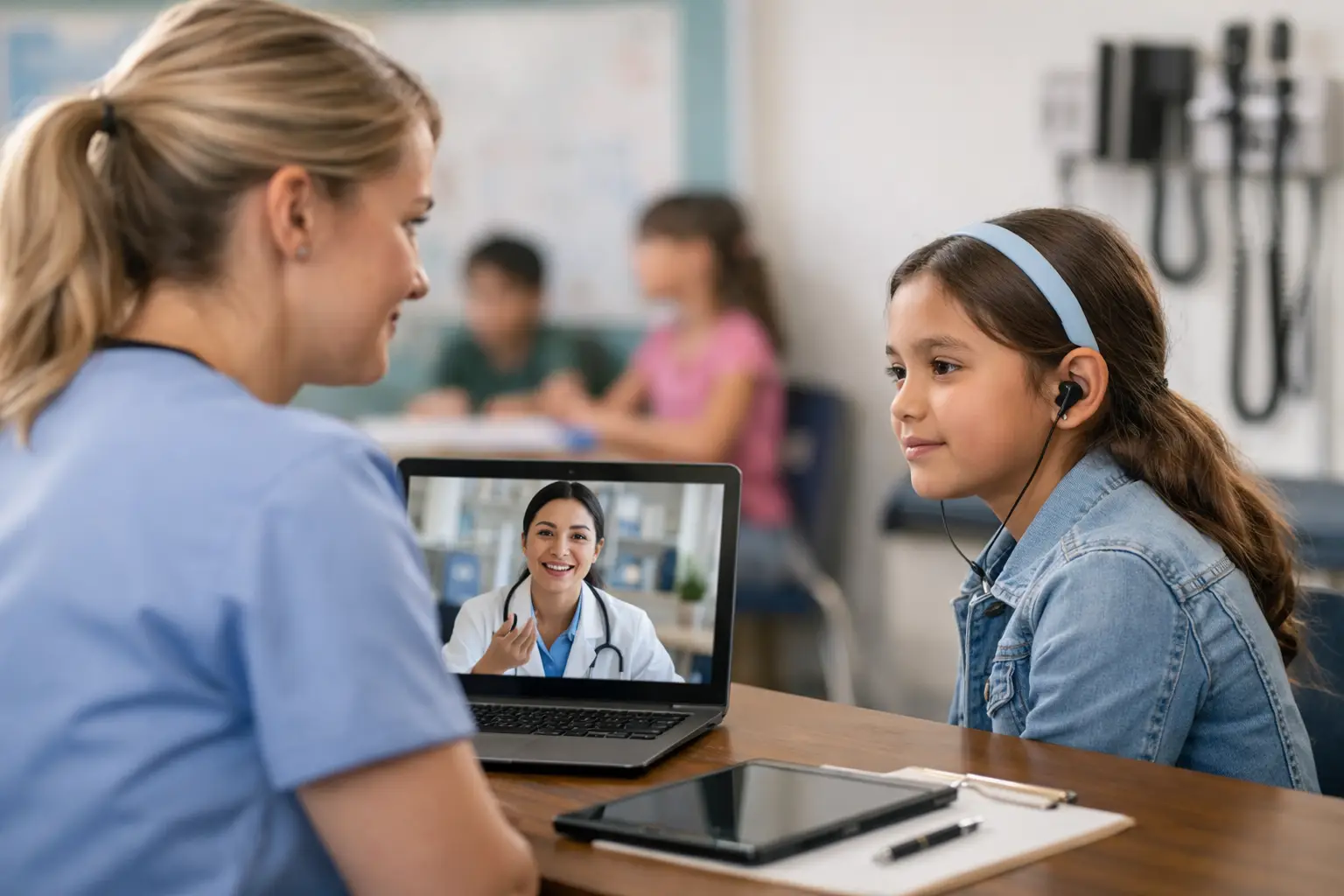
A child with asthma starts coughing during second period. A student with autism is already dysregulated before a specialist visit even begins. A parent has no car that day, or cannot leave work, or lives an hour from the nearest pediatric clinic. These are not edge cases. They are the daily operational reality that makes school-based telehealth programs increasingly relevant for pediatric providers, health systems, community health centers, and rural care organizations.
When designed well, school-based telehealth programs do more than add video into a school nurse’s office. They create a clinically useful, workflow-based extension of care delivery that brings providers closer to children where they already are. For organizations focused on access, continuity, and pediatric outcomes, that distinction matters.
Why school-based telehealth programs matter now
Schools are one of the few settings that touch children consistently across the year. That makes them valuable not only for episodic sick visits, but also for follow-up care, behavioral health support, chronic disease management, and caregiver engagement. For health systems trying to reach underserved pediatric populations, the school setting can reduce a major source of missed care – transportation and scheduling friction.
This is especially true in rural and safety-net environments. A single pediatric appointment can mean hours off work for caregivers, long travel times, and delayed treatment when families decide the burden is simply too high. In-school access changes that equation. It can move care from reactive to timely, and in some cases from inaccessible to feasible.
There is also a clinical quality question here. Basic video visits may be enough for counseling or medication follow-up, but they are often not enough when a clinician needs to assess respiratory sounds, inspect the throat, visualize the ear, capture vitals, or monitor ongoing conditions with better objectivity. The gap between a video call and a meaningful virtual physical exam is where many telehealth models succeed or fail.
What makes a school-based telehealth program effective
A strong program sits at the intersection of clinical utility, school workflow, caregiver participation, and reimbursement-aware design. If one of those pieces is weak, adoption tends to stall.
Clinical utility comes first. Providers need more than a webcam if they are expected to make informed decisions. Programs that support clinician-directed virtual exams, connected peripherals, and patient data capture are better positioned to handle pediatric needs with confidence. That is particularly important for children who may not tolerate travel well, including autistic children and pediatric patients with special healthcare needs who often do better in familiar, lower-stress environments.
Workflow matters just as much. Schools do not have spare staff time to manage complicated technology setups or unclear triage rules. Programs work better when roles are clear: what the school nurse handles, what the remote clinician evaluates, how consent is obtained, how parents are notified, and where documentation flows after the encounter. The less guesswork there is, the more sustainable the model becomes.
Caregiver participation is another practical factor. School-based care should not bypass the family. It should make family involvement easier. That may mean joining the visit by phone, participating through a secure virtual connection, or receiving post-visit instructions and follow-up plans in a format that fits the household. For pediatric care, the caregiver is often part of the treatment plan whether they are physically in the room or not.
Then there is reimbursement. Many promising pilots struggle because they are launched as technology experiments instead of care delivery programs. Organizations need to think early about payer mix, CMS-aligned workflows where applicable, state-level policy variation, documentation requirements, and how telehealth, remote patient monitoring, or chronic care management may fit into a broader model of care. The operational details are not secondary. They determine whether a program grows past a grant-funded phase.
Where schools can create the most value
Not every use case belongs in a school setting, and that is part of good program design. The best school-based telehealth programs start with high-need, high-friction areas where timely access makes a measurable difference.
Acute pediatric concerns are the most visible starting point. Respiratory symptoms, rashes, sore throats, minor infections, and symptom triage can often be addressed faster through a connected virtual care encounter than by sending a child home and hoping the family can secure an appointment. Faster evaluation can reduce unnecessary emergency department utilization and help schools make more informed decisions about return to class, escalation, or follow-up.
Chronic disease management is often where long-term value appears. Asthma, diabetes, obesity-related conditions, and other pediatric chronic needs benefit from routine touchpoints, data capture, and care plan reinforcement. A school setting can support monitoring and early intervention before a manageable issue becomes an avoidable crisis.
Behavioral health is another major area, although it requires a thoughtful approach. School access can reduce barriers to pediatric behavioral health support, but privacy, staffing, escalation pathways, and local regulations need careful planning. Some organizations begin with consultative or follow-up models before expanding.
Special populations may benefit the most. Children with developmental differences, sensory sensitivities, mobility challenges, or medically complex needs often face the highest burden from traditional appointment logistics. A connected school-based model can reduce disruption while keeping the child within a familiar support environment.
The technology question is really a clinical question
Many organizations frame school telehealth as a platform decision. In practice, it is a care model decision. The relevant question is not just whether a video connection is available. It is whether the technology supports a level of assessment that clinicians trust and administrators can operationalize.
That includes dependable connectivity, HIPAA-compliant communication, integrated data capture, device-enabled examinations, and workflows that fit school and provider staffing realities. It also includes training. A tool that can technically perform a virtual exam still fails if school personnel are uncomfortable using it or if remote clinicians do not have confidence in the information collected.
This is where connected-care platforms stand apart from video-only solutions. With the right virtual exam and monitoring tools, providers can assess more than appearance and conversation. They can gather clinically relevant findings that improve decision-making and reduce the number of visits that have to be repeated in person simply because not enough information was available the first time.
For organizations serving rural communities or pediatric populations with limited specialty access, that difference can be material. It affects throughput, family burden, provider confidence, and the financial case for expansion.
Common barriers and the trade-offs to plan for
School-based telehealth programs are promising, but they are not frictionless. Consent and privacy procedures must be clear. School and provider calendars do not always align. Broadband reliability can vary by district. Some children will still need in-person escalation, and some clinical scenarios are not appropriate for remote management.
There is also a staffing reality. School nurses are already stretched in many districts. If a program assumes they can absorb unlimited new tasks, it will create resistance quickly. The better approach is to reduce burden through role-based workflows, simple equipment design, strong onboarding, and clear escalation protocols.
Another trade-off is standardization versus flexibility. Large health systems often want one model that fits every school partner. In reality, implementation usually needs some local tailoring. A rural district with one nurse covering multiple campuses will not operate the same way as an urban district with dedicated health staff and stronger referral networks. Successful programs keep the clinical framework consistent while adapting the workflow to local conditions.
Building a program that lasts
The organizations seeing the strongest results usually treat school telehealth as part of a broader access strategy, not as a standalone school initiative. That means aligning pediatric service lines, care coordination teams, reimbursement specialists, IT, compliance, and community partners from the start.
It also means defining what success looks like beyond visit volume. Reduced absenteeism may matter. So may faster access to pediatric follow-up, fewer avoidable transfers, stronger chronic care adherence, improved caregiver engagement, and better reach into high-need populations. Different stakeholders will care about different measures, so the program has to be designed with those measures in mind.
A connected approach can help here. Dr. Miltie’s Circle of Care model reflects the idea that care in schools should not sit apart from home, clinic, and community-based follow-up. The strongest programs create continuity across settings, so a virtual encounter at school informs what happens next rather than becoming a disconnected episode.
School-based telehealth programs are not a replacement for every office visit, and they are not a cure-all for pediatric access. But for organizations serious about reaching children earlier, reducing avoidable barriers, and extending clinician-directed care into the places families already trust, they offer something practical: a way to move care closer to real life.
Move from information to action
See how the N9+ can fit your organization.
Explore the remote physical exam platform or request a focused demonstration.