
Rural Healthcare Access for Children With Special Needs
Rural healthcare access for children with special needs improves when providers combine telehealth, virtual exams, and caregiver-centered care models.
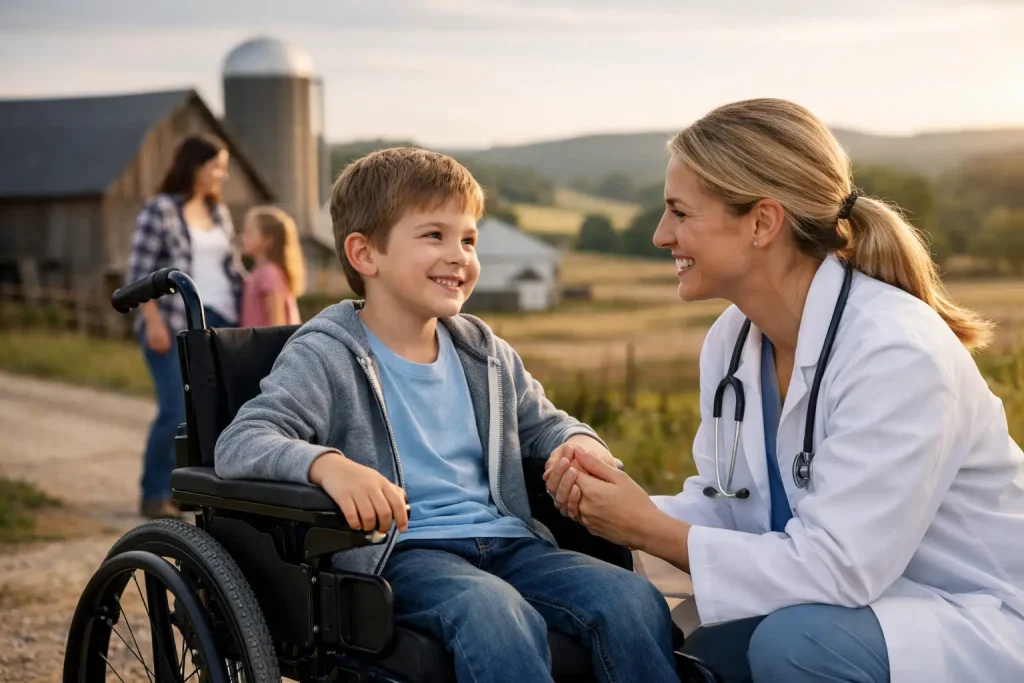
A child misses a developmental follow-up not because the family is disengaged, but because the nearest pediatric specialist is two hours away, the parent cannot leave work again, and the trip itself can trigger distress. That is the daily reality behind rural healthcare access for children with special needs. For providers and health system leaders, the issue is not simply geographic scarcity. It is the compounding effect of distance, workforce shortages, fragmented coordination, and care models that still assume the exam room is the center of pediatric care.
For children with autism, complex chronic conditions, mobility limitations, feeding disorders, sensory sensitivities, or developmental disabilities, access challenges often carry clinical consequences. Missed follow-up can delay medication adjustments, therapy coordination, preventive screening, chronic disease management, and caregiver education. In rural settings, each missed visit can widen the gap between what a child needs and what the local care infrastructure can realistically deliver.
Why rural healthcare access for children with special needs is different
Rural pediatric access is often discussed as a capacity problem, but for this population it is also a fit problem. A standard care model may technically offer an appointment, yet still fail the child and family. Long car rides, unfamiliar environments, overstimulating waiting rooms, and rigid scheduling can turn a clinically appropriate visit into a practical impossibility.
That is especially true when care depends on multiple participants. A child may need input from a pediatrician, a specialist, a school nurse, a therapist, and a caregiver who understands subtle changes in behavior or function. Rural communities often have committed clinicians, but fewer specialty resources and less redundancy in the system. When one provider leaves, retires, or reduces outreach coverage, access can change overnight.
The result is an uneven care experience. Some services remain local, while others require travel, delayed scheduling, or episodic outreach. Families become the default care coordinators, carrying records, managing communication, and trying to translate what happened in one setting to another. For healthcare organizations, that fragmentation creates both quality risk and operational strain.
The real barriers are clinical, operational, and financial
Transportation is the most visible barrier, but it is rarely the only one. Many rural families are balancing limited appointment availability, school absences, caregiver work disruption, childcare for siblings, and unreliable broadband or device access. For children with special healthcare needs, these obstacles can stack quickly.
Clinical barriers matter just as much. Some virtual care models are too limited for pediatric use because they rely only on video conversation. That can work for simple follow-up, but it is often not enough when a clinician needs to assess heart and lung sounds, inspect the throat or ears, evaluate skin issues, review vital signs, or monitor changes over time. If virtual care cannot support a clinically meaningful exam, organizations may struggle to use it for the children who need flexible access the most.
Financial and administrative realities shape access as well. Rural health clinics, federally qualified health centers, critical access hospitals, school-based programs, and community providers need workflows that align with staffing models, documentation requirements, and reimbursement pathways. A telehealth program that adds clinical burden without supporting continuity, care coordination, or sustainable payment will not scale, no matter how promising it looks in a pilot.
What better rural healthcare access for children with special needs looks like
The strongest models do not treat telehealth as a video substitute for in-person care. They use connected care to bring more of the pediatric encounter into the places where children already are – home, school, community clinic, pediatric practice, or rural spoke site.
That shift matters because it changes both the child experience and the provider experience. Children can often be evaluated in a familiar, lower-stress environment. Caregivers are more likely to participate fully when they do not need to manage a full-day travel burden. Local staff can support the visit when needed, and remote specialists can extend their reach without duplicating every service line physically.
For healthcare organizations, the goal is not to virtualize everything. It is to reserve travel and in-person referral for the visits that truly require them, while handling appropriate follow-up, monitoring, triage, chronic care management, and parts of the physical assessment closer to the patient. That is where connected exam capability and remote patient monitoring become far more valuable than basic video alone.
Virtual exams have to be clinically relevant
Children with special needs often require more observation, not less. A rushed, camera-only interaction can miss key signals, especially when the child has limited expressive language, sensory avoidance, or behavior that changes under stress. Clinicians need tools that support a more complete remote assessment and let them gather actionable data rather than rely on approximation.
When organizations deploy clinician-directed virtual examination tools, they can create a more credible remote encounter. That may include visual assessment, digital auscultation, image capture, vital sign collection, and structured follow-up across time. In pediatric rural care, this helps determine what can safely remain local, what needs escalation, and what can be monitored between appointments.
It also improves team confidence. Clinical leaders are more likely to champion virtual workflows when the technology supports real examination, not just communication. That distinction can determine whether telehealth stays a side program or becomes part of core access strategy.
Caregiver participation is not optional
For many children with special healthcare needs, caregivers provide the history that makes the visit useful. They know baseline behavior, sleep changes, feeding patterns, medication tolerance, sensory triggers, and the subtle signs that a child is not doing well. Rural care models work better when they are built around that reality.
Connected care makes caregiver involvement easier, but only if workflows are designed for it. Appointment timing, device setup, follow-up cadence, and escalation pathways all need to reflect family logistics. If the technology is difficult to use or the process feels disconnected from the child’s care plan, participation drops.
A caregiver-centered approach also supports equity. Families who cannot travel easily should not receive a lower standard of follow-up. They need access pathways that are clinically sound, practical, and respectful of the demands they are already carrying.
Operational design determines whether access improves
Healthcare organizations often frame rural pediatric telehealth as a technology purchase. In practice, it is an operating model. Success depends on where visits occur, who supports them, how data flows into the chart, what conditions are prioritized, how follow-up is routed, and whether reimbursement and compliance have been addressed from the start.
That is why the most effective programs usually start with use cases instead of broad promises. Developmental pediatrics follow-up, asthma management, school-based acute assessment, post-discharge monitoring, autism-friendly primary care touchpoints, and chronic condition check-ins all have different workflow needs. The right model depends on staffing, referral patterns, patient mix, and local infrastructure.
This is also where healthcare leaders need to be realistic about trade-offs. Not every community site can support every level of virtual exam. Not every family has the same comfort with technology. Not every pediatric specialty can be decentralized in the same way. A scalable model makes room for these differences while still reducing avoidable travel and expanding continuity.
One example of this approach is a connected-care platform that combines mobile virtual examination, remote monitoring, care coordination, and reimbursement-aware implementation. In pediatric and rural settings, that kind of model can help organizations move beyond isolated telehealth encounters toward a more durable Circle of Care that includes clinicians, caregivers, local sites, and specialists.
Why this matters now for rural providers and health systems
Rural organizations are being asked to improve access, manage workforce constraints, support complex patients, and demonstrate value at the same time. Children with special needs sit at the intersection of all four pressures. They require high-touch care, coordinated follow-up, and better continuity across settings, yet they are often served by systems with the least margin for inefficiency.
This is where a more capable virtual care strategy can change the equation. When providers can extend pediatric assessment into homes, schools, and community settings, they are not only adding convenience. They are protecting specialist capacity, improving follow-up reliability, supporting chronic care management, and reducing the friction that often leads to delayed care.
The bigger opportunity is not to replace rural care delivery. It is to strengthen it. Local clinicians remain essential. Community-based relationships remain essential. What changes is the reach of the care team and the number of clinically appropriate encounters that can happen without asking families to absorb the full cost of access.
For children with special needs, that is more than an operational improvement. It is a better way to meet them where they are, with care that is more flexible, more complete, and more realistic for the communities they call home.
Move from information to action
See how the N9+ can fit your organization.
Explore the remote physical exam platform or request a focused demonstration.