
How Telehealth Expands Access to Care
See how telehealth expands access to care by reducing travel, supporting virtual exams, improving follow-up, and helping providers reach more patients.
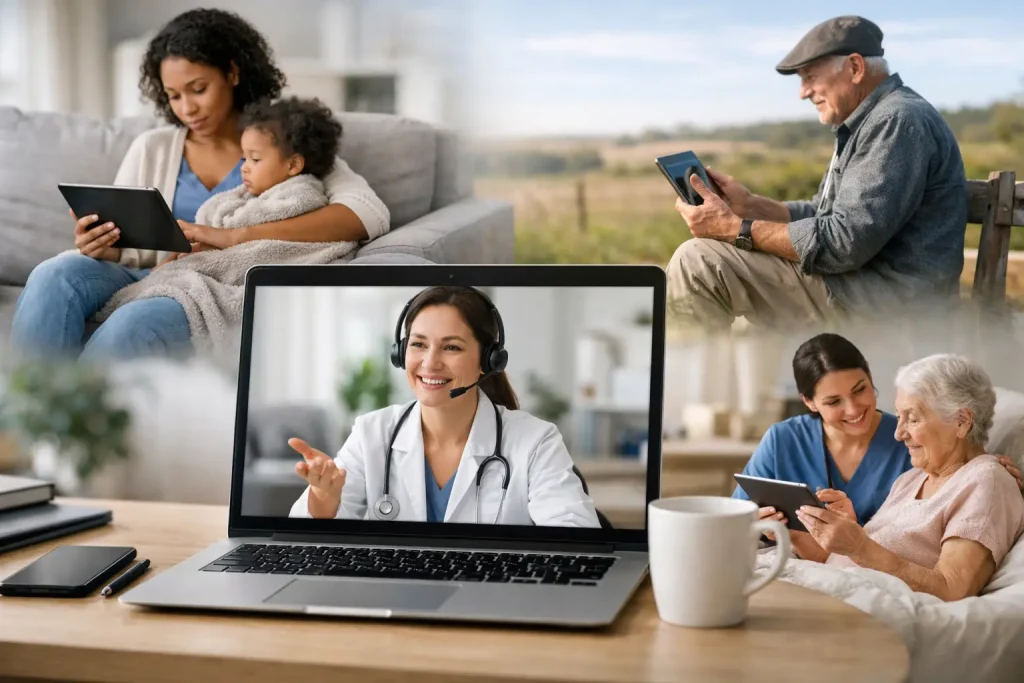
A missed follow-up is rarely just a scheduling problem. For a rural family, it may mean two hours on the road, lost wages, and childcare for siblings. For a child with sensory sensitivities, it may mean a stressful clinic environment that turns a routine visit into a major disruption. For a community health center already stretched thin, it may mean another gap in continuity. This is where how telehealth expands access to care becomes more than a convenience story. It becomes an operational strategy for reaching patients who are otherwise difficult to serve through traditional, site-based care alone.
Telehealth broadens access because it changes the geography, timing, and structure of care delivery. Instead of asking every patient to come to the exam room, organizations can bring parts of the exam, monitoring, follow-up, and care coordination to the patient. That shift matters most in pediatrics, rural health, chronic disease management, and safety-net settings, where barriers to access are often practical, financial, and deeply tied to workflow.
How telehealth expands access to care in real practice
The most obvious gain is reduced travel, but the larger benefit is reduced friction. When care can happen in the home, a school-based setting, a pediatric office, a community clinic, or another local access point, patients are more likely to complete visits, engage caregivers, and stay connected between episodes of care.
For healthcare organizations, that means telehealth can improve more than appointment volume. It can support earlier intervention, better follow-up adherence, and stronger continuity across dispersed populations. A virtual touchpoint may prevent a minor issue from becoming an urgent one. A remote check-in can maintain momentum after discharge. A device-enabled exam can help a clinician gather more meaningful information than a phone call alone.
This is why telehealth should not be framed as a replacement for in-person care. In most programs, it works best as an extension of clinical reach. Some encounters need hands-on examination, procedures, imaging, or facility-based services. Others do not. The value comes from matching the care modality to the patient, the clinical need, and the setting.
Access is not only about distance
Distance remains a major barrier, especially for rural health clinics, critical access hospitals, and community-based organizations serving wide geographic regions. Yet access problems also show up in urban and suburban populations. Transportation instability, limited caregiver availability, work schedules, language support needs, and clinical capacity constraints all affect whether a patient can realistically receive care.
Telehealth helps address these barriers by making care more adaptable. A parent can join a pediatric follow-up from work. A specialist can consult without requiring a transfer across counties. A care coordinator can monitor progress between visits instead of waiting for the next in-person appointment. When organizations build telehealth into care pathways, they are not just digitizing appointments. They are redesigning how patients move through care.
That is especially relevant for underserved populations, where gaps in access are often cumulative. A patient who struggles with transportation may also face broadband limitations, lower health literacy, or fewer local specialists. Telehealth does not erase those realities, but it can reduce the number of barriers that have to be overcome at once.
Why virtual exams matter more than video alone
Basic video visits have value, particularly for triage, medication follow-up, and routine consultation. But there are limits to what a clinician can assess through conversation alone. Organizations that want telehealth to support broader access often need more clinically relevant virtual exam capabilities.
Connected devices can extend what the clinician is able to evaluate remotely, including visual and physiological data that inform decision-making. That changes telehealth from a communication channel into a more useful clinical encounter. For pediatric populations, this can be particularly meaningful when a child can be assessed in a familiar, lower-stress environment with caregiver support present.
For healthcare leaders, this distinction affects program design. If the goal is meaningful access, not just digital contact, then telehealth infrastructure should support clinical quality, workflow integration, and documentation requirements. Otherwise, organizations may expand availability without truly expanding the scope of care that can be delivered.
Pediatric care is one of telehealth’s strongest access cases
Children are not simply smaller adult patients, and pediatric access challenges often involve the family as much as the child. Missed school, caregiver work disruption, transportation logistics, and stress associated with clinical environments can all interfere with timely care.
Telehealth can ease these pressures by supporting follow-up visits, remote assessments, chronic condition monitoring, and caregiver participation from settings that feel safer and more manageable. For autistic children and pediatric patients with special healthcare needs, familiar environments may reduce sensory overload and improve cooperation during an encounter. That can result in better observation, more productive communication, and less distress for both patient and caregiver.
There are trade-offs. Not every pediatric concern is appropriate for virtual management, and some clinicians remain cautious when a child cannot be physically examined in person. That caution is warranted. The best pediatric telehealth models create a flexible pathway, using remote visits where appropriate and escalating to in-person evaluation when necessary. Access improves most when virtual care is part of a larger, clinician-directed system rather than a standalone digital option.
Rural and safety-net organizations gain scale without adding sites
For rural providers and safety-net organizations, access constraints are often tied to workforce shortages and limited specialty coverage as much as location. Telehealth can help these organizations extend scarce clinical resources across distributed communities without requiring every service line to be physically replicated at every site.
A hub-and-spoke model, school-based support, community access points, or home-based monitoring can all expand service availability while preserving centralized clinical oversight. This can be especially valuable for chronic care management, preventive follow-up, and post-acute monitoring, where continuity matters but constant facility visits may not be realistic.
The operational advantage is significant. Organizations can reach more patients, improve panel management, and support earlier intervention without relying only on facility expansion. That said, scale depends on implementation discipline. Programs need defined workflows, staff training, patient selection criteria, and reimbursement-aware planning. Telehealth expands access most effectively when it is treated as a care delivery model, not just a technology purchase.
Reimbursement and workflow determine what lasts
Healthcare leaders know that access initiatives have to be financially sustainable. A telehealth program that clinicians cannot fit into their day, or that billing teams cannot support, will struggle regardless of patient demand.
That is why reimbursement, documentation, and workflow design matter from the start. Remote patient monitoring, chronic care management, and virtual exam programs can support access while also aligning with operational and financial objectives, but the details matter. Eligibility, coding, staffing models, and device deployment all affect long-term viability.
This is also where connected-care partners can add value. The strongest telehealth deployments account for compliance, training, integration, and real-world clinical use, not just hardware and software. For many organizations, especially those serving pediatric, rural, and underserved populations, the right model is one that supports both patient-centered care and administrative feasibility.
The organizations seeing the biggest impact think beyond the visit
When people ask how telehealth expands access to care, they often picture a single virtual appointment. In practice, the bigger opportunity is continuity. Telehealth can connect the initial visit to follow-up, remote monitoring, caregiver engagement, and care coordination across settings.
That broader view is especially important for community-based care. Access improves when the clinician, patient, caregiver, school nurse, local clinic, and health system are better connected around the same plan. A connected-care model can help organizations close care gaps, improve patient engagement, and reduce avoidable escalation, particularly for populations that do not move through the system easily.
Technology alone will not solve inequity, capacity shortages, or fragmented care. But when telehealth is paired with virtual exam tools, operational planning, and a patient-centered care model, it can move care closer to the people who need it most. For organizations building pediatric, rural, and community-based access strategies, that is not a marginal improvement. It is a practical way to deliver care where life is actually happening.
A useful telehealth strategy asks a simple question: where are patients losing access today, and what parts of care can be safely brought to them instead?
Move from information to action
See how the N9+ can fit your organization.
Explore the remote physical exam platform or request a focused demonstration.