
Remote Patient Assessment Technologies
Remote patient assessment technologies help providers extend exams, monitoring, and follow-up into homes, schools, and rural care settings.
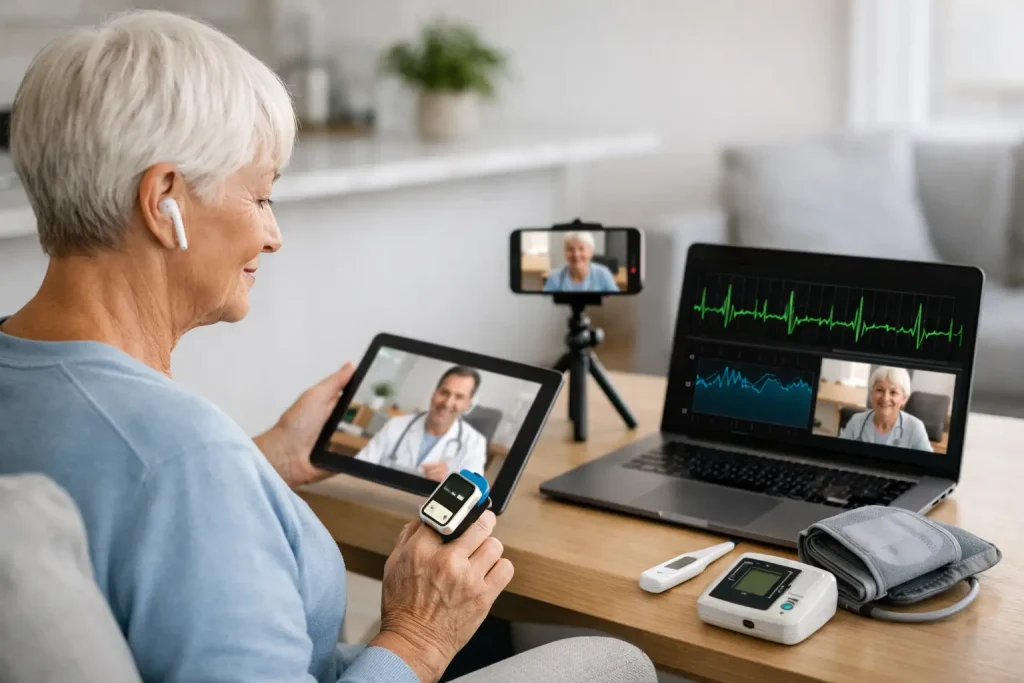
A child with sensory sensitivities may tolerate a brief in-home assessment far better than a long trip to a specialty clinic. A rural patient with heart failure may need closer follow-up than geography allows. These are the moments when remote patient assessment technologies move from interesting to operationally necessary.
For healthcare leaders, the question is no longer whether virtual care has a role. The real question is which technologies support clinically meaningful assessment, fit reimbursement and workflow requirements, and help care teams reach patients who are otherwise hard to serve. That distinction matters, especially in pediatric, rural, and community-based care, where access barriers are not abstract. They affect whether an exam happens at all.
What remote patient assessment technologies actually include
The term covers more than video visits. In practice, remote patient assessment technologies combine connected exam tools, patient monitoring devices, data capture, software workflows, and communication pathways that allow clinicians to assess a patient without requiring every encounter to happen in a traditional exam room.
Some tools focus on physiologic monitoring over time, such as blood pressure, pulse oximetry, weight, or glucose collection. Others support remote physical assessment by enabling a clinician to listen to heart and lung sounds, visualize the ear or throat, review skin conditions, or gather other clinically relevant findings during a guided virtual encounter. The strongest models bring these functions together rather than treating them as separate programs.
That difference is especially important for organizations serving children, patients with chronic conditions, and populations with transportation, mobility, or specialist access challenges. A standalone video platform may increase convenience, but it does not always increase clinical confidence. An integrated assessment model can.
Why clinical relevance matters more than virtual convenience
Healthcare organizations are under pressure to improve access, manage workforce shortages, and reduce avoidable utilization. Virtual care can help, but only when the technology supports decision-making instead of adding another fragmented touchpoint.
A remote assessment platform should help a clinician answer a real clinical question. Is this child improving after treatment? Does this respiratory patient need escalation? Can this follow-up happen safely at home, school, or a community site? If the technology does not improve the quality of those decisions, it may still create activity, but not necessarily value.
This is where many programs hit a ceiling. They launch telehealth, gain initial adoption, and then realize the care team still lacks the exam data needed to manage patients confidently. Video alone has limits. So do remote monitoring programs that collect numbers without enough clinical context. The better approach is to connect virtual exams, monitoring, care coordination, and follow-up into one operational pathway.
Where remote patient assessment technologies deliver the most value
The highest-value use cases tend to be settings where access is limited, follow-up is difficult, or the care experience itself creates barriers. Pediatrics is a strong example. Children, especially autistic children and pediatric patients with special healthcare needs, may do better in familiar environments with caregivers present. A lower-stress setting can improve cooperation, reduce missed appointments, and support more complete participation in care.
Rural health is another major fit. Critical access hospitals, rural health clinics, and community providers often face specialist shortages, long travel distances, and staffing constraints. Remote assessment tools can extend clinical reach without requiring every patient to travel for every touchpoint. That does not eliminate the need for in-person care. It helps organizations reserve in-person capacity for the cases that truly require it.
Safety-net settings also benefit when the technology is designed around real-world operations. Federally qualified health centers and community clinics often manage high-need populations with limited resources. In those environments, technology has to do more than impress in a demo. It must support continuity, work across distributed sites, and fit financially sustainable models of care.
What healthcare leaders should evaluate before adoption
Not every virtual care platform is built for assessment. For decision-makers, the first screening question should be whether the system enables clinically relevant data capture or simply facilitates communication.
That means looking closely at device integration, virtual exam capability, data quality, and workflow design. Can clinicians gather useful findings during the encounter? Can those findings be documented in a way that supports care planning? Can the program adapt to different service lines, from pediatric follow-up to chronic disease management to school-based care?
The next issue is operational fit. Technology that works in a pilot can still fail at scale if training demands are too high or workflows are too rigid. Organizations should examine who will support the patient during the encounter, how data moves into care coordination processes, and whether the model can function across homes, clinics, schools, and community settings.
Financial alignment also matters. Reimbursement-aware deployment is not a side consideration. It is central to long-term success. Healthcare leaders need clarity on how remote patient monitoring, chronic care management, telehealth, and related services may fit their billing strategy, compliance obligations, and staffing model. A platform can be clinically strong and still be difficult to sustain if implementation ignores the realities of CMS requirements, documentation standards, and payer variation.
The trade-offs organizations should expect
Remote assessment is not a replacement for all in-person care, and it should not be presented that way. Some conditions still require hands-on examination, imaging, testing, or procedures that cannot be replicated remotely. The goal is not to virtualize everything. The goal is to make care more responsive, more targeted, and easier to access when remote evaluation is appropriate.
There are also trade-offs around adoption. More advanced assessment capabilities may deliver better clinical value, but they often require stronger onboarding, clearer protocols, and greater staff engagement. Programs serving medically complex patients may need customized workflows rather than a one-size-fits-all rollout.
Patient and caregiver readiness can vary as well. In pediatrics, caregiver participation is often a strength of the model, but it still requires support and clear communication. In rural and underserved communities, broadband access, device availability, and digital comfort can affect utilization. These are not reasons to avoid deployment. They are reasons to design for reality.
Why connected care models outperform point solutions
Healthcare organizations increasingly need systems that support an ongoing relationship, not just isolated visits. That is why connected care models are becoming more relevant than single-purpose tools. When assessment devices, monitoring, care coordination, and patient engagement function together, teams can manage patients across settings with greater continuity.
This model is particularly effective when multiple stakeholders are involved in care. Pediatric patients may depend on parents, school nurses, primary care clinicians, specialists, and community programs. Rural patients may receive services across local clinics, regional hospitals, and home-based follow-up. A connected framework helps each participant contribute to a more complete view of the patient.
That is also where a platform approach becomes more valuable than a device-only approach. The technology should support the broader circle around the patient, including caregivers, clinicians, and operational teams. When organizations build around that principle, remote assessment becomes part of a durable access strategy rather than a temporary digital add-on.
How to think about scale
The most successful programs usually start with a clear clinical and operational use case, then expand. That may mean pediatric follow-up, chronic disease monitoring, school-based access, rural triage support, or post-discharge assessment. What matters is choosing a model where better access and better clinical visibility can be measured.
From there, scale depends on standardization without rigidity. Teams need defined protocols, training, documentation pathways, and performance metrics. They also need flexibility to adapt the model for different populations and sites of care. A platform such as Dr. Miltie N9+ is most useful when it helps organizations extend clinically guided virtual exams and monitoring into the settings where patients actually live, learn, and receive support.
For many provider organizations, the long-term value of remote patient assessment technologies is not just visit substitution. It is better reach, earlier intervention, more effective caregiver engagement, and a stronger ability to deliver care beyond the walls of the clinic.
The organizations that benefit most will be the ones that treat remote assessment as part of care redesign, not just technology adoption. When the model is clinically grounded and operationally practical, it gives care teams something more valuable than convenience. It gives them a way to bring care closer to the people who have historically had the hardest time reaching it.
Move from information to action
See how the N9+ can fit your organization.
Explore the remote physical exam platform or request a focused demonstration.