
Rural Health Transformation Program and Dr. Miltie N9+
How the rural health transformation program and Dr. Miltie N9+ support virtual exams, pediatric access, and scalable care in rural settings.
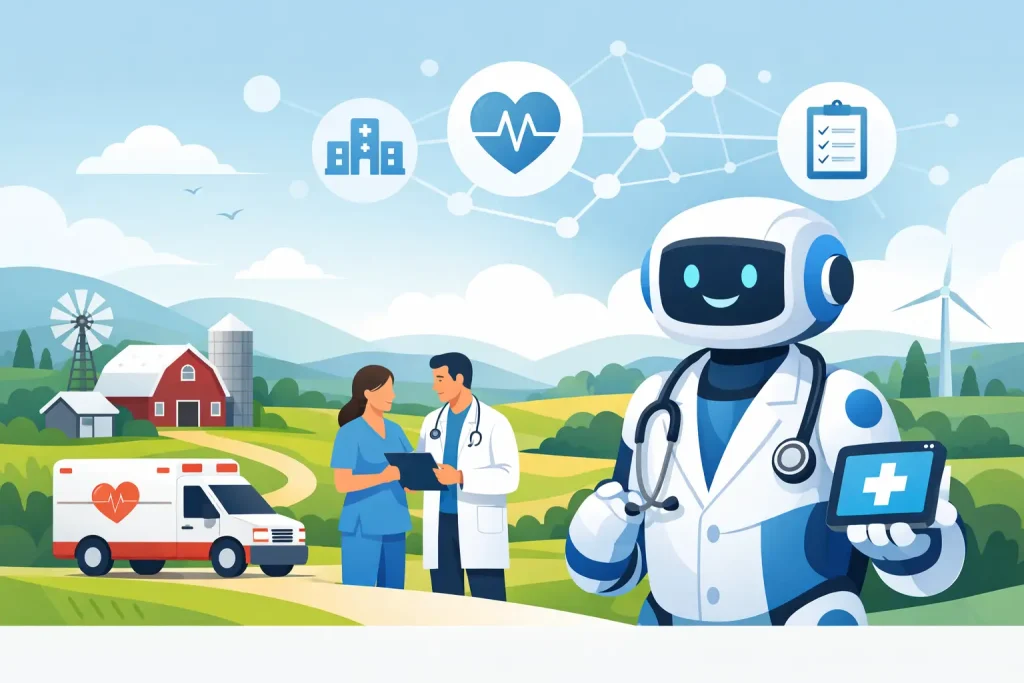
A rural clinic trying to recruit another full-time specialist often faces the same math problem: too few clinicians, too much geography, and patients who cannot keep losing half a day to travel for follow-up care. That is where the rural health transformation program (RHTP) and Dr. Miltie N9+ become part of the same operational conversation. For healthcare leaders focused on access, sustainability, and measurable outcomes, the real question is not whether virtual care matters. It is whether the technology in use is clinically meaningful enough to support care delivery in the places rural patients already are.
For many organizations, rural transformation is no longer about adding a video visit platform and calling it progress. Rural health clinics, critical access hospitals, federally qualified health centers, school-based programs, and community health organizations need a model that extends clinical reach without lowering the standard of care. That means remote patient monitoring, virtual physical exams, caregiver participation, documentation workflows, reimbursement alignment, and care coordination all have to work together.
Why the rural health transformation program and Dr. Miltie N9+ fit together
Rural health transformation programs are typically built around a familiar set of goals: improve access, reduce avoidable utilization, manage chronic disease more effectively, strengthen workforce capacity, and create financially sustainable care pathways. Those goals are straightforward on paper. Execution is where many programs stall.
The gap often comes from relying on virtual care tools that support conversation but not examination. Standard video can help with triage and follow-up, but it does not always give clinicians the data they need to make confident decisions. In rural settings, that limitation matters more because the alternative may be a long drive, a delayed referral, or a missed opportunity for early intervention.
The Dr. Miltie N9+ is relevant in this context because it supports clinician-directed virtual examination and patient monitoring beyond a basic telehealth encounter. For healthcare organizations building toward transformation targets, that distinction can change how remote care is deployed. Instead of treating virtual visits as a separate lane, organizations can integrate clinically relevant assessments into broader care models for primary care, pediatrics, chronic care management, school-based services, and community outreach.
What rural transformation actually requires
Healthcare executives usually do not need another broad promise about innovation. They need to know whether a platform can solve operational friction. In rural care delivery, that friction shows up in several ways at once.
One issue is workforce scarcity. A rural site may have strong nursing staff, medical assistants, or community-based personnel, but limited access to specialists or even enough primary care coverage. Another issue is patient travel burden, which affects appointment adherence, caregiver involvement, and continuity of care. A third issue is fragmentation. The patient may be seen in a clinic, monitored at home, supported at school, and escalated to a regional partner system only when symptoms worsen.
A rural transformation strategy works better when technology is designed for distributed care rather than a single point of service. That includes device-enabled assessments, remote monitoring, customized workflows, and a model that connects clinicians, caregivers, and community settings. It also means implementation must reflect reimbursement realities and not just technical capability.
Clinical value matters more than virtual access alone
Access is often measured by whether a patient can connect. Clinical value is measured by whether the encounter supports action. That distinction is especially important for pediatric populations, patients with chronic conditions, and patients with special healthcare needs.
In rural communities, children may need care in settings that reduce stress and disruption, including homes, schools, pediatric offices, or local clinics. For autistic children and pediatric patients with sensory or behavioral needs, familiar environments can support better engagement and more meaningful encounters. Caregivers can participate more directly, and the care team can gather information in context rather than relying only on what can be observed during a short in-person visit far from home.
This is where a connected-care platform becomes more than a telehealth add-on. When clinicians can guide a more complete remote assessment and review clinically relevant patient data, they are in a stronger position to monitor symptoms, adjust care plans, and determine which patients truly need in-person escalation. That can improve patient flow while preserving limited on-site resources for the highest-acuity needs.
Where Dr. Miltie N9+ can support rural care models
The strongest use cases are usually the ones that align technology with a specific service line or access problem. In rural environments, that might include virtual primary care support, chronic disease follow-up, pediatric monitoring, post-discharge check-ins, school-linked assessment pathways, or community-based screening and follow-up.
For a critical access hospital, the opportunity may center on reducing unnecessary transfers and improving specialist collaboration. For an FQHC, it may be about extending care into underserved communities while supporting chronic care management and preventive services. For a pediatric practice, it may be about keeping children engaged in care without requiring repeated travel that disrupts school, work, and caregiver schedules.
There is no single deployment model that fits every organization. Some programs need a mobile workflow. Others need fixed-site support in satellite clinics or school-based settings. Some are driven by population health priorities, while others begin with a narrow operational goal such as reducing no-shows or improving RPM adoption. The common denominator is that the technology has to fit the care model, not force the care model to fit the technology.
Implementation trade-offs healthcare leaders should weigh
It is easy to overstate what any platform can accomplish on its own. Rural transformation still depends on staffing models, clinical governance, workflow design, training, patient selection, and reimbursement strategy. A strong tool can support those efforts, but it does not replace them.
One trade-off is speed versus integration depth. A rapid rollout may help an organization prove early value, but long-term performance usually depends on how well the platform fits documentation practices, escalation protocols, and care coordination workflows. Another trade-off is breadth versus focus. Launching across too many service lines at once can dilute training and operational ownership. Many organizations do better when they begin with one or two high-impact use cases and then expand.
There is also the question of what level of virtual exam capability is necessary. Not every encounter requires advanced assessment. But for organizations trying to improve care quality in low-access settings, the difference between a conversation-only platform and a clinically useful remote exam platform can affect provider confidence, patient outcomes, and adoption rates.
Reimbursement-aware rural health transformation program planning
Transformation efforts are more likely to last when financial planning is part of program design from the start. Healthcare leaders evaluating the rural health transformation program and Dr. Miltie N9+ should look beyond purchase price and ask how the model supports billable services, workforce efficiency, continuity of care, and preventable utilization reduction.
CMS-aligned remote patient monitoring, chronic care management, and virtual care pathways can create meaningful value, but only when workflows support compliant documentation, patient engagement, and ongoing clinical oversight. This is one reason reimbursement-aware implementation matters. If staff are unclear on eligibility, billing processes, escalation thresholds, or patient communication responsibilities, promising programs can underperform even when the technology itself is sound.
A connected-care partner should help organizations think through not only deployment, but also adoption, training, and financial sustainability. That is especially relevant in rural and safety-net settings, where margins are tight and every operational decision carries downstream consequences.
A more practical way to think about transformation
The most effective rural transformation strategies are not built around the idea of replacing in-person care. They are built around placing the right level of care in the right setting, with the right clinical visibility. Sometimes that means an in-person exam. Sometimes it means remote monitoring between visits. Sometimes it means a virtual assessment supported by connected tools that allow the clinician to make a better decision without asking the patient to travel unnecessarily.
For healthcare organizations serving rural communities, pediatric populations, and underserved patients, that flexibility is not a convenience. It is part of access, equity, and quality. Dr. Miltie approaches this through a connected-care model that supports clinicians, caregivers, and distributed points of care rather than treating virtual care as an isolated encounter.
The healthcare leaders making the biggest progress in rural transformation are usually not the ones chasing the newest platform feature. They are the ones building care models that respect clinical reality, caregiver burden, and financial sustainability at the same time. When technology supports that balance, it stops being a pilot and starts becoming infrastructure.
Rural care does not need more workarounds. It needs tools that help good clinicians reach more patients, in more places, with fewer compromises.
Move from information to action
See how the N9+ can fit your organization.
Explore the remote physical exam platform or request a focused demonstration.